
Cream Ale: The American Beer That Tried to Beat Lager at Its Own Game

Cream Ale has a wonderfully misleading name. You might expect a thick, velvety beer with the texture of Guinness or perhaps something made with milk, but the reality is almost the opposite. Cream Ale is a pale, highly carbonated American beer, usually containing around 4.2–5.6% alcohol, with a delicate malt character, restrained bitterness and a clean, refreshing finish. There is no cream, no lactose and generally nothing particularly creamy about it.
Its history is considerably more interesting than its modest appearance suggests. Cream Ale emerged in nineteenth-century America when traditional ale brewers found themselves competing against the rapidly growing popularity of German-inspired lagers. Rather than surrender their customers, they developed a beer that borrowed much of lager’s crisp, refreshing character while taking advantage of the equipment and fermentation methods they already knew.
The result was a distinctly American compromise, and a clever one. Corn and other fermentable ingredients could lighten the body, restrained hopping made the beer accessible, and cold conditioning helped remove the rougher edges of fermentation. Cream Ale became especially popular in the northeastern and midwestern United States, surviving Prohibition and eventually finding new life through regional breweries and the craft beer movement.
It is not a beer designed to astonish with tropical hops, roasted coffee or barrel-aged complexity. Its appeal lies in precision: enough malt to avoid tasting watery, sufficient bitterness to balance the finish and carbonation that makes the next sip almost inevitable.
The Basics
- Origin: United States, second half of the nineteenth century
- Beer family: American ale, frequently produced using lager-inspired techniques
- Alcohol: Usually 4.2–5.6% ABV
- Colour: Pale straw to light gold
- Bitterness: Low, generally around 8–20 IBU
- Appearance: Usually clear and highly carbonated
- Principal grains: Barley malt, sometimes supplemented with corn or rice
- Hops: American or European varieties with restrained floral, herbal or spicy aromas
- Fermentation: Ale yeast, lager yeast or a combination of methods
- Maturation: Often cold-conditioned for a cleaner flavour
- Typical aromas: Fresh cereal, bread, crackers, light corn and subtle floral hops
- Body: Light to medium-light
- Finish: Crisp, dry to slightly sweet
- Serving temperature: Approximately 4–7°C
- Classic examples: Genesee Cream Ale, Little Kings Cream Ale, Sun King Sunlight and Pelican Kiwanda
- Best food pairings: Fried chicken, grilled fish, hamburgers, corn dishes and mild cheeses
What Is Cream Ale?
Cream Ale is a traditional American beer created to offer the easy-drinking character of lager while retaining the practical advantages of ale brewing.
It is usually golden, clear and lively, with a delicate grainy aroma and enough malt flavour to distinguish it from an ordinary industrial light lager.
The beer’s defining quality is balance. Malt contributes fresh bread, crackers and occasionally a gentle corn-like sweetness. Hops provide a modest bitterness, while fermentation remains sufficiently clean to avoid strong fruity or spicy aromas.
A Cream Ale should generally finish crisp rather than sweet. High carbonation reinforces that impression, making even slightly fuller examples feel light and refreshing.
Although the name contains the word ale, brewing methods vary. Some producers use ale yeast and cold-condition the finished beer, while others employ lager yeast or combine the two fermentation traditions.
The result is often described as a hybrid style, although that label should not suggest one mandatory brewing technique. Cream Ale developed through experimentation rather than adherence to a fixed formula.
Why Is It Called Cream Ale if It Contains No Cream?
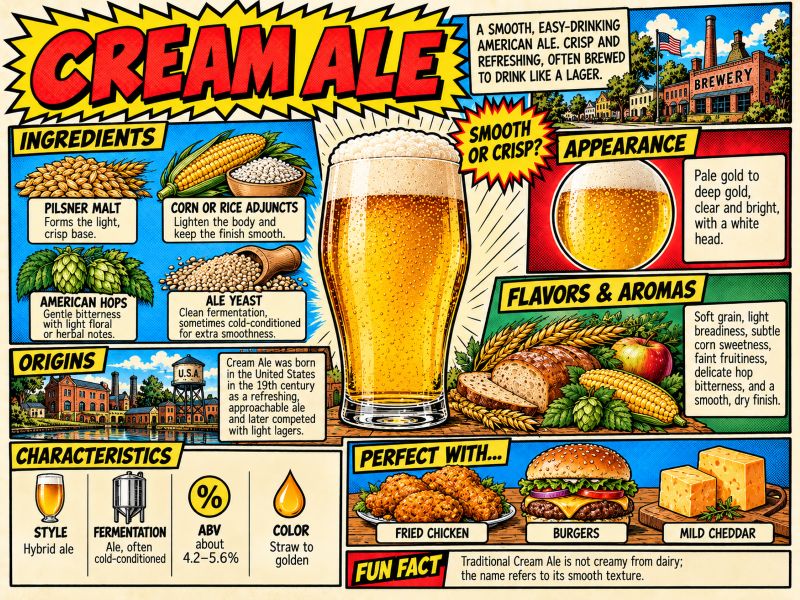
The precise origin of the name is not firmly established.
In nineteenth-century American brewing, terms such as cream, sparkling and present-use ale were associated with beers marketed for their freshness, pleasant texture and immediate drinkability.
The word cream had obvious commercial appeal. It suggested richness, smoothness and quality at a time when brewers competed aggressively for customers.
It did not indicate the use of dairy ingredients.
Nor did the original style necessarily have the dense, creamy foam associated with modern nitrogenated beers.
This distinction matters because some British and Irish beers have used the expression cream ale to describe a smooth texture created by nitrogen dispensing. That usage is different from the traditional American style.
The American version is generally highly carbonated, light and refreshing. Its name is largely a historical inheritance rather than a description of its ingredients.
The History of Cream Ale: America’s Answer to German Lager

During the nineteenth century, American brewing underwent a major transformation.
German immigration helped establish lager brewing across the United States, introducing beer styles that were increasingly attractive to customers accustomed to heavier or more assertively flavoured ales.
Golden lager offered a compelling combination of clarity, carbonation, moderate bitterness and refreshing drinkability.
Traditional American ale breweries faced a problem. Producing authentic lager generally required cooler fermentation and prolonged maturation, together with refrigeration or suitable cold-storage facilities.
These conditions involved additional investment and production time.
Cream Ale emerged as an alternative.
Brewers adjusted their recipes and fermentation practices to produce pale, clean-tasting beers that could compete with lager without necessarily requiring the same production arrangements.
By the latter half of the nineteenth century, related styles were established in the Northeast, Mid-Atlantic and Midwest.
Historical examples were not always identical to the relatively mild Cream Ales sold today. Some were stronger, more heavily hopped and noticeably more bitter.
The style gradually became lighter and more restrained as American drinking preferences shifted toward increasingly pale, accessible beers.
Cream Ale and Prohibition
American Prohibition, which lasted from 1920 until 1933, devastated much of the country’s brewing industry.
Many breweries closed permanently. Others survived through alternative products, including near beer and non-alcoholic beverages.
Cream Ale endured, particularly through regional brewing traditions and producers that resumed beer production after repeal.
Its combination of familiar flavour, moderate strength and easy drinkability made it suitable for a market increasingly dominated by pale lager.
One of the most remarkable episodes in its history came just two years after Prohibition ended.
Cream Ale Helped Introduce Canned Beer to America
On January 24, 1935, the Gottfried Krueger Brewing Company of Newark, New Jersey, introduced two beers in cans to the public in Richmond, Virginia.
They were Krueger’s Finest Beer and Krueger’s Cream Ale.
These were among the first commercially sold canned beers in the United States, marking a major change in the way beer was packaged and distributed.
The technology had required considerable development. Earlier cans struggled with beer’s internal pressure and the risk of metallic flavours, but improved linings and stronger construction finally made commercial distribution practical.
The experiment proved successful, and other breweries quickly adopted the new packaging.
Cream Ale therefore played a small but genuine role in one of the most important changes in modern beer history.
Genesee Cream Ale and the Survival of the Style
The modern identity of Cream Ale owes much to Genesee Brewing Company, based in Rochester, New York.
Founded in 1878, the brewery introduced Genesee Cream Ale in 1960.
The beer became a major regional success, eventually achieving national recognition and helping preserve the style during a period when American brewing was becoming increasingly standardised.
For many drinkers, Genesee Cream Ale became the definitive example: pale golden, lightly sweet, refreshing and easy to drink.
Its success established Cream Ale as something more than a forgotten nineteenth-century curiosity.
Other breweries, particularly in the Midwest, maintained their own versions, often associated with neighbourhood bars, local sporting events and everyday American drinking culture.
The craft beer movement later returned to the style, producing interpretations that ranged from faithful historical recreations to more aromatic modern variations.
How Cream Ale Is Brewed
The production of Cream Ale is relatively straightforward, but making an excellent example requires considerable precision.
Because the flavour is restrained, defects have nowhere to hide. Excessive fruity fermentation aromas, harsh bitterness, stale grain flavours or unwanted buttery notes become immediately obvious.
The brewer must create a beer that is delicate without being empty.
Barley Malt and the Role of Corn
Pale barley malt provides the foundation of Cream Ale.
Traditional recipes frequently used American six-row barley, which offered strong enzymatic activity and worked well with adjunct grains.
Modern brewers may use two-row pale malt, Pilsner malt or a combination of base malts.
Corn is one of the characteristic ingredients of traditional Cream Ale, although it is not compulsory.
Flaked corn or other suitable corn products can lighten the body and reduce the intensity of malt flavour. They help produce a relatively dry beer with a subtle grainy sweetness.
Rice can serve a similar purpose.
These ingredients are sometimes dismissed as cheap substitutes for barley, but their role is more nuanced. Used carefully, they help create the light, crisp character that defines the style.
An all-malt Cream Ale is equally possible, although it may have a fuller bread-like character.
The proportion of adjuncts must be controlled to avoid producing a beer that feels thin or flavourless.
Hops: Enough Bitterness, Little Aggression
Cream Ale is not a showcase for powerful hop aromas.
Traditional recipes used American and continental European varieties, often selected for restrained floral, herbal or spicy characteristics.
Cluster, one of the historically important American hops, appears in discussions of early Cream Ale production.
Modern brewers may use Liberty, Mt. Hood, Hallertau or other varieties that provide a gentle aromatic contribution.
The objective is to balance the malt rather than dominate it.
Bitterness generally remains low, often around 8–20 IBU, although historical and contemporary interpretations can fall outside that range.
A pronounced grapefruit, pine or tropical-fruit character would move the beer away from the classic style.
Fermentation: The Secret to Its Lager-Like Character
Fermentation is the most interesting technical aspect of Cream Ale.
Traditional ale yeast generally works at warmer temperatures than lager yeast and can produce noticeable fruity aromas.
Cream Ale brewers often select relatively neutral strains and ferment them under controlled conditions to obtain a cleaner profile.
Some then cold-condition the beer, allowing yeast and suspended particles to settle while the flavour becomes smoother.
Other producers use lager yeast from the beginning.
Historically, brewers also experimented with blending separately fermented beers or using different yeasts during production.
This flexibility reflects the style’s origins. Cream Ale was developed to compete with lager, not to satisfy a rigid definition of ale fermentation.
The finished beer should be clean, lightly aromatic and refreshing, regardless of the precise method used.
Cold Conditioning and Carbonation
Cold conditioning is particularly useful because Cream Ale benefits from clarity and a restrained fermentation profile.
After fermentation, the beer may spend time at low temperatures before packaging.
This helps suspended yeast settle and allows some fermentation-derived compounds to diminish.
Carbonation is another defining element.
Cream Ale generally has a lively, sparkling character, producing a crisp sensation that reinforces its light body.
Without sufficient carbonation, even a well-made example can seem dull or excessively sweet.
What Does Cream Ale Taste Like?
A classic Cream Ale pours pale straw to light gold, usually with excellent clarity and a white head.
The aroma is delicate: fresh grain, bread, crackers and sometimes a subtle corn-like note.
Floral or herbal hops may appear, but they should remain secondary.
On the palate, the beer is smooth and lightly malted, with modest sweetness followed by a clean, crisp finish.
A faint fruity character is possible, but strong banana, clove or tropical aromas are not typical.
Bitterness is restrained, allowing the cereal flavours to remain clearly perceptible.
The high carbonation creates a refreshing sensation that makes the beer particularly suitable for warm weather and casual drinking.
At its best, Cream Ale offers more flavour than an ordinary light lager without sacrificing the qualities that make lager so easy to enjoy.
Cream Ale vs Lager: What’s the Difference?
The distinction is primarily historical and technical rather than purely sensory.
Lager is generally associated with yeast adapted to cooler fermentation conditions and a tradition of cold maturation.
Cream Ale emerged among ale brewers seeking a similar clean, refreshing result, often using techniques that blurred the boundary between the two families.
A conventional American lager may display a slightly more neutral fermentation profile, while Cream Ale can offer a little more grain character and subtle fruitiness.
However, the difference is not always obvious in a blind tasting.
A well-made Cream Ale can closely resemble a pale American lager, particularly when both are lightly hopped and highly attenuated.
The important point is that Cream Ale represents its own American brewing tradition rather than simply being lager under another name.
Cream Ale vs Blonde Ale
Blonde Ale is another pale, accessible American beer, but it often has a somewhat fuller malt character and less aggressive carbonation.
Cream Ale tends to emphasise lightness, crispness and a particularly clean finish.
Blonde Ale may show a slightly more expressive ale fermentation character, with gentle fruit or bready malt aromas.
The categories overlap, especially in modern craft brewing.
The most reliable distinction is the brewer’s intended balance: Cream Ale generally aims for a more lager-like drinking experience.
Cream Ale vs Kölsch
German Kölsch is perhaps the closest European comparison.
Both beers are pale, clean, refreshing and commonly produced using ale yeast followed by cold conditioning.
Kölsch, however, has a specific historical and geographical connection with Cologne and is traditionally made according to a more clearly established regional brewing practice.
Cream Ale developed independently in North America, with greater flexibility in its use of corn, rice and different fermentation methods.
Kölsch often has a delicate fruity or floral character, while Cream Ale may display a more neutral grain profile and subtle corn sweetness.
The two styles share an emphasis on clarity, balance and drinkability.
Is Cream Ale Sweet or Creamy?
Despite the name, Cream Ale should not be particularly sweet.
A small amount of malt sweetness is normal, but the finish should generally be dry to slightly sweet.
Nor should the texture resemble a milk stout or a nitrogenated beer.
The smoothness comes from the interaction of malt, fermentation, attenuation and carbonation rather than cream or lactose.
Some contemporary breweries produce flavoured Cream Ales containing vanilla, orange or other ingredients. These can be enjoyable, but they represent modern variations rather than the essential traditional style.
It is important not to confuse a classic Cream Ale with a dessert-inspired beer marketed under a similar name.
The Best Cream Ales to Try
Genesee Cream Ale — Rochester, New York
The historic benchmark of the modern American style.
Introduced in 1960, Genesee Cream Ale helped keep the tradition alive through decades of changing beer fashions.
It is known for its pale golden colour, restrained grain character and refreshing finish.
The beer provides an excellent starting point for understanding what traditional Cream Ale is supposed to taste like.
Little Kings Cream Ale — Cincinnati, Ohio
<text color=”secondary” size=”xs” weight=”medium”>6% ABV</text>
Introduced by the Schoenling Brewery in 1958, Little Kings became famous for its distinctive seven-ounce green bottles.
Its character is slightly sweet, smooth and crisp, with enough body to distinguish it from many ordinary light lagers.
The small bottle became part of the brand’s identity, making Little Kings one of the most recognisable survivors of regional American brewing culture.
The contemporary version is bottled at 6% ABV, somewhat stronger than the usual modern Cream Ale range.
Sun King Sunlight Cream Ale — Indianapolis, Indiana
<text color=”secondary” size=”xs” weight=”medium”>5.3% ABV</text>
Sunlight is one of the most successful modern interpretations of the classic style.
Brewed by Sun King Brewery, it combines subtle malt character with restrained bitterness and a particularly crisp finish.
Its balanced profile has earned recognition in several major American beer competitions.
For drinkers who associate craft brewing exclusively with heavily hopped IPA, Sunlight demonstrates how much precision is required to produce a convincing pale, understated beer.
Pelican Kiwanda Cream Ale — Pacific City, Oregon
<text color=”secondary” size=”xs” weight=”medium”>5.4% ABV</text>
Kiwanda takes inspiration from the pre-Prohibition American tradition.
Originally developed by Pelican Brewing on the Oregon coast, it uses pale malt, flaked barley and Mt. Hood hops to produce a golden beer with gentle floral aromas.
Its bitterness is somewhat more assertive than in many modern Cream Ales, reflecting the greater hop presence found in certain historical interpretations.
The result is refreshing but not anonymous, with enough character to appeal to drinkers accustomed to more traditional craft beer styles.
New Glarus Spotted Cow — Wisconsin
Spotted Cow is frequently mentioned in discussions of Cream Ale, although New Glarus officially describes it as a farmhouse ale.
It is naturally cloudy, contains yeast in the bottle and has a more expressive fruity character than a textbook clear Cream Ale.
It is therefore better understood as a related American interpretation rather than a definitive example of the style.
Its inclusion in Cream Ale discussions illustrates how loosely historical American beer categories can overlap.
For someone learning the traditional profile, Genesee or Sunlight provides a more direct reference.
How to Serve Cream Ale
Cream Ale is best served cold, usually around 4–7°C.
The relatively low temperature reinforces its refreshing character while allowing enough malt aroma to remain perceptible.
A clean lager glass, nonic pint or simple tumbler works perfectly.
There is no need for elaborate glassware.
Pour steadily to produce a modest white head and release some carbonation.
The beer should be lively and sparkling rather than flat.
Cream Ale is generally intended to be enjoyed fresh. Long ageing rarely improves its delicate malt and hop character.
Food Pairings: What to Eat with Cream Ale
Cream Ale is particularly versatile because its restrained flavour does not overwhelm food.
Southern fried chicken with buttermilk biscuits and pickles is an excellent match. The beer’s carbonation cuts through the crispy coating and fat, while its gentle malt sweetness complements the breading.
Another convincing pairing is beer-battered cod with French fries and tartar sauce. The light body and clean finish provide refreshment without competing with the fish.
For something more substantial, try a grilled cheeseburger with caramelised onions and dill pickles. Cream Ale has enough malt character to support the toasted bun while remaining light enough to balance the meat.
It also works with grilled corn brushed with butter and lime, where subtle cereal notes echo the sweetness of the corn.
For cheese, choose Monterey Jack, young Wisconsin Colby and mild Cheddar. Their creamy texture and gentle savoury character suit the beer’s light malt profile without overwhelming it.
Can You Brew Cream Ale at Home?
Cream Ale is an excellent style for homebrewers, although it is less forgiving than its simplicity suggests.
A practical recipe for a 20-litre batch might use approximately 3.5 kg of pale malt and 500 g of flaked corn, supported by a restrained addition of traditional hops.
A neutral ale yeast fermented at the cooler end of its recommended temperature range can produce a suitable result.
Cold conditioning for one or two weeks after fermentation helps improve clarity and clean up the flavour.
A target around 5% alcohol produces a traditional, accessible beer.
The principal challenge is achieving a dry finish without making the beer thin.
Good fermentation management, clean ingredients and protection against oxidation are more important than complicated recipes.

