
Bière de Garde: The French Farmhouse Beer That Chose Malt Over Hops

France is famous for wine, but the northern part of the country has a beer tradition that deserves considerably more attention. In the villages of French Flanders, Artois and Hainaut, brewers developed strong, malt-rich beers designed to mature in cool cellars before being consumed. The result was Bière de Garde, a style that can range from golden blonde to deep chestnut brown, with flavours of fresh bread, toasted grain, biscuits, caramel and gentle spice.
The name means beer for keeping, although it should not be confused with the modern fashion for ageing strong beers indefinitely. Historically, the purpose was practical: brewing during the colder months helped avoid the unpredictable fermentation conditions of summer, while maturation gave the beer time to develop a smoother, more harmonious character.
Bière de Garde shares its rural origins with Belgian Saison, but the two styles have followed different paths. Saison often emphasises peppery yeast, lively bitterness and a distinctly dry, rustic personality. Bière de Garde is generally rounder, more malt-driven and cleaner, with restrained hop character and a surprisingly dry finish beneath its substantial body.
Some of France’s most recognisable beers belong to this tradition, including Jenlain Ambrée, Ch’ti Blonde and 3 Monts. Together they reveal a regional brewing culture that has survived industrialisation, changing drinking habits and the growing dominance of international lager.
The Basics
- Country: France
- Historical region: French Flanders and the former Nord–Pas-de-Calais area, now part of Hauts-de-France
- Beer family: Traditional French farmhouse and speciality beer
- Main variations: Blonde, Ambrée and Brune
- Alcohol: Typically 6–8.5% ABV
- Bitterness: Approximately 18–28 IBU in the BJCP style guidelines
- Colour: Golden blonde to copper, reddish amber or chestnut brown
- Fermentation: Ale or lager yeast, depending on the brewer
- Maturation: Traditionally prolonged cool conditioning
- Principal malts: Pale, Pilsner, Vienna and Munich; darker versions may include caramel malts
- Hops: Generally continental European varieties
- Aroma: Bread crust, biscuit, toasted malt, light caramel and occasional fruity or herbal notes
- Flavour: Malt-rich, smooth, moderately bitter and dry to medium-dry
- Carbonation: Moderate to high
- Serving temperature: Approximately 8–12°C, depending on the beer
- Classic producers: Brasserie Duyck, Brasserie Castelain, Brasserie 3 Monts and Brasserie La Choulette
- Traditional food pairings: Carbonnade flamande, roast pork, poultry, Maroilles and aged Mimolette
What Is Bière de Garde?
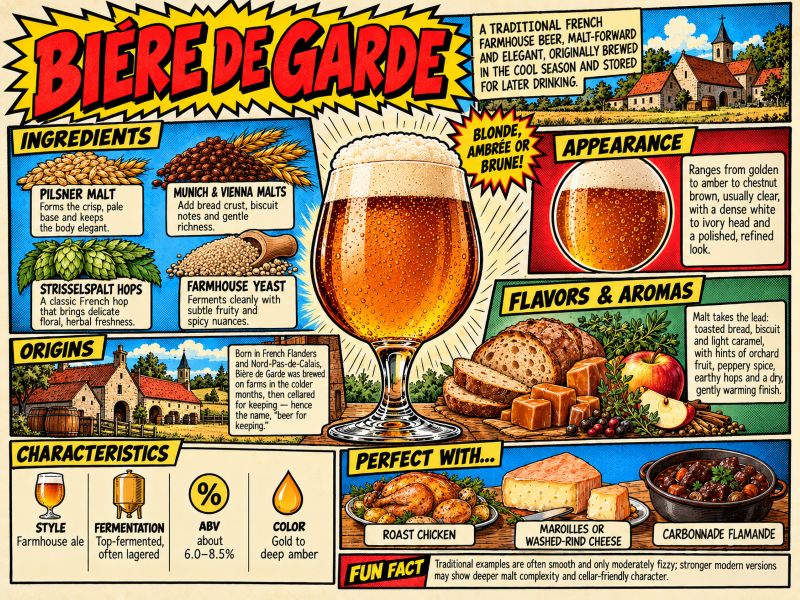
Bière de Garde is a traditional beer from northern France characterised by a pronounced malt profile, relatively restrained bitterness and a period of maturation that gives it a smooth, integrated character.
Unlike a narrowly defined German lager, Bière de Garde accommodates several colours and fermentation methods. The modern style includes Blonde, Ambrée and Brune, ranging from pale gold to deep brown.
The shared identity is sensory rather than purely technical. These beers should display substantial malt flavour without finishing excessively sweet. Toasted bread, biscuit, light caramel and gentle fruit notes are common, while hop bitterness provides enough balance to prevent heaviness.
The BJCP 2021 guidelines classify Bière de Garde as style 24C, with an original gravity of 1.060–1.080, final gravity of 1.008–1.016 and an alcoholic strength between 6% and 8.5%.
Those figures are useful reference points, not a legal definition controlling every French beer carrying the name.
The style is also notable for its relatively clean fermentation profile. Pronounced sourness, barnyard aromas, aggressive phenols or mustiness are not required characteristics of traditional modern Bière de Garde.
Why Is It Called Beer for Keeping?

The name Bière de Garde refers to the practice of producing beer during colder months and allowing it to mature before consumption.
Before reliable refrigeration, fermentation during summer was difficult to control. High temperatures could encourage undesirable microbial activity and produce inconsistent results.
Brewing during winter and early spring provided more favourable conditions.
The finished beer could then be stored in cool cellars for consumption during the warmer months, when brewing was less predictable.
Relatively strong alcohol, adequate attenuation and careful storage helped preserve the beer.
The historical tradition was not identical across every farm or village. Recipes, ingredients and fermentation practices varied according to local resources and individual brewers.
What survives in the modern style is the emphasis on maturation and stability, rather than the idea that every bottle should develop indefinitely in a cellar.
The History of Bière de Garde
Northern France once supported a dense network of local breweries serving agricultural communities, villages and industrial towns.
The proximity of Belgium helped create a shared brewing culture, particularly across French Flanders and the former county of Hainaut. Barley, local agricultural products and established brewing skills encouraged the development of regional beers that differed from those produced in southern France.
During the nineteenth century, beers associated with seasonal brewing and storage were already part of this regional landscape.
However, the Bière de Garde sold today is not an unchanged survival of a medieval farmhouse recipe.
Industrialisation, refrigeration, changing consumer preferences and competition from pale lager transformed French brewing during the nineteenth and twentieth centuries. Many small breweries disappeared, while others adapted by producing more standardised beers.
The modern revival of Bière de Garde owes much to regional producers that recognised the commercial potential of a stronger, more distinctive local speciality.
Among them, Brasserie Duyck in Jenlain played a decisive role.
Jenlain and the Modern Revival
Brasserie Duyck was established in 1922 in the village of Jenlain, near Valenciennes.
Its best-known beer, Jenlain Ambrée, became a model for the modern amber Bière de Garde and helped establish the style’s reputation beyond northern France.
The beer is associated with the traditional large, corked bottle and an aromatic profile built around malt, cooked fruit and caramel.
At 7.5% ABV, Jenlain Ambrée offers enough strength to support substantial malt flavour without sacrificing drinkability.
Its copper colour, gentle sweetness and measured bitterness reflect the qualities that became central to the modern understanding of Bière de Garde.
The success of Jenlain also encouraged renewed interest in regional French speciality beers during the second half of the twentieth century.
Other breweries, including Castelain and Saint-Sylvestre, developed their own interpretations, helping establish Bière de Garde as an internationally recognisable style.
The Three Types of Bière de Garde
The distinction between Blonde, Ambrée and Brune concerns more than colour. Different malt selections influence aroma, body and flavour, although all three remain relatively clean, malt-focused beers.
Bière de Garde Blonde
The blonde version is generally the lightest in colour and the most restrained in malt intensity.
Its appearance ranges from golden yellow to deep gold, with a white head and moderate to high carbonation.
The aroma may suggest fresh bread, pale malt, honey, cereal and gentle floral or herbal hops.
On the palate, the beer is smooth and relatively full, but a dry finish keeps it refreshing.
Hop character can be slightly more evident than in darker versions, although it should not dominate.
Ch’ti Blonde and 3 Monts Blonde are two important references, demonstrating how the blonde style can maintain considerable alcoholic strength without relying on caramel or dark malt flavours.
Bière de Garde Ambrée
Ambrée is the most traditional and recognisable expression of the modern style.
Its colour ranges from amber to copper or reddish bronze.
Vienna, Munich and other speciality malts may contribute bread crust, toasted grain, biscuit, toffee and light caramel.
The aroma is richer than in the blonde version, occasionally with subtle dried-fruit or cooked-fruit notes.
The palate should remain balanced, however. A well-made Ambrée can taste generously malted without becoming sticky or excessively sweet.
Jenlain Ambrée remains the most obvious reference point.
Bière de Garde Brune
The brown variation develops the malt character further.
Its appearance can range from deep reddish brown to chestnut, often with an ivory-coloured head.
The aroma may include toasted bread, caramel, nuts, dark biscuit and subtle dried fruit.
Despite the darker colour, Bière de Garde Brune is not intended to resemble a heavily roasted stout or porter.
Strong coffee, burnt grain and aggressive roast bitterness are generally inappropriate.
The best examples balance deeper malt complexity with a clean fermentation profile and a sufficiently dry finish.
What Does Bière de Garde Taste Like?
The defining impression is malt richness without excessive residual sweetness.
A typical amber example opens with bread crust, biscuit, toasted cereals and light caramel. Gentle fruity notes may suggest apple, pear or cooked fruit, while the hops contribute subtle herbal or spicy accents.
The body is usually medium to medium-light, sometimes with a smooth, silky texture.
Moderate to high carbonation prevents the beer from feeling heavy, particularly at strengths approaching 8% ABV.
Bitterness remains restrained but should be sufficient to balance the malt.
The finish is one of the most important characteristics. Despite the rich opening, a good Bière de Garde finishes medium-dry to dry, leaving toasted grain, a little bitterness and gentle alcoholic warmth.
A beer that tastes excessively sugary or syrupy misses this essential balance.
How Bière de Garde Is Brewed
The production process combines a malt-focused recipe with careful fermentation and extended conditioning.
Malt and Grain Selection
Barley malt forms the foundation of most modern recipes.
Blonde versions commonly rely on Pilsner or pale malt, sometimes supported by small quantities of Vienna malt.
Amber examples may incorporate more Vienna and Munich malt, together with carefully selected caramel malts.
Brown versions use darker speciality malts to create additional complexity without introducing aggressive roasted flavours.
Sugar can also be used to increase attenuation and prevent the finished beer from becoming too heavy.
The objective is to build a complex malt profile while preserving a relatively dry finish.
Hops and Bitterness
Hops play a supporting role.
Continental varieties with herbal, floral or gently spicy characteristics are well suited to the style. French Strisselspalt, Hallertau and similar European hops can provide balance without overwhelming the malt.
Modern brewers may use other varieties, but intense tropical-fruit or resinous aromas would move the beer away from its traditional character.
Bitterness generally remains moderate, within the broad range of approximately 18–28 IBU.
This is enough to counterbalance the malt, not to create the sharp finish of an American IPA.
Fermentation: Ale or Lager?
One of the most persistent misconceptions is that every Bière de Garde must be a top-fermented farmhouse ale.
Historically, ale fermentation was important, but modern examples may use ale or lager yeast.
Some breweries ferment ale yeast at relatively cool temperatures, reducing excessive ester production. Others use lager yeast and extended cold conditioning to achieve a similarly clean result.
The important characteristic is the finished flavour.
A Bière de Garde should generally display restrained fermentation-derived fruitiness, without the prominent peppery phenols commonly associated with Saison.
This flexibility makes the style particularly interesting from a technical perspective: different fermentation methods can produce beers with a recognisable shared identity.
Cold Conditioning
Maturation is central to the meaning of Bière de Garde.
After fermentation, the beer is typically conditioned for an extended period, often at cool temperatures.
This allows yeast and suspended particles to settle, fermentation by-products to diminish and the various flavour components to integrate.
The result should be smoother, cleaner and more harmonious.
Cold conditioning does not mean that every Bière de Garde must be aged for months after purchase.
The traditional concept concerns the beer’s preparation and maturation before consumption, not an obligation to keep finished bottles for years.
Bière de Garde vs Saison
Bière de Garde and Saison are often grouped together as farmhouse beers, but their typical modern flavour profiles are markedly different.
Saison, associated with Belgium, generally emphasises high attenuation, lively carbonation, peppery yeast character and greater bitterness.
Bière de Garde is usually cleaner, maltier and rounder.
Where Saison may suggest pepper, citrus, herbs and earthy fermentation aromas, Bière de Garde leans toward toasted bread, biscuits, caramel and gentle fruit.
The difference is especially evident when comparing an amber Bière de Garde with a classic Belgian Saison.
Both can be dry, relatively strong and refreshing, but they reach that balance through different aromatic structures.
Historical farmhouse brewing was more varied than either modern category suggests. The present distinction is best understood as a useful description of recognised contemporary styles rather than an absolute account of every beer brewed on either side of the French-Belgian border.
Bière de Garde vs Bock and Belgian Dubbel
The malt character of Bière de Garde can resemble certain German Bock beers.
Both may emphasise bread crust, toasted grain, moderate bitterness and relatively clean fermentation.
However, Bock is a separate German tradition with its own production history and established substyles.
Bière de Garde usually shows a distinctive combination of regional French malt character, fermentation flexibility and cellar conditioning.
Belgian Dubbel offers another useful comparison, particularly with darker Bière de Garde.
Dubbel often displays more expressive fermentation aromas, including dark fruit and spicy notes, while Bière de Garde generally remains cleaner and less dependent on yeast-driven complexity.
Neither comparison is exact, but both help explain the style to drinkers encountering it for the first time.
The Best Bière de Garde Beers to Try
Jenlain Ambrée — Brasserie Duyck
<text color=”secondary” size=”xs” weight=”medium”>7.5% ABV · Jenlain, France</text>
<AsyncImage query=”Jenlain Ambree Brasserie Duyck beer bottle label” aspectRatio=”5:3″ maxHeight={190} fit=”contain”/>
One of the definitive modern examples of Bière de Garde.
Jenlain Ambrée pours copper with a fine, persistent head. The aromatic profile centres on malt, toasted bread, cooked fruit and caramel, with relatively restrained bitterness.
Its generous palate and balanced finish make it an excellent starting point for understanding the amber style.
Ch’ti Blonde — Brasserie Castelain
<text color=”secondary” size=”xs” weight=”medium”>6.8% ABV · Bénifontaine, France</text>
<AsyncImage query=”Brasserie Castelain Ch’ti Blonde beer bottle” aspectRatio=”5:3″ maxHeight={190} fit=”contain”/>
A traditional blonde Bière de Garde from Brasserie Castelain.
The beer undergoes prolonged cool maturation and displays a golden colour with aromas of malt and flowers.
The palate combines cereal, gentle honey-like sweetness and delicate hop bitterness.
It is a particularly useful reference for the lighter-coloured expression of the style.
3 Monts Blonde — Brasserie 3 Monts
<text color=”secondary” size=”xs” weight=”medium”>8.5% ABV · Saint-Sylvestre-Cappel, France</text>
<AsyncImage query=”3 Monts Blonde original bière beer bottle French Flanders” aspectRatio=”5:3″ maxHeight={190} fit=”contain”/>
Introduced in 1984, 3 Monts Blonde is one of the most recognisable strong blonde beers of French Flanders.
Made using Pilsner barley malt, Nugget hops and the brewery’s own yeast, it combines golden colour, cereal aromas and a restrained herbal hop character.
The palate is substantial but balanced, with malt, gentle fruit, a citrus accent and mild bitterness.
At 8.5% ABV, it demonstrates how a strong blonde beer can retain freshness without depending on aggressive hopping.
La Choulette Brune — Brasserie La Choulette
<text color=”secondary” size=”xs” weight=”medium”>Traditional brown expression · Hordain, France</text>
<AsyncImage query=”La Choulette Brune bière de garde beer bottle” aspectRatio=”5:3″ maxHeight={190} fit=”contain”/>
Brasserie La Choulette is another important name in the regional brewing tradition.
Its darker Bière de Garde illustrates the fuller malt character associated with the Brune variation, where toasted cereal, caramel and darker bread notes become more prominent.
It is a useful counterpoint to the better-known blonde and amber examples.
How to Serve Bière de Garde
Bière de Garde should be served cool rather than excessively cold.
A temperature around 8–12°C works well for most examples, although individual producers may recommend slightly cooler service.
Jenlain Ambrée, for instance, is recommended at 6–8°C, while 3 Monts Blonde is best served around 8–10°C.
The appropriate glass is a tulip or stemmed beer glass, which allows the malt aromas to develop while preserving carbonation.
Large-format 75 cl bottles remain characteristic of several French producers, reflecting the tradition of beers intended for sharing at the table.
Pour steadily, leaving any yeast sediment behind if a bottle-conditioned expression is not intended to be served cloudy.
As the beer warms slightly, toasted malt, fruit and gentle spice generally become more expressive.
Food Pairings: What to Eat with Bière de Garde
Bière de Garde is particularly suited to the substantial cuisine of northern France.
The classic pairing is carbonnade flamande, a beef stew slowly cooked with beer, onions and often a little brown sugar or bread spread with mustard. An amber Bière de Garde complements the browned meat and caramelised onions while providing enough bitterness to balance the dish.
A blonde version works beautifully with roast chicken with thyme and potatoes, where its cereal character supports the crisp skin and savoury juices without overwhelming the meat.
For a richer combination, choose pork cheeks braised in beer with roasted root vegetables, particularly with an Ambrée or Brune. The toasted malt echoes the cooking aromas, while carbonation helps refresh the palate.
The region also produces cheeses that are exceptionally well suited to the style.
Maroilles AOP, with its washed rind and pungent character, is a classic partner for a rounded amber Bière de Garde. Mimolette extra-vieille works with the nutty, toasted notes of darker versions, while Vieux-Lille, a powerful washed-rind cheese, benefits from a beer with sufficient body and a dry finish.
For dessert, try tarte au sucre, the traditional northern French sugar tart, particularly with a brown version whose caramel and toasted-bread notes can support the sweetness.
Can Bière de Garde Be Aged?
The name can create a misleading expectation.
Bière de Garde was historically designed to withstand a period of storage, but that does not mean every modern example improves with extended bottle ageing.
Some strong, bottle-conditioned versions can develop additional complexity over time, particularly when stored in cool, stable conditions.
However, excessive ageing can also reduce freshness and introduce oxidation.
Old bottles may develop sherry-like, papery, stale or unpleasantly musty aromas that should not automatically be considered authentic expressions of the style.
A pronounced cellar or mouldy smell is not a quality requirement.

