
American Wheat Beer: How American Brewers Reinvented the Classic Wheat Ale

In Bavaria, wheat beer is famous for its unmistakable aroma of ripe bananas and cloves. In the United States, a group of small breweries looked at the same basic ingredients during the 1980s and decided to take a different direction. They kept the wheat, abandoned the characteristic German yeast flavours and introduced a cleaner fermentation profile, sometimes reinforced by the citrusy personality of American hops.
The result was American Wheat Beer, a pale, refreshing beer with a soft, grainy character, lively carbonation and considerably more flexibility than its European relatives. It can be brilliantly clear or naturally cloudy, delicately hopped or noticeably aromatic, but its central appeal remains the same: the flavour of wheat supported by clean fermentation and enough bitterness to keep the finish crisp.
The style became one of the defining beers of the early American craft brewing movement. Widmer Brothers helped popularise cloudy wheat beer in Portland, Bell’s turned Oberon into a Midwestern summer ritual, and breweries from Chicago to Kansas City developed their own interpretations.
American Wheat Beer rarely attracts the attention lavished on Imperial Stouts or heavily dry-hopped IPAs. Yet making a convincing example is surprisingly demanding. With no roasted malt, powerful yeast spices or enormous hop additions to hide mistakes, the quality of the ingredients and fermentation becomes immediately apparent.
The Basics
- Origin: United States, modern craft brewing movement of the 1980s
- Beer family: Wheat beer
- Alcohol: Usually around 4–6% ABV
- Colour: Straw yellow to deep gold, occasionally light amber
- Appearance: Clear to hazy, depending on filtration and yeast
- Main grains: Malted wheat and barley malt
- Wheat content: Commonly 30–50% of the grain bill, sometimes more
- Fermentation: Clean American ale yeast or, less commonly, lager yeast
- Typical flavours: Fresh bread, wheat dough, crackers, light citrus and gentle floral or herbal notes
- Hop character: Low to moderate in classic versions; more pronounced in some modern interpretations
- Bitterness: Generally around 10–35 IBU
- Body: Light to medium
- Carbonation: Moderate to high
- Finish: Crisp, refreshing and slightly dry
- Typical serving temperature: 4–7°C
- Important beers: Widmer Hefe, Bell’s Oberon, Boulevard Unfiltered Wheat, Goose Island 312 and 3 Floyds Gumballhead
- Food pairings: Fried fish, grilled shrimp, roast chicken, tacos, fresh cheeses and summer salads
What Is American Wheat Beer?
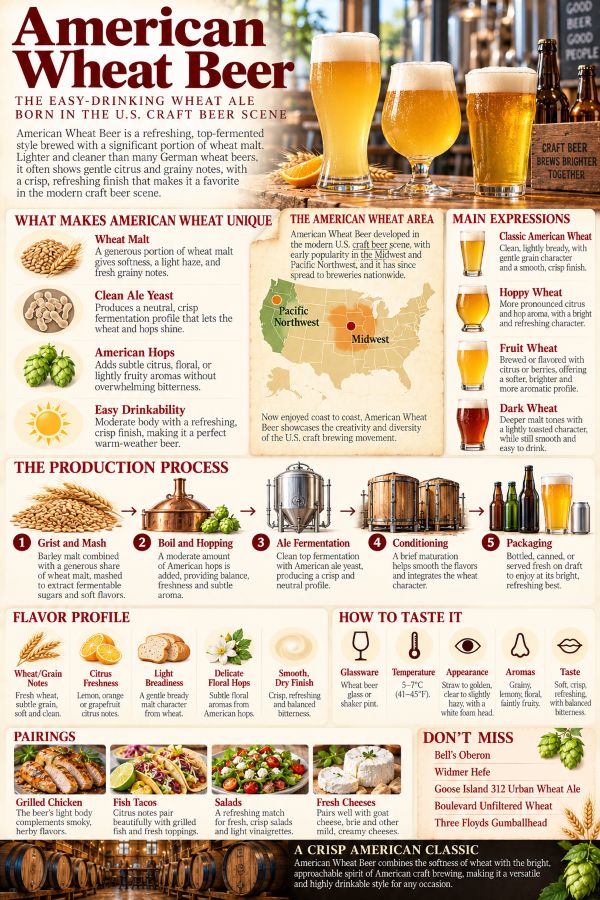
American Wheat Beer is a modern American interpretation of wheat-based brewing, characterised by a substantial proportion of wheat malt and a relatively clean fermentation profile.
The wheat contributes flavours reminiscent of fresh dough, bread and cereal, while barley malt provides additional structure and fermentable sugars.
Unlike traditional Bavarian wheat beer, American Wheat Beer generally avoids the pronounced banana and clove aromas produced by specialist German wheat-beer yeasts.
Instead, the beer develops much of its personality through the grain and hops.
Some versions are restrained, with a gentle floral aroma and very little bitterness. Others display noticeable citrus, grapefruit or stone-fruit notes from American hop varieties.
The beer’s appearance is equally flexible. Filtering can produce excellent clarity, while unfiltered versions retain suspended yeast and proteins that give the beer its familiar cloudy appearance.
American Wheat Beer is therefore best understood as a family of closely related beers rather than one narrowly defined recipe.
What unites them is their light, refreshing structure and the decision to let wheat flavour take precedence over expressive yeast-derived spice.
The Birth of American Wheat Beer
Although wheat had been used in brewing for centuries, the modern American style developed during the revival of small independent breweries in the 1980s.
The historical background is important. American brewing had become overwhelmingly dominated by pale industrial lager, and the earliest craft brewers were searching for alternatives.
European traditions provided inspiration, particularly British ales, German wheat beers and Belgian specialities.
However, the American pioneers were not necessarily interested in reproducing European recipes exactly.
In 1984, Anchor Brewing in San Francisco introduced its Summer Wheat Beer, one of the early examples of the emerging American wheat tradition.
Pyramid followed with Wheaten Ale in 1985, helping establish a market for wheat beers that differed from the familiar German versions.
The decisive development came in Portland in 1986, when two brothers transformed an ordinary brewing decision into one of the most influential American craft beers of the decade.
Widmer Brothers and the Beer That Changed Portland
Brothers Kurt and Rob Widmer founded their brewery in Portland, Oregon, in 1984.
Their original ambition was to produce German-inspired beers, including Altbier, a darker ale associated with Düsseldorf.
The business struggled initially. Portland drinkers were not necessarily ready to embrace an unfamiliar brown ale, and the brothers needed something more approachable.
They introduced a filtered wheat beer, but the turning point came when the owners of the Dublin Pub asked them for another beer.
With limited fermentation equipment, the Widmers took an unusually practical approach: they served their existing wheat beer without filtering it.
The result was Widmer Hefeweizen, introduced on May 15, 1986.
Despite the German name, it was not a conventional Bavarian Hefeweizen. The brewery used a relatively neutral ale yeast and Cascade hops, producing a cloudy beer without the characteristic banana and clove aromas.
Customers initially found the appearance unusual, but the beer quickly became popular.
Widmer Hefe helped normalise cloudy wheat beer in the United States and established an approach that other American breweries would adopt.
Its success was not simply a matter of making German beer less complicated. The combination of wheat, neutral yeast and American hops created a distinct flavour profile.
Why Wheat Matters
Wheat is responsible for much of the beer’s texture and grain character.
Compared with barley malt, wheat malt is particularly rich in proteins that can contribute to foam stability and the soft, sometimes hazy appearance of the finished beer.
Its flavour is generally light and delicate, often suggesting fresh bread dough, crackers or cereal.
Wheat also lacks the husk found on barley grains, which can make lautering more difficult when large quantities are used.
Brewers therefore commonly combine wheat with barley malt. The barley contributes additional enzymes and helps create a grain bed through which the wort can flow more easily.
Most American Wheat Beers use a substantial proportion of malted wheat, commonly around 30–50% of the grain bill.
Higher proportions are possible, but they require careful attention to the mashing and lautering process.
The result should be a beer with recognisable grain flavour, not merely a pale ale containing a token amount of wheat.
How American Wheat Beer Is Brewed
The brewing process resembles that used for many pale ales, but the grain composition, yeast selection and hop schedule give the style its distinctive identity.
Malt and Mashing
A typical recipe uses pale barley malt and malted wheat in roughly comparable proportions.
The barley provides a clean malt foundation, while wheat supplies the characteristic doughy flavour and contributes to the beer’s head retention.
Some recipes include small amounts of Vienna malt or other lightly kilned grains to create additional depth.
However, excessive caramel or toasted malt would obscure the delicate wheat character.
Mashing temperatures are selected to obtain a relatively fermentable wort, helping create the crisp finish expected of the style.
Because wheat lacks a husk, brewers using high proportions may add rice hulls to improve lautering. These do not contribute meaningful flavour; they simply help the liquid drain through the grain bed.
Fermentation: The Crucial American Difference
Yeast selection is the most important distinction between American Wheat Beer and Bavarian Hefeweizen.
Traditional German wheat-beer yeasts produce pronounced fruity esters and spicy phenols, responsible for the familiar banana and clove aromas.
American brewers generally use relatively neutral ale yeasts.
These strains allow the wheat and hops to remain prominent without creating strong fermentation-derived flavours.
Some breweries use lager yeast or cooler fermentation conditions to achieve an even cleaner profile.
A restrained fruity note is acceptable, but obvious banana or clove character would move the beer toward German wheat-beer territory.
The difference is not about yeast quality. Both traditions rely on skilled fermentation management; they simply pursue different aromatic results.
Hops: From Gentle Spice to American Citrus
American Wheat Beer allows more hop expression than traditional Bavarian Hefeweizen.
Classic versions may use floral, herbal or gently spicy varieties, creating a balanced beer where bitterness remains relatively low.
American hops introduced additional possibilities.
Cascade can contribute grapefruit and floral notes, while Amarillo may add citrus and peach-like aromas.
Modern interpretations sometimes use late hopping or dry hopping to create more pronounced fruit character.
However, American Wheat Beer should not automatically taste like a heavily hopped IPA.
In the classic style, hops complement the wheat rather than overwhelming it.
Filtration and Haze
American Wheat Beer can be clear or cloudy.
Unfiltered versions retain suspended yeast and proteins that affect appearance and sometimes texture.
Filtering removes much of this material, producing a brighter beer with a cleaner visual presentation.
Neither version is automatically superior.
A cloudy American Wheat Beer should not be mistaken for a defective or unfinished product, but cloudiness alone does not establish quality either.
The best examples maintain freshness, appropriate carbonation and a clean flavour regardless of appearance.
What Does American Wheat Beer Taste Like?
A classic American Wheat Beer pours pale yellow to gold, often with a substantial white head.
Unfiltered examples may have a soft haze, while filtered versions can be almost brilliantly clear.
The aroma usually begins with fresh cereal, wheat dough and light bread.
Hops may introduce gentle citrus, flowers or herbal spice, depending on the recipe.
The palate is light to medium-bodied, with delicate grain flavours and modest malt sweetness.
Carbonation provides an energetic, refreshing sensation, while restrained bitterness keeps the finish balanced.
The best examples feel soft without becoming heavy.
They should be easy to drink, but not watery or flavourless.
In more hop-forward versions, grapefruit, peach or tropical-fruit notes can become prominent, although the underlying wheat character should remain recognisable.
American Wheat Beer vs German Hefeweizen
The two styles share wheat as a principal ingredient, but the similarities become less obvious once fermentation character is considered.
German Hefeweizen traditionally uses a specialist yeast that produces banana-like esters and clove-like phenols.
These aromas are central to the style, along with high carbonation and a soft wheat-malt foundation.
American Wheat Beer generally uses a cleaner yeast and allows the grain and hops to take a more prominent role.
The German version often smells immediately of ripe banana, clove and sometimes bubblegum.
The American version is more likely to suggest fresh bread, cereal, citrus and floral hops.
Both can be cloudy, highly carbonated and refreshing, but their aromatic personalities are quite different.
The distinction also explains why a beer such as Widmer Hefe can carry a German-style name while belonging firmly to the American brewing tradition.
American Wheat Beer vs Belgian Witbier
Belgian Witbier provides another useful comparison.
Witbier commonly includes unmalted wheat and is traditionally flavoured with coriander and orange peel.
Belgian yeast may contribute additional fruity or spicy complexity.
American Wheat Beer usually relies more heavily on malted wheat and does not require coriander or citrus peel.
Its fruity or citrus character generally comes from hops and restrained fermentation rather than a prescribed mixture of spices.
This does not mean American breweries never produce flavoured wheat beers.
Samuel Adams Summer Ale, for example, incorporates citrus peels and grains of paradise, making it an intentionally spiced American interpretation rather than the simplest expression of the traditional style.
The distinction is useful when choosing between beers. A Witbier generally offers more obvious spice, while a classic American Wheat Beer places greater emphasis on cereal freshness and clean fermentation.
American Wheat Beer vs American Pale Ale
The difference between American Wheat Beer and American Pale Ale can be surprisingly small when both are brewed with clean ale yeast and moderate hops.
The most important distinction is the grain bill.
An American Pale Ale generally relies on barley malt, while American Wheat Beer contains a substantial proportion of wheat.
This changes the texture, foam and flavour.
Wheat contributes soft doughy notes and a distinctive cereal character, while barley can create a firmer malt foundation.
American Pale Ale also tends to emphasise hop bitterness and aroma more strongly.
Some contemporary beers deliberately occupy the territory between the two styles.
Gumballhead from 3 Floyds is an excellent example, demonstrating how wheat can provide the foundation for a more assertively hopped American ale.
The Best American Wheat Beers to Try
Bell’s Oberon Ale — 5.8% ABV
Oberon is one of the most recognisable seasonal beers in the American Midwest.
Brewed with wheat and barley, hops and Bell’s house ale yeast, it has a distinctive orange-gold colour and a lightly hazy appearance.
The flavour balances wheat malt with citrusy, gently fruity notes and a spicy hop character.
At 5.8% alcohol, Oberon is slightly stronger than many traditional examples but retains an exceptionally refreshing profile.
Its annual return has become a seasonal event for beer drinkers across Michigan and beyond.
For understanding American Wheat Beer as a successful craft brewing style rather than a technical curiosity, Oberon is an excellent starting point.
Boulevard Unfiltered Wheat — 4.4% ABV
Boulevard Unfiltered Wheat is one of the clearest examples of the restrained American approach.
It pours pale gold with a natural haze, offering gentle wheat character and subtle citrus freshness.
With approximately 14 bitterness units, the hops support rather than dominate the grain.
Its relatively low alcohol content makes it particularly suitable for warm weather, casual drinking and food pairings.
The beer has become a longstanding regional favourite, demonstrating the appeal of a style built around balance rather than intensity.
Goose Island 312 — 4.2% ABV
Named after Chicago’s telephone area code, 312 is a light, slightly hazy wheat ale.
Its flavour centres on fresh grain, lemon-like notes and restrained hops.
The brewery uses Millennium, Cascade and Hallertau hops, creating a gentle balance between American citrus character and traditional herbal qualities.
At 4.2% ABV, it is among the lighter examples worth exploring.
312 demonstrates how wheat beer can provide more flavour and texture than a conventional light lager without sacrificing refreshment.
3 Floyds Gumballhead — 5.6% ABV
Gumballhead represents the more assertive end of American wheat brewing.
The brewery describes it as an American Wheat Pale Ale, a useful indication of its character.
Brewed with white wheat and prominently featuring Amarillo hops, it offers grapefruit, peach and citrus aromas over a soft grain foundation.
Its 38 bitterness units place it above the range associated with many classic American Wheat Beers.
That greater hop presence is precisely what makes Gumballhead interesting: it shows how the style can move toward American Pale Ale while retaining a recognisable wheat-based identity.
Samuel Adams Summer Ale — 5.3% ABV
First introduced in 1995, Summer Ale became one of the most widely recognised seasonal American wheat beers.
The current recipe includes lemon, lime and orange peels, together with grains of paradise.
The result is bright, citrusy and gently spicy, with a light body and low bitterness.
Because its flavour comes partly from added spices and citrus, Summer Ale is better understood as a flavoured variation rather than a definitive example of unspiced American Wheat Beer.
Nevertheless, it played an important role in bringing wheat-based craft beer to a much wider audience.
Widmer Hefe — The American Wheat Pioneer
Widmer Hefe deserves a place in any serious history of American Wheat Beer.
Introduced in 1986, it established the model of a cloudy wheat beer fermented with relatively neutral yeast and supported by American hop character.
Its success helped define the modern American interpretation of Hefeweizen.
The beer also popularised the familiar practice of serving American wheat beer with a lemon wedge, although that garnish remains a matter of preference rather than a requirement.
How to Serve American Wheat Beer
American Wheat Beer is best served cool, usually around 4–7°C.
This temperature highlights carbonation and freshness while preserving enough aroma to appreciate the wheat and hops.
A tall wheat-beer glass works well, particularly for unfiltered versions with substantial foam.
A simple nonic pint or tulip glass is also suitable.
Pour steadily to develop a white head.
For unfiltered beers, a small quantity of yeast may remain at the bottom of the bottle or can. Some drinkers prefer to distribute it through the beer, while others leave the sediment behind.
There is no universal requirement to add lemon.
A citrus garnish may make a lightly hopped beer more refreshing, but it can also obscure subtle malt aromas. Taste the beer without one before deciding whether it needs anything else.
Food Pairings: What to Eat with American Wheat Beer
American Wheat Beer is particularly good with food because it combines delicate flavour with lively carbonation.
Beer-battered cod with tartar sauce and thick-cut fries is an excellent match. The beer’s carbonation cuts through the frying oil, while its restrained bitterness allows the fish to remain prominent.
Another convincing pairing is grilled shrimp tacos with lime, coriander and cabbage slaw. The wheat character supports the tortillas, while citrusy hops complement the garnish.
For a more substantial meal, choose roast chicken with lemon, thyme and rosemary potatoes. The beer has enough grain character to accompany browned skin without overpowering the meat.
It also works well with sweetcorn fritters, grilled zucchini and fresh herb mayonnaise, particularly when the beer has a gentle floral hop profile.
For cheese, try Monterey Jack, fresh chèvre and young Wisconsin Colby. Their creamy texture and moderate saltiness complement wheat’s soft cereal flavour without overwhelming the beer.
Heavily hopped versions such as Gumballhead can handle slightly spicier food, including buffalo chicken sandwiches or tacos with a moderate amount of chilli.
Can You Brew American Wheat Beer at Home?
American Wheat Beer is a good project for homebrewers because the ingredients are relatively straightforward.
A practical recipe for 20 litres might use approximately 2 kg of pale barley malt and 2 kg of malted wheat, with a modest addition of hops providing around 15–25 bitterness units.
A clean American ale yeast fermented at the temperature recommended by its producer will preserve the grain character.
A small late-hop addition can introduce light citrus or floral aroma.
The main technical challenge is controlling the mash when the wheat proportion is high. Rice hulls may improve lautering, while a careful mash schedule helps obtain an appropriately fermentable wort.
Cold conditioning can improve clarity and produce a smoother final beer, but extended lagering is not essential.
The objective is a well-attenuated, crisp beer with enough wheat flavour to remain interesting.
Adding excessive hops, caramel malt or strongly aromatic yeast would undermine the character of a classic American Wheat Beer.
Is American Wheat Beer Always a Summer Beer?
The style is strongly associated with summer because its moderate alcohol, light body and high carbonation make it particularly refreshing.
Seasonal examples such as Oberon and Samuel Adams Summer Ale have reinforced that reputation.
However, there is no technical reason why American Wheat Beer must be limited to warm weather.
Its restrained malt profile and versatility with food make it suitable throughout the year.
Some breweries produce it continuously, while others use the grain bill as a foundation for darker, stronger or more heavily hopped interpretations.
The association with summer is primarily cultural and commercial rather than a requirement of the style.
What Defines a Great American Wheat Beer?
A convincing example should smell and taste unmistakably of wheat without becoming heavy or dull.
The grain character should suggest fresh bread, crackers or soft dough, supported by clean fermentation.
Hops may add citrus, floral or herbal aromas, but the balance should remain appropriate to the intended interpretation.
Carbonation needs to be lively enough to preserve refreshment, while the finish should be crisp rather than sticky.
A cloudy appearance is acceptable, but haze should not be confused with quality.
The best American Wheat Beers are precise, clean and easy to drink, with enough personality to stand apart from ordinary industrial lager.
They also demonstrate a form of brewing craftsmanship that is easy to underestimate. When a beer relies on such delicate flavours, small technical mistakes can become disproportionately noticeable.
The Beer That Helped American Craft Brewing Find Its Voice
American Wheat Beer emerged at a moment when small American breweries were trying to establish an identity beyond industrial lager.
The earliest producers borrowed ideas from European wheat beer, but their most important contribution was adapting those ideas to local ingredients, yeast strains and consumer tastes.
Widmer Hefe transformed an unfiltered wheat ale into a symbol of Portland’s emerging beer culture. Bell’s Oberon made wheat beer part of the Midwestern summer, while Boulevard, Goose Island and other breweries developed approachable versions that reached beyond the specialist craft beer audience.
The style also proved flexible enough to accommodate more assertive hopping, as demonstrated by Gumballhead, without abandoning its grain-based foundation.
Its appeal remains refreshingly straightforward: fresh wheat, clean fermentation, lively carbonation and enough hops to keep everything balanced.
American Wheat Beer may lack the flamboyance of more fashionable styles, but at its best it delivers something equally valuable—a beer that is light enough for a hot afternoon, flavourful enough to reward attention and balanced enough to make the next glass difficult to resist.

