
Discover Belluno 2024: Gateway to the Dolomites and a Treasure of History
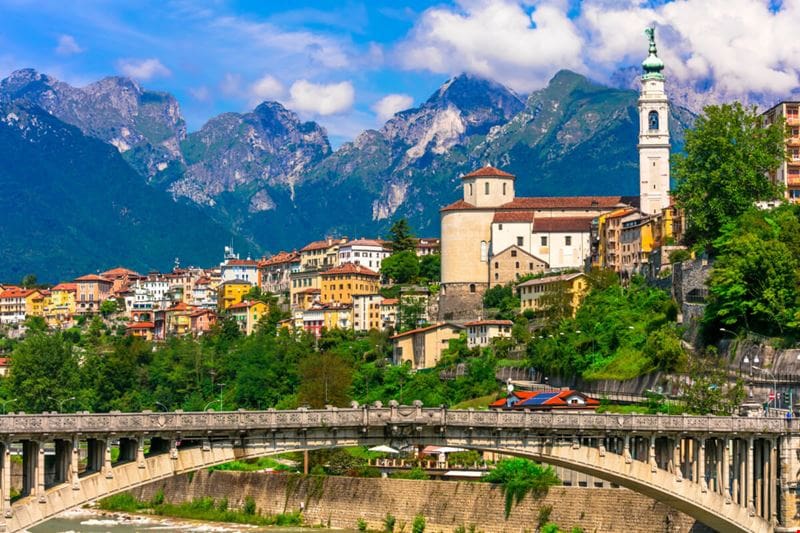
A town of 35,000 people and the provincial headquarters of the Alpine part of Veneto, Belluno is also a significant center of the Piave valley, which rises at the confluence of the same river with the Ardo stream. It is also known as the Gateway to the Dolomites.
The town’s elevated position on a terrace overlooking the river, as described by the 20th-century writer and journalist Dino Buzzati in his text “La mia Belluno,” has historically made it a crucial location for trade between the Alpine valleys and the lordships of the Venetian plain, particularly Treviso and Venice. It has also played an important role in protecting the inhabited center from the Piave’s floods.
History
The city’s transformation into a free municipality prior to the lordships’ conquest occurred primarily during the Middle Ages, although Celtic communities began to colonize the region as early as the 5th century BC.
It finally came under the control of Venice in 1404, following years of fighting, and flourished and developed under their rule.
The Belluno Alps were unwitting sites of First World War battles in the twentieth century, and the city was a focal point of partisan activity in the fight against Nazi fascism in the Second World War, earning the city the gold medal for military valor awarded to the Resistance.
What Belluno Has to Offer
Piazza dei Martiri
In fine weather, the bar tables line up in front of the late Renaissance porticoes that surround Piazza dei Martiri, also called “Campedel,” the city’s liveliest spot. Additionally, the square is home to a moving Monument to the Resistance, a fountain, and a park surrounded by trees.
Municipal Theater and Palazzo Fulcis
Near Piazza dei Martiri on Piazza Vittorio Emanuele stand the Porta Dojona and the neoclassical Municipal Theatre, both constructed in the early nineteenth century. Palazzo Fulcis is also located on this square. The Civic Museum is housed in Palazzo Fulcis, an eighteenth-century edifice, which lies just in front of the theater.
Porta Dojona
This historic gate in the medieval fortifications of Belluno is called Porta Dojona, and it is sandwiched between the Municipal Theater and a palace. This white and pink marble side, which looks out over the square, dates back to the sixteenth century.
Chiesa di San Rocco
The 16th-century Church of San Rocco was constructed as a token of gratitude for the cessation of the plague epidemic that had afflicted Belluno. It overlooks Piazza dei Martiri. Several pieces of art, including paintings and a tabernacle made of wood, can be seen within the chapel.
Cathedral and Piazza del Duomo
From an architectural perspective, Belluno is most known for its Cathedral and Piazza del Duomo. The Palazzo dei Rettori, the former headquarters of the Venetian government, may be immediately identified by its clock tower; it dates from the fifteenth to the sixteenth century and is one of several historic buildings surrounding this area. Palazzo Rosso, which stands out in the neighborhood thanks to its reddish hue, is now the town hall. In contrast, the Auditorium is located in the Palazzo dei Vescovi, a structure that dates back to the thirteenth century and is framed by the civic tower, which has its roots in the Middle Ages. The city’s primary place of worship is the Duomo, also known as the Cathedral Basilica of San Martino. The construction of this structure started in 1517 and lasted for a long period; as a result, there is a visible fluctuation of styles. A baroque entrance and two Gothic windows adorn the incomplete exposed stone façade. The interior, on the other hand, features Renaissance-style naves with round arches. The 72-meter-tall bell tower was conceived in 1732.
Piazza del Mercato
Close by Piazza Duomo lies Piazza del Mercato, another name for the same plaza: Piazza delle Erbe. Amidst old buildings like the Monte di Pietà, the Casa Miari, and the Loggia dei Ghibellini, with the Fountain of San Lucano in its center, the area is a true treasure, although in the morning it is generally filled with fruit and vegetable stalls.
Some say it’s the most picturesque church in Belluno, and that would be the Church of Santo Stefano. Its simple but attractive façade dates back to 1468. Numerous artists’ works are housed within.
Other churches
The city center is home to multiple houses of worship, including the four-century-old Church of San Pietro and the 16th-century Church of Santa Maria delle Grazie, both of which overlook Piazza del Duomo. The former was constructed in the 14th century and the latter in the 16th.
Surroundings of Belluno
Nature lovers will find enough to do in Belluno’s environs. For example, at the base of Col Visentin lies Nevegal, a ski resort perfect for alpine sports. You may reach Lake Santa Croce, one of the most picturesque lakes in the Veneto, by traveling south toward Conegliano from Ponte nelle Alpi. The lake is a magnificent body of fresh water nestled among the mountains.
In addition to serving as a portal to the Dolomites, Belluno is also the starting point for excursions into the historic Cadore region, which spans the northern part of the province of Belluno and includes the regions of Veneto, Trentino-Alto Adige, Friuli Venezia-Giulia, and Austria.
Nature and the Outdoors
The geographical region of Cadore, which includes towns like Auronzo di Cadore, Santo Stefano di Cadore, Selva di Cadore, Sappada (which has been part of the Friuli province of Udine since 2017), and Cortina d’Ampezzo, is home to distinct historical, cultural, and linguistic traditions.
Some of the most popular ski resorts in the Veneto region are located in the Belluno mountains; throughout the summer, however, these same slopes become ideal for mountain bikers, hikers, climbers, and mushroom hunters.
The tragic landslide that occurred on October 9, 1963, near Monte Toc, and which eventually made its way into the lake held by the Vajont Dam is what the province of Belluno is most famous for. The river overflowed its banks and flooded the valley below, killing 1,917 people as it swept away everything in its path downstream. It also leveled the village of Longarone.
In the Friulian Dolomites Natural Park, in the village of Erto, the Vajont Dam is still visible. Located at the Visitor Center of the Friulian Dolomites Natural Park of Erto and Casso, the Vajont museum pays tribute to the catastrophe and may be explored by visitors. Along with the museum, guided excursions are available through the Friulian Dolomites Natural Park that allow visitors to walk on the top 20 meters of the dam.
Cultural and Seasonal Events
The Sagra dei Fisvòt, a religious event that has been celebrated in Belluno since 1716, takes place annually, two Sundays before Easter. It is timed to coincide with the Feast of the Madonna Addolorata. Typically housed at the Church of Santo Stefano, the figure of the Madonna dei Sette Dolori is paraded through the center’s streets during this event. Even though the Sagra dei Fisvòt has become more commercial and less focused on its religious significance, it is still much anticipated by locals and has a long history of celebration.
On the same dates as the Ex Tempore Internazionale di Scultura su Legno, which features artists from all over Italy, the city has an antiques market and wine tastings in honor of San Martino, its patron saint, in November.
Arriving at the destination
The A27 freeway connects Venice with the upper Piave valley; it continues through Treviso and continues up to the Ponte delle Alpi area, where it terminates and the SS51 begins; from there, take SP1 signs for Belluno to reach your destination.
Not far from Belluno’s historic center, to the north, you’ll find a bus terminal and a train station.
Both the “Canova” in Treviso (85 km) and the “Marco Polo” in Venice (97 km) are major airports in the area.

