
Halloween Around the Globe: Unveiling Unique Traditions and Celebrations

When it comes to ancient traditions, Halloween is undeniably one of the heavy hitters. Celebrated on the 31st of October, it’s an event that’s still very much alive in various parts of the world. However, it’s in the United States and Canada where the occasion truly comes to life. Every year, a whopping 65% of Americans deck their homes and offices to celebrate Halloween, a holiday second only to Christmas in its popularity.
Interestingly, it’s also the time of the year when Americans buy the most sweets—beating out even the Christmas season! Though perhaps less enthused, Europe has been warming up to Halloween, particularly among younger generations who’ve been indoctrinated through cartoons and TV shows. So whether you’re a fan or a critic, let’s embark on a global tour of how Halloween is celebrated.
Halloween in Europe
In Austria, it’s customary to leave bread, water, and a lit lamp on the table before going to bed on Halloween night. Why, you ask? Well, these offerings were traditionally believed to welcome back the souls of the departed, on a night considered by Austrians to be brimming with cosmic energies.
In Belgium, candles are lit to honor deceased relatives, while in Slovakia, chairs are placed by the fireplace—one for each living family member and one for each departed soul.
Over in Germany, the knives are safely tucked away so as not to harm the returning spirits. The British Isles are where Halloween truly has historical roots. Children used to carve beets into dolls called “Punkies,” an age-old custom used to chase away malevolent spirits. Stones, vegetables, and nuts were once thrown into bonfires to scare spirits off. These symbolic offerings also served as divining tools. If a stone vanished by morning, its thrower was not expected to live another year.
In Ireland, considered the true birthplace of Halloween, the tradition still thrives today much as it does in the U.S. Bonfires and “trick-or-treat” abound, and post-treat, most people head to gatherings featuring treasure hunts for sweets and traditional cakes called “barnbrack.”
Sweden observes Halloween, known there as “Alla Helgons Dag,” sometime between October 31 and November 6, differing each year.
And while France and even Italy view it as an American import, the younger generations have started to embrace it, hosting parties from the north to the south.
Halloween in Asia
China’s Teng Chieh: A Spiritual Voyage
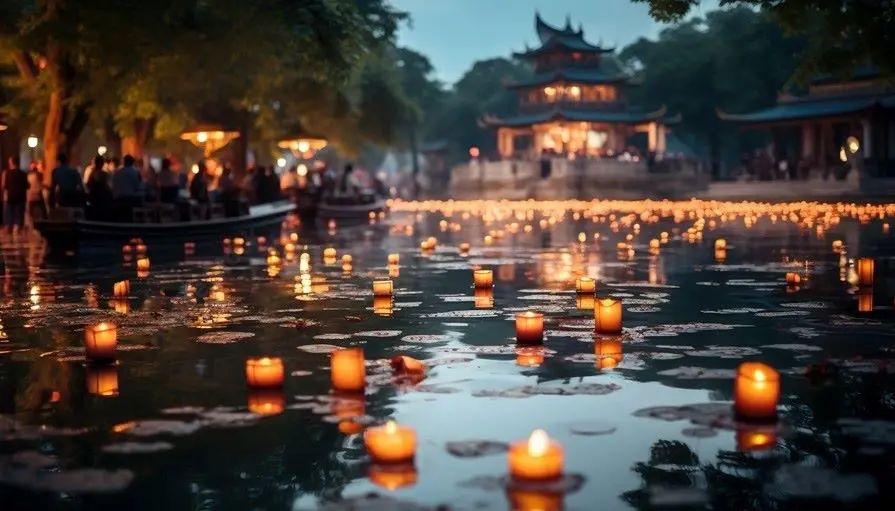
In China, the celebration known as Teng Chieh invites both food and water to grace the altars set up before photographs of departed family members. Picture it: lanterns and fires are kindled to light the way for wandering spirits as they traverse the earthly realm. Within the tranquil walls of Buddhist temples, believers craft paper boats. Some are almost grandiose, and come evening, they are set aflame. Why, you ask? Well, the ritual serves a dual purpose: it not only commemorates the departed but also aims to release restless spirits known as Pretas so they can ascend to the heavens.
Hong Kong’s Yu Lan: The Festival of Hungry Ghosts
In Hong Kong, the spectacle is known as Yu Lan, or the Festival of Hungry Ghosts. It’s a time when spirits are believed to roam the Earth for a mere 24 hours. During this brief but intense window, some locals take to burning paper effigies of fruit or money, in the conviction that these images will reach the spirit world and bring comfort to the ghosts.
South Korea’s Chusok: A Harvest of Gratitude
Moving along to South Korea, there exists a festival akin to Halloween, known as Chusok. It’s a heartfelt occasion where families extend their gratitude towards their ancestors for the bounty they’ve reaped. How do they do this? Family members pay homage by visiting ancestral graves and making offerings of rice and fruit. However, it’s worth noting that Chusok unfolds in August, so don’t expect any pumpkins to feature in this ritual.
Japan’s Obon Festival: A Summer Reunion with the Departed

Finally, we journey to Japan for the Obon Festival, alternately known as Matsuri or Urabon. It echoes the themes of Halloween, as it’s dedicated to the spirits of one’s ancestors. During this celebration, special foods are prepared and vibrant red lanterns are hung far and wide. Even the rivers and seas participate, becoming the resting places for floating lanterns. At nightfall, fires are lit every evening during Obon to guide ancestors back to their families. But remember, this festival is a summertime affair, taking place in either July or August.
Halloween in the Americas
Halloween in Canada: From Celtic Roots to Carved Pumpkins
Up north in Canada, Halloween isn’t merely an American import; it’s an embraced tradition with deep historical roots. Modern Halloween festivities in the Great White North can be traced back to the arrival of Scottish and Irish immigrants in the 1800s. It was then that carving pumpkins into grinning jack-o’-lanterns and partaking in the timeless “trick or treat” games came into vogue. Homes are festively adorned with pumpkins and cornstalks, turning the neighborhoods into spook-tacular landscapes.
Día de Muertos: Mexico’s Joyful Remembrance
But don’t think Halloween is only a feature of English-speaking countries! In Spanish-speaking nations, most notably Mexico, the celebration is known as “Día de Muertos.” Despite its solemn name, it’s actually a cheerful and heartwarming occasion—a time to fondly remember deceased friends and family. Officially marked on November 1st and 2nd, the revelry actually kicks off on the night of October 31st.
A Latin American Touch: Honoring the Dead
In Mexico and other Latin American countries, relatives tend to the graves of their departed loved ones by mowing the grass, repairing the masonry, and adding fresh coats of paint to the tombstones. Graves are adorned with vibrant flowers, wreaths, and colorful paper garlands. Come November 2nd, families gather at the graveside, turning it into a lively affair with picnics, music, and, yes, tequila.
The Michoacán Phenomenon: The Return of the Monarch Butterflies
Lastly, let’s swing by the state of Michoacán. Every autumn, millions of Monarch butterflies return to the sacred fir forests, reinforcing an age-old belief inherited from the Aztecs. They thought these delicate butterflies carried the spirits of their deceased ancestors, and this migration keeps that awe-inspiring belief alive.

