
Trieste’s Castle Trail: Journey through the Region’s Magnificent Strongholds

The myth that narrates the birth of the city of Trieste is among the most beautiful that can be told.” Bora, the young and beloved daughter of Aeolus, the Latin god of the winds, one day, while playing with the clouds on a Carso plateau in Friuli, met the handsome young Tergesteo, one of the adventure companions of Jason, the hero of the Golden Fleece.
At first sight, they fell in love. The two young lovers were so in love that they locked themselves in a cave until Bora’s father found them. The angry god sent a storm, which killed the young Argonaut by throwing him against a wall.
The young goddess started to cry and run away. Each of her tears turned into a sharp stone, and the fury of her pain destroyed everything and everyone she met.
Mother Nature felt so sorry for Tergesteo that she used a drop of his blood to create the sumac, a typical shrub that turns the plateaus of the Carso red in the fall. She also brought shells and algae from the sea to cover the young hero’s body.
At the base of the small hill, the city of Tergeste grew. Over time, it became known as Trieste, and even now, the fierce Bora winds blow over the city, destroying everything in their path.
This story fits well with the mysterious allure of this narrow strip of land: a disputed and borderland land wedged between the woods of Slovenia and the troubled plateaus of the Karst, the province of Trieste, in just a few kilometers, offers glimpses of nature that are stunningly beautiful and architectural gems that are worth a lot.
Among these, you should pay special attention to the beautiful castles that line the coast of Trieste. This is meant to be a small guide for travelers who are interested in medieval art and want to see the impressive Julian fortresses.
The Muggia Castle

After you land in Ronchi Dei Legionari and pick up your rental car at the Trieste airport, drive to Muggia. This town is in the very south of Friuli Venezia Giulia, 3 km from Trieste and only 1 km from the Slovenian border.
There are many Venetian influences in the small town, from the civil and religious architecture to the dialect and folk traditions. However, the Roman tower that the castle was built on in 1374 is just as important. Flavia, who was from Trieste, was on her way to Pula. Because of its location, this small, fortified village was a defensive stronghold until the year 1700.
The impressive manor has been fixed up many times over the years, so much so that almost nothing is left of the original building, which was probably made of sandstone blocks from quarries in Cerei, just across the border.
The castle is on a hill that overlooks the town. To get there, you can take a staircase from the small port down below. This walk gives you amazing views of the Gulf of Trieste and the Karst plateau.
Since it was no longer needed for defense, the Castle of Muggia was left alone for 200 years until it was bought by Doctor Giacomo Derossi, who added a new tower and new living areas to turn it into a private home.
But it wasn’t until 1991 that the castle really got back to its former glory. The sculptor Villi Bossi bought it and did a careful restoration that stayed true to the manor’s architectural history. Today, the artist lives in the castle and puts on music, literary, and cultural events that anyone can attend.
Where: Calle dei Lauri, 7 (34015), Muggia (TS)
Visits. Calling the Consortium for the Safeguarding of Historic Castles of Friuli Venezia Giulia will set up a time for you to see the castle. Not to miss in the area. The Carnival of Muggia is the only one of its kind. It includes a trip to the Archaeological Park of Muggia Vecchia, where you can see the remains of old medieval houses, and a sunset over the Adriatic Sea, which can only be seen from this spot because of its location.
San Giusto Castle

In the middle of Trieste, on the hill where the mythical remains of the Argonaut Tergeste are said to be buried, stands the Castle of San Giusto, a large, well-kept fortress that belongs to the city and is now used as a museum. Colle San Giusto has been home to a castelliere, a type of fortified settlement that is common in this area, since prehistoric times. When the Romans ruled the area, it grew into an important and busy town, as shown by the remains of the Forum and the Theatre.
The history of Trieste, which has always been fought over by Austria and the Republic of Venice, can be seen in how the castle came to be. In fact, the Venetians built the first part of the castle in 1363, but Frederick III of Habsburg added the square tower, the inner garden, and the house next to it after he took over the city.
Instead, the round bastion was built by the Republic of Venice, which briefly took back control of the city in 1508. The Austrians are also responsible for the growth that came after them.
The dark stone castle is big and strong, and it is clear that it deserves respect. The entrance is especially impressive because you have to go down a ramp and then cross a drawbridge. A series of paths and walkways then take you to the ramparts, from which you can see a beautiful view, especially when the sky is clear because of the Bora, all the way to the Gulf of Panzano.
Since the beginning of the last century, the Castle of San Giusto has been owned by the city, which uses it to hold exhibitions and cultural events. The new Lapidario Tergestino has been set up on one of the bastions. This is where all the Roman stone finds are kept.
Where: Cathedral Square 3, Trieste, 34100
Opening time. Tuesday through Sunday, from 10 to 17 o’clock. Adult tickets cost €3, reduced tickets cost €4, and tickets to see only the walls cost €1. For more information, visit the official website. Not to miss in the area. A trip to the “old city,” which is made up of winding streets that go up the hill, the Roman Theater, which was built right on the water in 1938, and the huge Faro della Vittoria, which marks the official joining of Trieste to the Kingdom of Italy, are all musts.
Miramare Castle
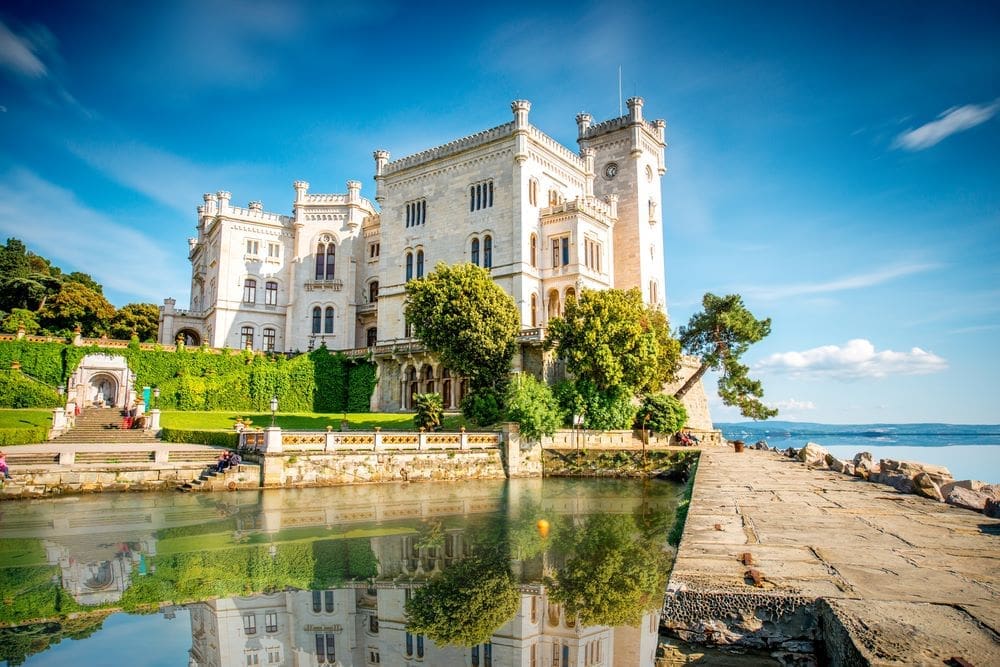
“O Miramar, your white towers wait for the rainy sky,” Carducci wrote in “Le Odi Barbare” to describe the whiteness of the fairy-tale Miramare Castle, which sits on a karst promontory, is surrounded by a lush park, and looks out over the sea.
We are ten kilometers north of Trieste, near the village of Prosecco. This is where the most famous castle in all of Friuli Venezia Giulia is located. It is a stately residence built between 1856 and 1860 by Archduke Ferdinand Maximilian of Habsburg for his wife Charlotte, daughter of the Belgian king Leopold I.
So, Miramare Castle wasn’t built for war, but for love, even if it was a bad love: “Goodbye, castle for happy days, love nest built in vain.” G. Carducci
Maximilian actually went to Mexico, where he became emperor but also died. Carlotta is said to have gone crazy after this, and it is still said that anyone who stays in the manor will die in a violent way.
The Middle Ages fortress has more than 20 rooms and is open to the public. The recently fixed-up “Room of Maximilian” and the beautiful “Sala del Trono” are not to be missed. The park is also a work of art. It has 22 hectares of rare plants, valuable sculptures, interesting corners, and paths that lead through the greenery down to the sea.
Miramare Castle and its park host a lot of exhibitions and interesting cultural events, especially in the summer. The manor house is a popular place for tourists to visit, but Triestins who want some peace and quiet like to go to the garden.
Where: Viale Miramare, 34014, Grignano hamlet, in the city of Trieste.
Opening time. Every day from 9 a.m. to 5 p.m. and 9 p.m. to midnight (closed on December 25 and January 1). Price of a ticket to get into the castle. Full price is €8, discounted price is €5, and children under 18 get in for free. The park is free to get into. Visit the official website to find out more. Not to miss in the area.
A visit to the Science Center Immaginario Scientifico, which has interactive tours and multimedia experiences for learning, a canoe trip at sunset to find clear water to swim in, and a trip to the Grotta Gigante di Sgonico, which is just a few kilometers away, are all real trips to the “center of the Earth.”
The Duino Castle

If you keep going north for another 15 km, you’ll reach the Castle of Duino, which is one of the most interesting and historic buildings in the whole Trieste Karst. Sitting on a cliff with a view of the sea, it is now a popular place for tourists to visit and a place where many people attend exhibitions, concerts, and other cultural events.
The Castle of Duino has a long history. It was the private home for four hundred years of the princes Torre and Tasso, whose presence gives the manor a warm and welcoming atmosphere that is far from the colder one of the more traditional museums.
The first building was built during the Roman era, and you can see the remains of it on the promontory next to the current one. Instead, the “Castello Nuovo” was built in 1400. It was the site of many wars until the Austrian emperor Maximilian I of Habsburg took it over in 1508.
Later, it was married to the German princes “Thurn und Taxis,” who were art lovers and patrons of the arts. The princely residence has been home to many artists, including Franz Liszt, Paul Valérie, Gabriele D’Annunzio, and the great Bohemian poet Rainer Maria Rilke, who wrote part of his “Duinesi Elegies” here. The “Rilke Path,” which goes from Sistiana to Duino, is one of the most beautiful and fascinating walks overlooking the Gulf of Trieste.
After the First World War, the building went through a lot of changes, but the owners were able to restore the architectural volumes in a way that kept the original layout.
Even the Castle of Duino is surrounded by a beautiful park with statues and ancient artifacts. Romantic paths wind through the park and lead to a cliff with a view of the sea.
From its location, the fortified fortress looks out over the Gulf of Trieste and offers guided tours of its 18 rooms. The Helical Staircase by Palladio, an architectural masterpiece, is not to be missed, and neither is a visit to the Bunker, which was dug out during World War II for defensive purposes and is now home to an underground museum with interesting artifacts from that time.
Where: Via Castello Di Duino, 32, 34011, Duino-Aurisina (Ts).
Opening time. From 9:30 a.m. to different times depending on the time of year. Visit the official website for more information. The full price for a ticket to get in was €8, and the reduced price was €6.
Not to miss in the area. A visit to the Grotta delle Torri di Silvia, which is considered one of the wonders of the Trieste Karst, and a trip to the Bay of Sistiana, which lights up at night and has music to make the little ones happy.

