
Discover the Charm of the Black Forest: Exploring the Enchanting Street of Clocks and Cuckoo Clocks

When there’s a long weekend or a holiday, people often want to get away, but they don’t want to go somewhere that’s overrun with tourists. Because of this, we’d like to suggest a place that’s close but not too close, immersed in a beautiful natural setting, where tradition and culture come together to make an ideal trip even for families with young children.
Then we go to the German Black Forest to see the Street of Clocks, or Deutsche Uhrenstraße.
To get a better idea of where the route goes, you can think of it as passing through an area near Freiburg (Freiburg im Breisgau), a city in the very south-west of Germany, just a few kilometers from the border with France and 50 kilometers north of Switzerland.
Since the 17th century, the Black Forest has been known throughout Europe as one of the best places to make watches. In particular, the town of Waldau is where the first wooden watches were made.
Today, the real craft work is surrounded by tourist infrastructure like museums, shops, and inns. These are built in villages with houses that have stone roofs that slope down, and they are surrounded by green mountains with secular trees and large meadows.
The route, which is a “ring” of about 110 km, can be done in one or two days, depending on how comfortable you are. You can do it by car, motorbike, or, even better, by bike, starting from any of the Black Forest villages with a long history of making the famous cuckoo clocks. Because of how things work, the route we suggest starts in the village of Titisee-Neustadt, which is 35 kilometers southeast of Freiburg.
There is a lake here that is very popular on the weekends, but if you are interested in watches, you can’t miss a trip to the Hones laboratory, which makes watches by hand. From Titisee, you can go 8 km to the next village, Eisenbach, where you can make a quick stop at the Heimatstube Wolfwinkelhalle to see an exhibition of old clocks and dials.
Villingen-Schwenningen

The next stop is one of the most famous: the village of Villingen-Schwenningen, 25 km north-east of Eisenbach. There are two museums there: the Uhren- und Heimatmuseum, which has watches of all kinds (wall, pocket, pendulum, etc.) made from the 17th to the 19th century, and the Uhrenindustriemuseum, which tells the history of the town through the making and selling of watches. In both cases, you need a ticket to get in. After the visit, you can take the B33 road from Villingen-Schwenningen to Konigsfeld, which is 12 km away. This is the best place to look for an old clock. In fact, at Uhren Fabrik Peter Auber, new pieces are made based on ancient models, and the factory shop sells original pieces from the last two centuries.
After traveling another 12 km, you’ll reach Schramberg, where the municipal museum (Stadtmuseum) has displays about the craft of watchmaking as well as examples of Art Nouveau clocks made by Arthur Junghans at the end of the 19th century. There is no charge. There is also a tourist information office in the town that can help you plan a walking tour of the most important historic buildings.
Triberg

Twenty-four kilometers west of Schramberg, on the Cuckoo Clock Road, you can’t miss the town of Triberg. Its main street is a great place to shop for watches because you can find so many different kinds there. If you’re looking for something more traditional, you shouldn’t miss the Schwarzwald Museum, where you can see traditional Black Forest clothes and other items.
Near the town, in the middle of the forest, on a path with great views that you can walk, there are beautiful waterfalls that people love to see.
The Haus der 1000 Uhren, also called the House of 1000 Watches, is in the town of Gremmelsbach, which is only 5 km from Triberg. It has a large collection of wooden watches. A few kilometers away in Schonach, the main production center, is what is thought to be the world’s biggest cuckoo clock. It was made by master watchmaker Josef Dold between 1981 and 1983 and is as big as a house.
Furtwangen Museum
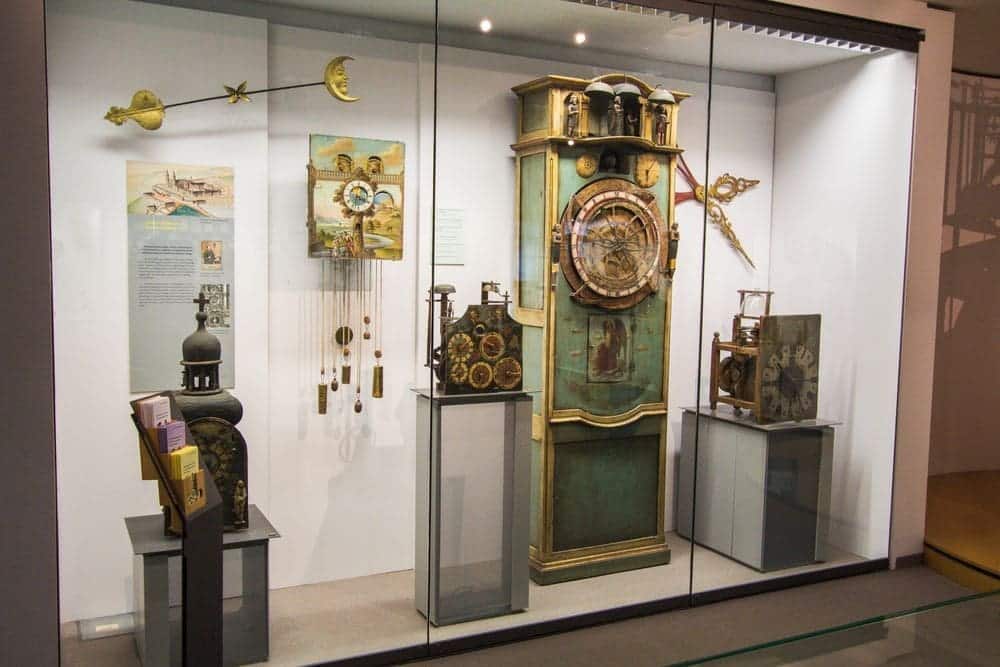
From here, you can go 23 km south to the village of Furtwangen, which is in a high-altitude valley between two mountains.
It is unusual because it is home to the Deutsches Uhrenmuseum, which has the world’s largest collection of Black Forest Cuckoo Clocks as well as clocks from all over the world and all different times.
The last part of the route through the Black Forest is in the village of Gütenbach, which is 7 km away. Gütenbach is one of the historic sites of watchmaking, and it is also home to the Dorf- und Uhrenmuseum, where you can learn about how craftsmen lived before the Industrial Revolution.
At this point in the journey, you can choose to “close the loop” by going back to Titisee and visiting a few more towns along the way, or you could move to Freiburg and focus on getting to know the city.

