
Taste the Best of Sicily: Wine and Food Tour from Marsala to Syracuse

There are a thousand different ways to enjoy Sicily. Around every corner, there are things to see, stories to hear, and moments to live. You can visit its beautiful cities, dive into the water at its most beautiful beaches, walk through its archaeological sites, or sail through the Egadi islands, just to name a few options.
Still, the pleasures of the table are just as important as those of the eyes and soul. In this way, Sicily is a riot of tastes and smells that are worth a trip on their own.
Our plan is to make a route that goes all over the island and stops at some of the most famous wineries on the way to the best wines.
So, we suggest a trip that starts in Marsala and ends in Syracuse, but there’s nothing stopping you from going the other way. What’s important is that you get the gist of the tour and experience what Sicily has to offer, both in your mind and in your stomach.
Marsala
The adventure starts in the province of Trapani, or to be more specific, in Marsala, which is in the most western part of the island.
We have already written about Marsala in our article about the tour of Western Sicily. After the Thousand landed in 1860, Garibaldi crossed the old city to get to the center of Marsala. Even now, if you walk from the seafront to the historic center, you can follow the old path by going under Porta Garibaldi.
The Chiesa Madre (Mother Church), which has a Mannerist-Baroque front, is in the main square. Do not miss a trip to the atrium of the former Carmine convent.
It is a small portico with a lot of charm that is part of a building that is a real architectural gem. Also, the Fontana del Vino is a tribute to the city of wine by Salvatore Fiume. It is in Piazza Pizzo.
At the Laguna dello Stagnone, just outside of Marsala, you can start a trip to the island of S. Pantaleo, where the Phoenician city of Mozia used to be. In this natural park, you can often see herons or pink flamingos among the ruins and beautiful remains of sanctuaries and mosaics.
At sunset, when the sun goes down behind the sea, these places turn red and become even more interesting. The pink reflections of the salt pans that spread out along the lagoon make them look even more beautiful.
Donnafugata winery
Tomasi di Lampedusa called these parts of Sicily “Donnafugata” because that’s where Queen Maria Carolina ran for safety when Napoleon’s troops were getting closer to Naples.
In this part of the island, in the province of Palermo, you can find the vineyards of the Contessa Entellina estate, where both local and foreign grapes are grown.
These grapes and zibibbo from the Pantelleria vineyards go to the Donnafugata winery in Marsala to be aged and put in bottles.
Here, in the cozy barrel room set aside for tastings, you can enjoy all of the most popular “food-wine” pairings in a Mediterranean-style setting.
When you look at the cellar, which was built by the ancestor of the Rallo family in 1851, you can see the typical “baglio” with a large, citrus-tree-filled inner courtyard.
Inside, the simple tools used in the old cellars and the underground barrel cellar are kept in rooms made of tuffaceous rock, which keeps temperatures down.
Monreale: the second stop
The province of Palermo is the next stop on our tour of Sicily’s wines. In fact, let’s go to Santa Cristina Gela, which is close to Monreale, a city best known for how beautiful its cathedral is.
This beautiful Norman church, which has a lot of hidden treasures inside, is a must-see. When you look at the towers from the outside, you’ll be amazed by how big they are. But when you go inside, you’ll be speechless when you see all the mosaics that decorate them.
Don’t be afraid of the steep stairs. We suggest going to the terraces from the end of the nave so you can see the large cloister with its Romanesque capitals and two fountains from above.
Mosaic art is more popular than ever in Monreale, where there are many craft shops where great works are made by real masters. Walk along the panoramic road, which is lined with fountains, to get to the highest point in the city and get a good view of the area. During the trip, you should try some of Monreale’s delicious traditional cookies.
Baglio di Pianetto
Count Paolo Marzotto started this brand in 1987 because he loved his land, its fruits, and its flavors. Count Marzotto wants to take advantage of the island’s bounty to make a new Sicilian wine that combines family tradition with new technology.
The vines are in Baroni (area DOC Eloro) and Pianetto (area DOC Monreale), both of which have mild and cool climates. From here, the grapes are put into crates and taken to the Pianetto winery, which has four floors. Each floor is used for a different step in the winemaking process.
The crates are unloaded on the fourth floor, which is also where the grapes are cooled and then pressed. On the third floor, gravity moves the must into the containers where it ferments for the right amount of time. It then continues its journey in “free fall” to the underground barrel cellar where it ages in Allier oak barrels.
In the last step, bottling, the barriques are moved to the second floor by a freight elevator for the last step of the process. After all of this good “up and down,” it’s time for a well-deserved taste. All that’s left is to decide between the floral notes of a white Ficiligno and the cherry notes of a red Nero d’Avola.
Licata and the Valley of the Temples in Agrigento
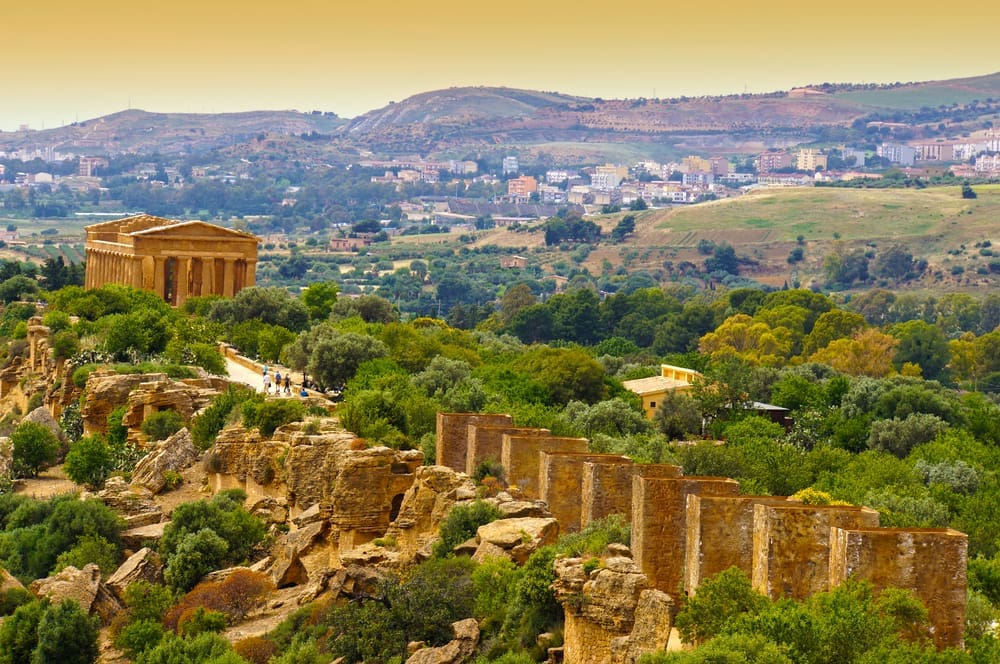
The Valley of the Temples of Agrigento, a UNESCO World Heritage Site, is one of the best examples of Greek art and culture, which were at their best in Akragos Agrigentum.
A trip to the archaeological site in the countryside, which is full of flowers and almond trees that smell good, is a one-of-a-kind experience. Even better is to do it first thing in the morning, when you can also figure out why the temples are where they are.
Each temple, from the oldest, which was built for Heracles, to the most complete one for Concordia, faces east, so that at sunrise, the statues inside the temples of the gods were completely lit up. A natural show that will take people back to the time of Magna Graecia, if only for a moment.
Tenuta Barone
The Tenuta Barone is in the Piana di Licata, which is a great place to grow grapes. It was built by the La Lumia family in the 18th century and has an Arab-style farmhouse.
The beautiful view of the turquoise sea that dominates the horizon frames the hectares of the estate, which are only grown with native vines that are among the best in Sicily: Nero d’Avola, Inzolia, Nerello Mascalese, and Frappato.
The current owner, Baron Nicolò, makes high-quality wines from these grapes: the Traditionals, the Family Range, and the Grecisti. These wines can be tasted in a cozy room, under stone arches, or under a palm tree in the lush garden of the farmhouse, which is surrounded by vineyards.
The Wine Route of Etna
We move to the foot of ‘a Muntagna, which is in the province of Catania. Etna is not only the highest volcano in Europe, but it is also the center of a unique area where some of the most beautiful villages in Sicily are located and where the food and wine traditions are known all over the world for being the best.
On a route that goes through Santa Venerina, Zafferana Etnea, Milo, Sant’Alfio, Piedimonte Etneo, Linguaglossa, Castiglione di Sicilia, Randazzo, Adrano, and Biancavilla, you can try the specialties of this land and get a sense of the flavor that the volcano gives to its fruits.
First courses, main courses, side dishes, oil, desserts, and wine are all available in these areas. You can try them all at the wine bars, farmhouses, and farms you pass along the way.
Syracuse: the end of the trip

Syracuse is a reminder of the many people and cultures that have lived here and left important architectural and cultural marks. Every street, every building, and every square in this city is full of history. The Corinthian people built the great “Pentapolis” on the shores of Ortigia, which is a small island in the middle of Syracuse. This place is full of amazing things, like the ancient Doric Temple of Apollo and the fountains of Diana and Arethusa.
By walking through the streets of the historic center, you can get to the heart of the island of Ortigia, where the Baroque Cathedral, which was once a Doric temple to Athena, stands majestically.
You can see the Porto Grande, the island of Ortigia, the salt pans, and the Plemmirio Marine Protected Area when you visit the Archaeological Park of Neapolis and look at the remains of the Greek theater that was built for Zeus. To remember the glory of Magna Graecia, you can watch the classic plays of Sophocles or Euripides, which are put on every year in Sicily’s largest Greek theater.
Laganelli winery
Baron Gandolfo started the company in 1948 on the outskirts of Syracuse (Strada San Domenico 5), close to a nature reserve. It covers a large area with typical Mediterranean scrub. The company grows a wide range of citrus fruits as well as traditional grapes like Moscato, Catarratto, and Grillo. His son Vincenzo planted the Moscateddu grape clone so that the famous Moscato di Siracusa DOC could be made again.
Our tour in a nutshell
Itinerary: Marsala, Stagnone Reserve, Island of San Pantaleo, Monreale, Santa Cristina Gela, Licata, Valley of the Temples of Agrigento, Santa Venerina, Zafferana Etnea, Milo, Sant’Alfio, Piedimonte Etneo, Linguaglossa, Castiglione di Sicilia, Randazzo, Adrano, Biancavilla, Syracuse.
Length of route: about 650 km.
Duration: 7–10 days

