
Discover Spain: Unveil Hidden Gems Between Sea, Cities, and Mountains

For decades, Spain has been one of the most popular summer vacation destinations. Indeed, with the fall of Franco’s dictatorship in 1975, the way was cleared for international tourism to infiltrate the entire Iberian peninsula. At certain times of the year, visitors are interested not only in the Mediterranean beaches, but also in learning about the country’s culture, monuments, and traditions.
History
Spanish history is so rich and varied that it has left imprints in almost every corner of the country. Peoples from all over Europe and the Mediterranean basin invaded, contaminated, and shaped the land and culture of the people who live there at least 35,000 years ago. Traces of prehistoric life, such as cave paintings, can be seen in the Cueva de la Araa, near Bicorp, and throughout the Valencian Community (Comunitat Valenciana), while in Andalusia (Andaluca), for example, you can breathe the Arab influence of centuries of Moor dominion in the south of the peninsula; further north, in Galicia, the Celtic tradition and symbolism are instead very present, while close to the Pyrenees, on the border with France, its own language and strong pre-Indo-European roots are the distinctive feature of the Basque people.
What to see and do in Spain
Spain is a country that should be explored over the course of a lifetime, rather than in a single trip. And it is always difficult to advise a friend on which area to visit for these reasons. We have chosen to provide some general ideas to stimulate our readers’ imaginations and encourage them to travel to any destination in Spain.
Barcelona, the Costa Brava, and Valencia
The evergreen Barcelona is an urban and architectural masterpiece, endowed with a thousand faces, frequented by millions of young people, loved for its work by Gaudi (from the Sagrada Familia to Parc Güell, you are spoiled for choice), for the tree-lined avenues that cross it far and wide, and for the beaches that border its southern side.
However, Barcelona, the capital of Catalonia (Catalunya), is an excellent starting point for exploring the Costa Brava beaches and the many resorts that overlook them, which are literally invaded by tourists from half of Europe every summer. A couple of days in Girona and its surroundings will be dedicated to something more peaceful, always in Catalonia: the countryside dotted with stone farmhouses (here called can), the nearby beaches of Baix Empordà, or the coves of Cap Roig.
Further south, along the Mediterranean coast, Valencia has emerged as a tourist destination in recent years as a result of a series of investments, most notably the creation of the City of Arts and Sciences, the work of architect Santiago Calatrava, who has transformed the face of the city where paella was invented. If its beaches draw tourists in the summer, thousands of people arrive in March to attend the traditional festival of Las Fallas de San José, an unmissable event on the local calendar.
Murcia, Andalusia, the Costa del Sol, and the Costa de la Luz
Continuing one’s exploration of Spain in a southerly direction, a series of beautiful cities forces one to leave the coast and venture into the hills of the interior: Murcia, Jaén, Cordoba, and Granada are all visited by an increasing number of tourists each year.
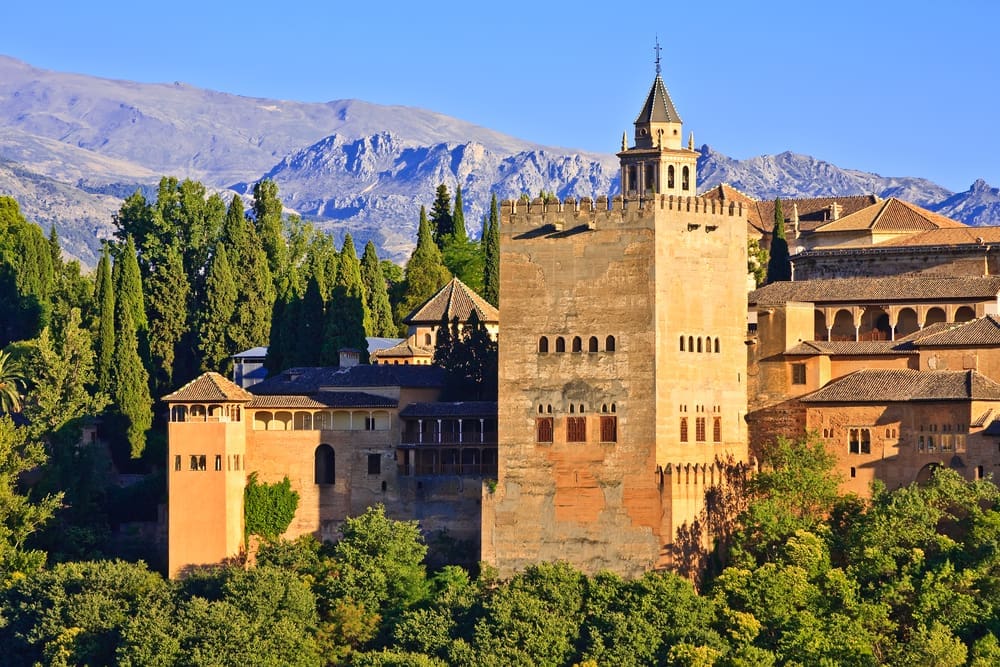
We are now in Andalusia, a region that has been influenced by the Arabs more than any other, as can be seen by walking through its streets. Seville, the country’s capital, is one of the most beautiful cities in the country, and UNESCO couldn’t help but recognize some of its jewels as World Heritage Sites, including the incredible Alcázar, the Cathedral of Santa Maria, and the Archive of the Indies. The summer heat is unbearable; the mercury column frequently rises above 40°C, but its historic center is an authentic masterpiece.
To escape the heat, simply head to the Andalusian coast, where millions of tourists flock each year. The four main coastal cities are Almeria, Malaga, Marbella, and Cadiz; the Mediterranean stretch is known as the Costa del Sol, while the Atlantic stretch is known as the Costa de la Luz.
Galicia and Central-West Spain
The border with Portugal is very close at this point, and to the north, the towns of Cáceres, in the rugged region of Extremadura, and, above all, Salamanca (Castilla y León), whose historic center is a UNESCO World Heritage Site.
The next step is to travel to Galicia, one of the country’s most isolated regions, located in the extreme north-west on the Atlantic Ocean’s shores, where rain and wind blow all year.
They speak their own language, Galician, which is very similar to Portuguese, and an ancient Celtic cultural substratum is discernible.
Santiago de Compostela is its most well-known location; aside from having a vast architectural and historical heritage, it is, of course, the final stage of the Camino de Santiago, whichever of the many routes you choose.
Northern Spain: Asturias, Cantabria, and the Basque Country
The region of Asturias (Asturias) in Spain’s far north is one of the most fascinating, but also one of the least known. Its main cities are Oviedo and Gijón, but despite its proximity to the sea, it is primarily a mountainous region, with the Picos de Europa National Park, a series of three limestone massifs rising more than 2400 meters above sea level, being the most spectacular. and shares a border with the neighboring province of Cantabria.
Cantabria shares an eastern border with the Basque Country (Pas Vasco in Spanish, Euskadi in Basque), the region with the most distinct cultural identity in Spain. The local language is Basque (or Euskera), a pre-Indo-European language that is nearly incomprehensible to those who do not speak it.
We are close to the border with France (where the Euskadi region also continues), and its main cities are known for the sea and the party (in this case, San Sebastián) or for their cultural heritage (in this case, Bilbao is directly involved, especially because it houses the Guggenheim Museum).
The Basque cultural region also includes neighboring Navarre, which includes Pamplona, which is famous around the world for the mad running of the bulls through its streets.
Further south, Zaragoza is the capital of Aragon; it is not only the fifth most populous city in Spain, but it is also rich in history, as evidenced by its monuments and buildings. The Romans, Muslims, and Christians all passed through here, leaving indelible traces of their passage.
Central Spain: not just Madrid
We purposefully saved central Spain, including the capital, for last. Madrid is a wealthy city that serves as the seat of political and economic power.
The Parliament, the Royal Palace, and all of the country’s main institutions are located here, as well as some extraordinary museums such as the famous Prado Museum, the Thyssen-Bornemisza Museum, the Centro de Arte Reina Sofia (which houses Picasso’s Guernica painting), and more popular areas such as La Latina with its massive weekly market of El Rastro, the barrio of Chueca, and the Parque del Buen Retiro.
Some historic cities around Madrid, such as Toledo and Segovia, draw tourists for day trips.
National Parks
However, Spain is not only made up of cities; as lovely as they are, there are many natural wonders that deserve more than a passing glance.
To name a few, this is true of the Sierra Nevada National Park, the Doana National Park, or the Los Alcornocales Natural Park (Andalusia), the Terre del Ebro Biosphere Reserve (Catalonia), and the Chufn Cave in Rionansa (Cantabria).
The Spanish islands: the Balearics and Canary Islands

In the collective imagination, Spain is also, if not foremost, the sea. In addition to the places already mentioned, we must include internationally renowned destinations such as the Balearic Islands, where Ibiza has long reigned supreme in terms of nightlife and summer.
However, it is not the only one: the smaller Formentera, as well as the more distant Mallorca and Menorca, are equally popular with holidaymakers, particularly young people, who flock to them during the summer months.
A trip to the Canary Islands, in the Atlantic Ocean, directly in front of Africa’s western coasts, is more expensive and time consuming. Tenerife, Gran Canaria, La Gomera, and Fuerteventura are now familiar names when one thinks of an exotic European destination, but the sea is not the only attraction of the archipelago; in fact, many choose to venture into the Teide National Park to reach the top of the volcano (3718 meters above sea level).
As you will have realized, Spain is so large that a single trip will not suffice to explore it all. Our advice is to savor it slowly, taking the time to stop and interact with the locals, who are usually very willing to lend a hand and involve visitors, if possible by returning again and again. After all, it’s not that far away and can be reached in just over an hour by plane.
Climate
The Spanish climate varies from the Mediterranean to the Pyrenees, from the Atlantic coast to the desert plateaus, making it impossible to define a fundamental weather characteristic. As a result, for more information, please see our article on the climate of Spain.
How to get to Spain
Every day, hundreds of flights depart from all over Europe to reach the major Spanish cities: Barcelona, Madrid, Valencia, and Seville are the best served, but the islands, particularly in the summer, also have excellent traffic coverage. Low-cost flights to Spain are now available from nearly all Italian airports.
Many young people prefer to travel to Spain by train, using InterRail, which can be a good option for those who have the time to travel up and down the country.
However, many people prefer to travel by car or camper to have more freedom of movement, even in more remote areas, or simply to avoid relying on public transportation. Spain is easily accessible by crossing France (550 km from Ventimiglia to the first Spanish city on the border, La Jonquera) with no special bureaucratic or customs complications.

