
The Mosaic of Time: Rome’s Arch of Constantine
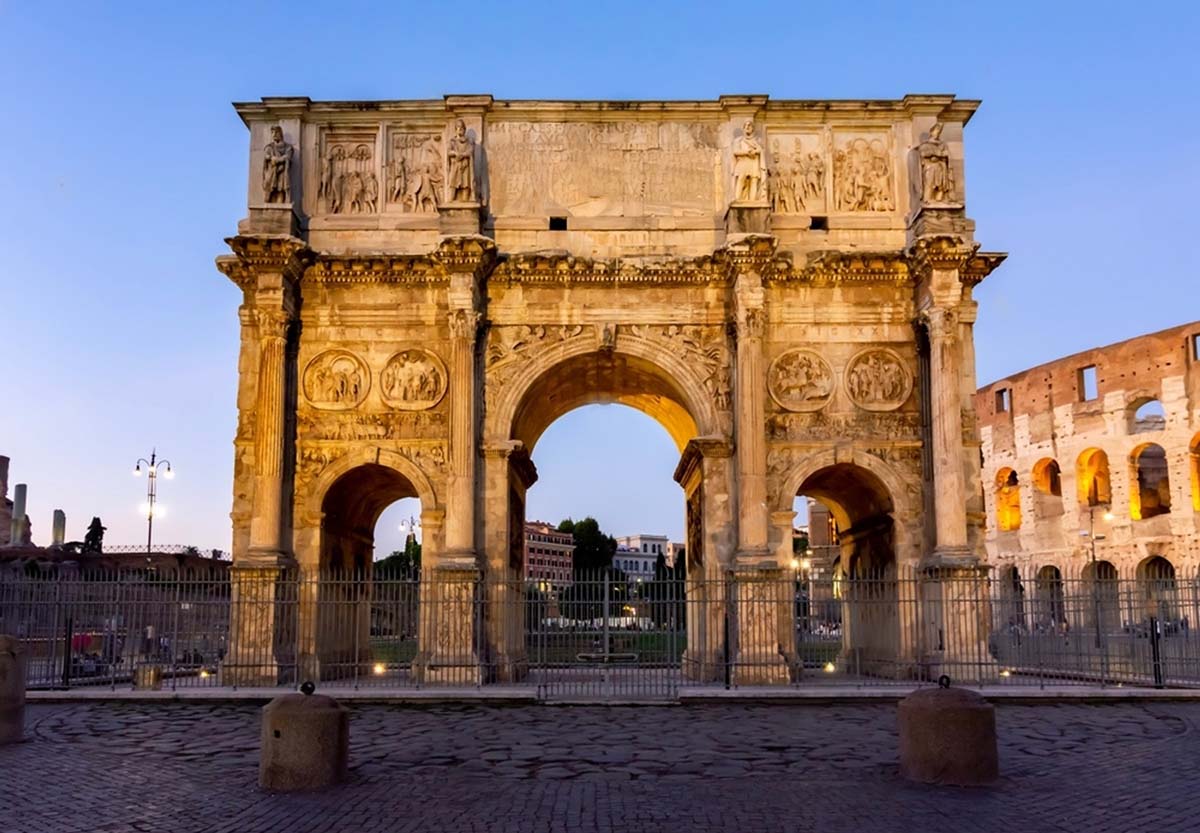
The Arch of Constantine stands immediately beside the Colosseum, but it belongs to a very different moment in Roman history.
Dedicated on 25 July 315 CE, the monument commemorated Emperor Constantine’s victory over his rival Maxentius at the Battle of the Milvian Bridge on 28 October 312. That victory gave Constantine control of Rome and became one of the decisive political events of the late Roman Empire.
The arch is particularly important because much of its sculpture was not carved for Constantine at all.
Reliefs, statues and architectural elements from monuments of Trajan, Hadrian and Marcus Aurelius were removed and incorporated into the new arch. Constantinian sculptors added new reliefs narrating the campaign against Maxentius and altered the faces of earlier emperors so that several now represented Constantine.
The result is one of antiquity’s most sophisticated exercises in political appropriation. Constantine did not merely place himself beside Rome’s respected earlier emperors: he physically absorbed their monuments into his own.
At approximately 25 metres high, the Arch of Constantine is also the largest surviving Roman honorary arch. Unlike the nearby Colosseum and Roman Forum, it can be seen free of charge from the surrounding pedestrian area at any time, making it one of Rome’s easiest major ancient monuments to examine closely. The Parco archeologico del Colosseo continues to list the monument as free access in 2026.
Where Is the Arch of Constantine?
The arch stands in Piazza del Colosseo, between the Colosseum and the Palatine Hill.
Location: Piazza del Colosseo, Rome
Metro: Colosseo – Line B and Line C Colosseo–Fori Imperiali
Bus: 51, 75, 81, 85, 87, 118
Tram: 3
The official archaeological park confirms these current transport connections.
The location is historically essential.
The arch stood along the route used by Roman triumphal processions, between the Circus Maximus and the Arch of Titus. Victorious generals and emperors moving ceremonially through Rome would pass through a landscape already saturated with imperial monuments.
Constantine therefore placed his new memorial exactly where Roman power was already being performed publicly.
The Battle of the Milvian Bridge
The monument commemorates Constantine’s defeat of Maxentius.
By the early 4th century, the Roman Empire was divided among several rulers under the political system created by Diocletian and usually known as the Tetrarchy.
Constantine and Maxentius became rivals for control of the western empire.
In 312 Constantine invaded Italy.
After victories in northern Italy, his army advanced towards Rome and met Maxentius near the Milvian Bridge, north of the city.
The battle took place on 28 October 312.
Maxentius was defeated and died while attempting to cross the Tiber.
Constantine entered Rome as victor shortly afterwards.
The official archaeological park identifies this victory explicitly as the event celebrated by the arch.
Constantine and the Christian Vision
The Battle of the Milvian Bridge later became inseparable from the history of Christianity.
Christian writers, particularly Lactantius and Eusebius, described Constantine receiving a divine sign before the battle.
Later tradition developed the famous story that Constantine saw a cross or Christogram accompanied by a message commonly rendered as “In this sign, conquer.”
The historical accounts differ in significant details and were written within Christian interpretative frameworks.
What is certain is that Constantine increasingly supported Christianity after 312.
In 313, Constantine and Licinius issued what is usually called the Edict of Milan, establishing religious toleration and restoring confiscated Christian property.
Constantine would later become the principal imperial patron of major Christian churches, including the first basilica of Saint Peter in Rome.
Yet the Arch of Constantine itself is strikingly restrained in explicit Christian symbolism.
Its imagery remains overwhelmingly rooted in traditional Roman imperial language: victory, sacrifice, military authority, the Senate, the army and the relationship between emperor and people.
The monument therefore stands at a fascinating transitional moment rather than functioning as a straightforward Christian triumphal arch.
The Dedication of 315
The arch was formally dedicated on 25 July 315, during celebrations marking Constantine’s decennalia, the beginning of the tenth year of his reign.
The Senate dedicated the monument to the emperor.
The large inscription occupies both principal faces of the attic.
The official archaeological park confirms both the dedication date and the connection with Constantine’s tenth regnal year.
The monument therefore had a double function.
It celebrated the victory over Maxentius, but it also presented Constantine’s regime as legitimate, stable and deeply embedded within Roman imperial tradition.
The Famous Inscription
The inscription is one of the arch’s most discussed elements.
Its crucial phrase states that Constantine defeated the tyrant and his faction:
instinctu divinitatis
The expression can be translated approximately as “by divine inspiration” or “through the prompting of the divinity.”
Its ambiguity is significant.
The inscription does not explicitly name Christ.
A Christian viewer could interpret the phrase in reference to Constantine’s Christian God.
A follower of traditional Roman religion could understand it more broadly.
That ambiguity suited an emperor ruling a religiously diverse empire in 315.
The arch therefore provides valuable evidence for the gradual nature of Constantine’s religious transformation.
Why the Arch Has Three Openings
The structure has a large central passage flanked by two smaller arches.
This three-bay design belongs to the monumental Roman triumphal tradition and allowed the arch to dominate a broad ceremonial road.
The proportions create a clear hierarchy.
The tall central opening establishes the principal ceremonial axis.
The smaller lateral arches provide visual balance and additional passageways.
Four detached columns on each principal façade divide the surface vertically and support the projecting entablature.
Above them, the attic forms an enormous rectangular upper zone containing the inscription and reused reliefs.
How Large Is the Arch?
The monument is approximately:
25.7 metres high
25.6 metres wide
and around 7.4 metres deep.
Its scale is easier to appreciate when viewed from the Colosseum side rather than standing directly beneath it.
Despite being dwarfed visually by the amphitheatre next door, this is an enormous freestanding structure.
It remains the largest surviving Roman honorary arch, as the archaeological park emphasises in its current interpretation.
Spolia: Why Constantine Reused Older Monuments
The most important idea for understanding the Arch of Constantine is spolia.
The term refers to architectural or sculptural material removed from earlier buildings and reused in later structures.
The arch contains extensive sculpture from the reigns of:
Trajan
Hadrian
and Marcus Aurelius.
New Constantinian reliefs were inserted around them.
For decades, some historians interpreted this reuse as evidence that 4th-century Roman artists had lost the technical ability to produce sculpture comparable with earlier imperial work.
That explanation is now considered far too simplistic.
The selection was clearly ideological.
Trajan, Hadrian and Marcus Aurelius belonged to the group of emperors remembered as successful rulers.
By reusing their monumental imagery, Constantine presented himself as their successor.
The archaeological park explicitly interprets the older reliefs as a means of legitimising Constantine through association with the great emperors of Rome’s past.
Constantine as a New Trajan, Hadrian and Marcus Aurelius
The reused reliefs were not neutral antiques.
Their imperial faces were sometimes recarved to resemble Constantine.
The official archaeological park notes that the faces of emperors represented in several earlier reliefs were reshaped in Constantine’s likeness and provided with the nimbus that indicated imperial majesty.
This changed the meaning of the scenes.
A relief originally depicting Hadrian could now appear to represent Constantine acting like Hadrian.
Constantine therefore inherited both the physical sculpture and the virtues attached to the emperor who originally occupied it.
The arch became an extraordinary form of visual historical rewriting.
The Trajanic Sculpture
Some of the oldest material reused on the arch dates from the reign of Trajan, emperor from 98 to 117.
Large relief panels originally belonged to a monument connected with Trajan’s military victories.
Parts of this material were divided and incorporated into the central passage and attic areas.
The imagery presents warfare and imperial victory.
Above the projecting columns also stand eight statues of Dacian prisoners.
These figures were made from coloured pavonazzetto marble and probably originated in a Trajanic architectural complex associated with the emperor’s Dacian victories.
Their presence connected Constantine with one of Rome’s most successful military emperors.
The recent conservation campaign revealed an inscription on their bases reading AD ARCU, indicating that the statues had already been designated for installation on the arch.
The Dacian Prisoners
The eight Dacians are among the most striking figures on the monument.
They stand above the columns at attic level.
Unlike idealised Roman figures, the prisoners wear trousers, tunics and distinctive cloaks associated with Dacian costume.
Their carved garments once benefited from the visual contrast of coloured stone.
The arch originally possessed substantially more colour than its present pale appearance suggests.
The archaeological park records columns of giallo antico, Dacians in pavonazzetto marble, red porphyry behind the Hadrianic roundels and probably additional coloured marble bands.
Ancient Rome was not a monochrome city of white marble.
The Hadrianic Roundels
Eight large circular reliefs, usually called Hadrianic tondi, decorate the principal façades above the lateral arches.
They date from the reign of Hadrian, 117–138.
Their subjects alternate between hunting scenes and sacrifices.
Hunting had strong aristocratic and imperial associations.
It demonstrated courage, physical control and mastery over the natural world.
Sacrifice displayed the emperor’s proper relationship with the gods.
Together, the scenes created an ideal image of imperial behaviour.
When they were reused on Constantine’s arch, several imperial portraits were recut.
The original Hadrianic ruler could therefore be visually transformed into Constantine.
The roundels are among the easiest pieces of spolia to identify because their circular format differs clearly from the rectangular Constantinian friezes below.
The Marcus Aurelius Panels
Eight rectangular reliefs in the attic come from the period of Marcus Aurelius, emperor from 161 to 180.
They probably belonged to an earlier honorary monument.
Their scenes include imperial ceremonies associated with warfare and government.
The emperor addresses troops, receives defeated peoples and participates in acts of imperial clemency and authority.
The subjects were ideal for Constantine.
Marcus Aurelius had become an admired model of legitimate imperial rule.
By integrating his images into the new monument, Constantine claimed continuity with that tradition.
Again, imperial portraits were modified where necessary.
The viewer therefore encountered Constantine acting through the prestigious visual language of an emperor who had lived more than a century earlier.
The Constantinian Frieze
The reliefs actually carved for the arch in Constantine’s own period are concentrated mainly in the long frieze running around the lower portion of the monument.
They tell the story of the campaign against Maxentius.
The sequence includes episodes such as:
Constantine’s departure from Milan
the siege of Verona
the Battle of the Milvian Bridge
Constantine’s entry into Rome
his address to the citizens
and the distribution of money.
This creates something close to a continuous political narrative.
The military victory leads logically towards the emperor’s public acceptance and generosity.
The message is clear: Constantine did not merely defeat a rival. He restored legitimate political order.
The Battle Scene
The representation of the Battle of the Milvian Bridge is particularly significant.
Figures are compressed into the available space and arranged less naturalistically than in the earlier Trajanic or Hadrianic reliefs.
For older art historians, this stylistic difference was often treated as evidence of decline.
Modern interpretation tends to approach it differently.
Constantinian sculpture increasingly prioritised hierarchy and political clarity over classical naturalism.
The emperor’s importance needed to be visually immediate.
Bodies could become more frontal, proportions more symbolic and scenes more compressed.
This represents a changing artistic language rather than simply technical failure.
The Oratio Scene
One of the most important Constantinian panels depicts the emperor addressing the Roman people.
Constantine stands on the Rostra in the Roman Forum.
The setting includes monuments that help reconstruct the appearance of the Forum in the early 4th century.
The emperor occupies the central position and appears significantly more important than surrounding figures.
The composition demonstrates the increasing use of hierarchical scale.
Political meaning becomes more important than naturalistic spatial organisation.
For historians of late antique art, this panel is therefore particularly valuable.
The Liberalitas Scene
Another relief represents liberalitas, the emperor’s distribution of gifts or money to the population.
Imperial generosity was an essential political virtue.
A Roman emperor was expected to reward soldiers, citizens and supporters.
Constantine again occupies the compositional centre.
The scene reinforces the broader message of the arch: the emperor had not conquered Rome as a foreign enemy but restored prosperity and legitimate government after the supposed tyranny of Maxentius.
Why Maxentius Is Called a Tyrant
The arch does not celebrate victory over a foreign people.
Constantine had defeated another Roman emperor.
That created a political problem.
Traditional triumphs celebrated victories against external enemies.
Civil war was harder to present honourably.
The solution was propaganda.
Maxentius was represented not as a legitimate Roman ruler defeated by another Roman ruler but as a tyrant from whom Constantine had liberated the city.
The arch therefore transforms civil war into liberation.
This language allowed Constantine to adopt the symbolism of triumph without openly celebrating the killing of fellow Romans.
The Phrase “Liberator of the City”
Constantine is described through ideas including the liberation of Rome and the restoration of public order.
That message appears repeatedly in Constantinian propaganda after 312.
It is important to remember that Maxentius had governed Rome for several years and had substantial political support.
History written by the victor transformed him into an illegitimate tyrant.
The arch is one of the most spectacular surviving examples of that rewriting.
Was It Really a Triumphal Arch?
The monument is routinely called a triumphal arch, but honorary arch is more precise.
Roman arches could commemorate victories, imperial journeys, public works or political anniversaries without necessarily being tied to one formal triumph.
The official Parco archeologico del Colosseo itself describes Constantine’s monument as the largest surviving honorary arch.
Its location on the triumphal route and its victory imagery make the conventional term understandable, but the distinction is useful.
The Arch and the Roman Triumph
The monument stood along one of the most symbolically charged routes in Rome.
Triumphal processions moved through the city towards the Capitoline Hill.
The nearby Arch of Titus already commemorated Flavian victory.
The Colosseum represented another enormous statement of imperial authority.
Constantine inserted his own monument into this historic sequence.
A procession passing through the valley was therefore surrounded by generations of imperial memory.
The arch used both location and recycled sculpture to place Constantine inside that lineage.
What the Arch Originally Looked Like
The present monument is far less colourful than it was in antiquity.
Different marble varieties created deliberate contrasts.
The official conservation documentation identifies:
giallo antico columns
red porphyry associated with the Hadrianic roundels
cipollino marble statue bases
and pavonazzetto used for the Dacian figures.
Additional coloured marble may have run horizontally across the architecture.
Metal attachments, painted details and polished surfaces would have increased the visual effect.
The modern impression of uniform pale stone is therefore historically misleading.
The Arch and the Meta Sudans
Immediately beside the Arch of Constantine once stood the Meta Sudans, a monumental fountain constructed in the Flavian period.
Its name referred to its form and water effect.
“Meta” recalled the turning posts used in Roman circuses, while “sudans” referred to water appearing to sweat or flow from its surface.
The fountain occupied an important intersection in the valley between the Palatine, Colosseum and surrounding districts.
It remained in use until around the 5th century, when drainage systems in the valley began deteriorating.
Its surviving remains were demolished during the Fascist period when the area was radically reorganised for the construction of Via dei Trionfi.
Archaeological traces remain visible near the arch today.
The Arch in the Middle Ages
Unlike many Roman monuments completely dismantled for building stone, the Arch of Constantine survived substantially intact.
Its location beside the Colosseum and major medieval routes helped preserve its visibility.
The monument remained one of the most prominent ancient structures in the city.
Over time, ground levels, surrounding buildings and new roads changed how it was experienced.
Its present isolation in an archaeological landscape is largely modern.
Ancient and medieval Rome would have been considerably denser around it.
Renaissance Interest in the Arch
Renaissance architects and antiquarians studied the Arch of Constantine intensively.
Its mixture of architectural orders, reliefs and ancient sculpture made it an important reference for artists trying to reconstruct Roman architectural vocabulary.
But observers also noticed the dramatic stylistic difference between the earlier reused sculpture and Constantinian work.
This contrast later became central to theories about the supposed decline of Roman art during Late Antiquity.
Modern scholarship has complicated that interpretation by recognising the ideological and stylistic choices made deliberately during Constantine’s period.
The 2021–2024 Conservation Campaign
The arch has undergone repeated conservation interventions, particularly since the late 20th century.
Between February and June 2021, extraordinary maintenance was carried out on portions of the monument.
The work addressed biological growth, rain infiltration, failed joints, surface disintegration and deposits caused by pollution and birds.
Conservators cleaned fragile marble using methods ranging from water and brushes to laser technology.
Delicate Trajanic and Hadrianic reliefs required particularly selective treatment.
Tiny cracks were individually sealed to prevent water and pollutants penetrating the marble.
The conservation programme also allowed specialists to identify previously obscured details, including the AD ARCU inscription on bases associated with the Dacian statues.
The 2024 Lightning Strike
On 3 September 2024, a violent storm struck central Rome and lightning hit the southern side of the Arch of Constantine.
Fragments of stone fell from the monument.
Archaeological staff immediately recovered and secured the pieces.
The timing was fortunate in one respect: scheduled conservation work on the southern side had begun only days earlier, allowing the newly discovered damage to be incorporated into the ongoing intervention.
Reuters reported that the storm produced around 60 millimetres of rain in central Rome in less than an hour and caused widespread damage around the city.
The incident demonstrated how vulnerable even massive Roman monuments remain to environmental conditions.
Conservation in 2026
The monument remains under the responsibility of the Parco archeologico del Colosseo, which continues to publish its conservation documentation and lists the arch as freely accessible from Piazza del Colosseo.
The official conservation material describes the marble as generally well preserved thanks to repeated interventions, while identifying pollution, biological growth, salts, water infiltration and weather exposure as persistent risks.
Because maintenance can require temporary platforms or limited barriers around individual sections, visitors should expect conservation activity to appear periodically without the monument itself becoming a ticketed attraction.
How Long Do You Need at the Arch of Constantine?
Most visitors spend fewer than five minutes here.
That is enough to photograph the monument but not enough to understand it.
Allow 20–30 minutes if you want to identify the major groups of sculpture.
Architecture and Roman-history enthusiasts can easily spend forty-five minutes moving around the different façades.
The key is to look at the arch in layers rather than treating the decoration as one uniform composition.
Start with the overall structure.
Then identify the Dacians.
Find the circular Hadrianic reliefs.
Look at the rectangular Marcus Aurelius panels.
Finally examine the lower Constantinian frieze.
Once the different dates are recognised, the monument becomes dramatically easier to read.
The Best Way to Look at the Arch
Begin from the Colosseum side and step far enough away to see the entire structure.
Notice the three openings and four columns.
Then focus on the upper level.
The standing Dacians divide the attic into separate sculptural zones.
Below them are the Hadrianic roundels.
The long Constantinian frieze runs much lower.
Walk around the monument.
The relief subjects change, and the arch was designed to be read by people moving through the landscape rather than from one fixed viewpoint.
Binoculars or a good zoom lens are surprisingly useful because many of the most important reliefs stand high above eye level.
Best Time to See the Arch
Early morning provides the calmest experience.
Arrive before the major Colosseum visitor flow develops and it is possible to examine the monument with relatively little distraction.
Late afternoon produces stronger modelling across the reliefs as angled light creates shadows inside the carving.
The arch is also illuminated after dark.
Night removes much of the visual competition from the surrounding archaeological area and emphasises the basic architectural structure.
Because exterior access is free, there is no reason not to see it twice if staying nearby.
Tickets and Opening Hours in 2026
There is no ticket required specifically for the Arch of Constantine.
The Parco archeologico del Colosseo currently lists it as:
Free access
The monument can be viewed from the surrounding public archaeological landscape without entering the Colosseum or Roman Forum.
If combining it with the archaeological park, the 2026 schedule from 29 March to 30 September has the Colosseum opening at 08:30 and the Forum-Palatine area at 09:00, with the PArCo closing at 19:15.
These hours apply to the ticketed archaeological areas, not to the exterior view of the arch itself.
Accessibility
The Arch of Constantine is one of the easiest major ancient Roman monuments to view for visitors with reduced mobility because no stairs or interior route are required.
It stands in the pedestrian archaeological area around the Colosseum.
The ground surfaces around Piazza del Colosseo can still be uneven in places, but the monument is visible clearly from accessible public routes.
The Colosseo metro station places visitors extremely close to the site.
What to Combine with the Arch of Constantine
The obvious combination is the Colosseum.
Do not rush directly from the metro into the amphitheatre queue. Spend time looking at the arch first, because Constantine’s monument belongs to a political world more than two centuries later than the Colosseum’s original construction.
The Roman Forum and Palatine should follow.
Inside the Forum, the Arch of Titus provides an excellent comparison.
Titus’s monument dates from the late 1st century and uses a very different sculptural language.
The Arch of Septimius Severus, at the opposite end of the Forum, provides another important three-bay imperial arch.
Seeing all three in one day creates a concise history of Roman imperial commemorative architecture.
Arch of Constantine and Arch of Titus
The contrast between the two monuments is particularly revealing.
The Arch of Titus was erected after the emperor’s death and celebrates the Flavian victory in Judaea.
Its famous inner relief shows Roman soldiers carrying the menorah from the Jerusalem Temple.
The Arch of Constantine was dedicated more than two centuries later.
Its sculpture intentionally incorporates material from multiple earlier reigns.
Titus’s arch therefore presents a relatively unified Flavian commemorative programme.
Constantine’s arch turns imperial memory itself into building material.
Arch of Constantine and Arch of Septimius Severus
The Arch of Septimius Severus was dedicated in 203 CE.
Like Constantine’s monument, it has three openings and stands prominently along a major ceremonial route.
Its reliefs celebrate military campaigns against the Parthians.
Comparing the two reveals how Roman commemorative architecture evolved over approximately a century.
Septimius Severus still presented an emperor’s military victories largely through sculpture created for the monument itself.
Constantine deliberately constructed an ideological relationship with the imperial past through reused reliefs.
Was the Arch Built from an Older Arch?
Some older theories proposed that Constantine may have transformed an existing earlier structure rather than creating an entirely new monument.
The extensive reuse of sculpture encouraged speculation about whether the architectural core itself might also predate 315.
The question has been debated.
The safest interpretation is that the monument was conceived in the Constantinian period as a unified commemorative programme, while incorporating large quantities of earlier sculptural and architectural material.
The Parco archeologico del Colosseo describes the decoration explicitly as a unified Constantinian project using mostly reused material.
Why the Arch Matters
The Arch of Constantine matters because it captures Rome at a moment when the empire was changing without abandoning its past.
Constantine would become inseparable from Christianity.
He would found Constantinople.
His dynasty would reshape imperial politics.
Yet in 315 his great monument in Rome still spoke largely through the visual language of earlier pagan emperors.
Trajan, Hadrian and Marcus Aurelius were turned into predecessors whose authority could be transferred to the new ruler.
The monument therefore does not simply commemorate victory.
It shows how political legitimacy could be manufactured through art, memory and architecture.
That makes the Arch of Constantine one of the most intellectually interesting monuments in ancient Rome.
Arch of Constantine Essential Information
Italian name: Arco di Costantino
City: Rome
Location: Piazza del Colosseo
Dedicated: 25 July 315 CE
Victory commemorated: Constantine over Maxentius
Battle: Milvian Bridge, 28 October 312 CE
Emperor: Constantine I
Height: approximately 25.7 m
Width: approximately 25.6 m
Type: three-bay Roman honorary arch
Major reused sculpture: Trajanic, Hadrianic and Marcus Aurelian
Constantinian decoration: narrative frieze of the campaign against Maxentius and imperial ceremonies
Major sculptural figures: eight Dacian prisoners
Principal concept: imperial legitimacy through reuse of prestigious earlier monuments
2024 event: lightning damage during severe storm
Current status in 2026: standing beside the Colosseum under the protection of the Parco archeologico del Colosseo
Admission: free
Recommended visit: 20–30 minutes
Nearest metro: Colosseo, Lines B and C

