
Trastevere: An Insider’s Guide to Rome’s Most Picturesque Neighborhood

A guided tour of the Trastevere neighborhood will teach you about an important part of Rome’s history as it takes you through its most beautiful streets and squares and shows you where to eat at the most traditional restaurants in the city.
If you’re in Rome and want to see real, unique places that have kept almost all of their old charm, you should spend a few hours in the Trastevere district. This area is known for its traditional inns and restaurants, but it also has some hidden sights and attractions in the city.

A part of the city that has been inhabited since ancient Rome because it is close to the Tiber and the city’s first port, which was on the island in the Tiber.
Because it was built on the other side of the river from the center of imperial Rome, the area was called Trastevere, which means “across the Tiber.”
People mostly from the East chose to live there, and it became a district for merchants and traders. The high hill behind it, the Gianicolo, was the privileged seat of wealthy lords who built sumptuous domus with gardens, like the famous Horti of Caesar, who, it seems, also hosted the famous Queen Cleopatra.

Trastevere was almost always a residential area, even during the Middle Ages and the Renaissance. This is why you can still see all of its unique charm when you walk through its charming alleys and squares. The three main squares are worth a visit: Piazza Trilussa, Piazza di Santa Maria in Trastevere, and Piazza in Piscinula.
The first is for the great Roman poet Carlo Alberto Salustri, also known as Trilussa. A bronze statue in the square shows him reading one of his poems: “While I read my usual newspaper scattered in the shadow of a pajaro, I see a pig and I say, “Goodbye, majale! “Goodbye, donkey!” I exclaim when I see a pacifier. “Maybe these beasts won’t understand me, but it makes me happy that I can say things as they are without being afraid of going to jail.”
The main feature of the square is the large scenographic fountain on the stairs. Pope Paul V Borghese wanted it at the beginning of the 1600s, but it was originally on the other side of the river, near Via Giulia, leaning against the hospice of the Centopreti, which was destroyed when the Tiber walls were built at the end of the 19th century.
Piazza di Santa Maria in Trastevere
When we get to Piazza di Santa Maria in Trastevere, the heart of the neighborhood, we can visit one of the oldest Marian basilicas in the city. It is said that Pope Callistus I built it in the 3rd century AD. The facade and apse are decorated with beautiful mosaics made by Pietro Cavallini in the 13th century.
The Romanesque bell tower, which dates back to the 12th century, is also very old and you should visit it. On the other hand, Carlo Fontana rebuilt the portico and added a ceiling from the 17th century with carved coffers and gilded and multicolored backdrops based on a design by Domenichino.
On the other hand, the ceiling from the 17th century, which has carved coffers and polychrome backgrounds based on a design by Domenichino, and the portico, which was changed by Carlo Fontana, are both later additions.
In the other direction, a few meters from the Tiber Island is Piazza in Piscinula. It was named after a Roman spa with tubs and pools that was there at the time.
The Case Mattei, which was built in the 1500s and looks out over the square, was made from buildings from the 1300s that belonged to the powerful and wealthy family in charge of keeping the peace in the city.
In fact, it seems that Matteo Mattei’s ancestor was given the important job of “guardian of the bridges and banks” by the Vatican. He was in charge of directing pilgrims from Porto Portese to St. Peter’s, and part of his wealth came from the “tolls” they had to pay.
But you should also go to Piazza Sant’Egidio, Piazza dei Mercanti, and the area around Porta Portese, where the famous market is held every Sunday morning, even though the alleys are the real stars of the show.
Among the most characteristic are via dell‘Arco dei Tolomei, via di Porta Settimiana, via della Scala, and via dei Cinque.
Some have unique surprises, like the Vicolo dell’Atleta, which got its name from the statue of the athlete Apoxyomenos that was found there around the middle of the 1800s.
This statue is now in the Vatican Museums, but it was once called the Vicolo delle Palme because palm trees were a symbol of Judea.
In fact, this was where the Jewish community lived before they moved to the other side of the Tiber. In fact, there is a beautiful medieval building right here that looks like it was a synagogue in the 1200s.
If you look closely, you can see that the central column of the arch has some Jewish characters carved into it.
Due to the opening of Viale di Trastevere, a road that was built at the end of the 19th century and was originally called Viale del Re, the district seems to be clearly split into two parts. However, one of Rome’s oldest festivals, the Festa de’ Noantri, takes place right here in July, during the summer.
In 1535, after a storm, a group of fishermen at the mouth of the Tiber found a statue of the Virgin Mary made of cedar wood. The men decided to give it to the Carmelite friars at the Church of San Crisogono, who recognized it as their Madonna del Carmine. The statue, which is also called the “Madonna of Fiumarola,” quickly became the Trasteverini’s patron saint. Since about the end of the 1800s, however, it has been kept in the nearby church of Sant’Agata. This is because the special chapel attached to San Crisogono that was meant to hold the statue was taken apart so that Viale Trastevere could be built.
Every year, the Madonna is carried in a procession through the streets of the neighborhood to San Crisogono, where she stays for eight days. Then, she is taken back to the church of Sant’Agata in another procession. In short, a district with lots of streets and squares to explore.
Where to eat in Trastevere
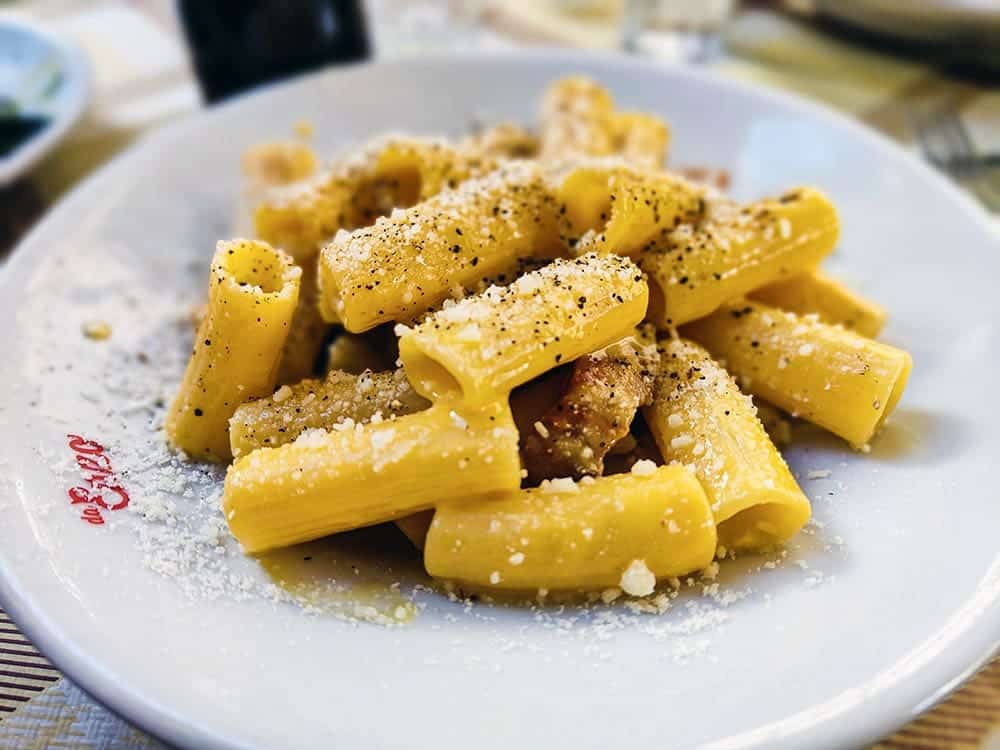
- Da Enzo al 29 – In a pleasant and casual setting, this family-owned restaurant provides classic Roman cuisine. They specialize in classic Italian meals including carbonara, cacio e pepe, and amatriciana. Coda alla vaccinara is delicious too. Reservations are strongly advised. In the humble opinion of the writer, Da Enzo al 29 is the best trattoria in Rome, certainly the most authentic and adherent to the traditions of Roman cuisine.
- La Scala – Renowned for its delectable seafood meals, La Scala provides a variety of delicacies such as fried anchovies, spaghetti with clams, and grilled swordfish. The restaurant serves lunch and dinner and has a wonderful outside seating area.
- Roma Sparita is famous for its cacio e pepe, a typical Roman pasta dish cooked with cheese and black pepper, and is located in a picturesque square. The restaurant also serves a range of other Italian cuisine and has an extensive wine list.
- Osteria der Belli – Popular with both locals and tourists, this rustic trattoria is recognized for its ample portions and inexpensive costs. Traditional Roman dishes such as pasta all’amatriciana and saltimbocca alla romana are on the menu.
- Ivo a Trastevere – For more than 50 years, Ivo a Trastevere has been providing exquisite wood-fired pizzas. There are also antipasti, salads, and homemade sweets on the menu. The restaurant has a warm and inviting ambiance and is ideal for families and groups.

