
The ultimate city guide to Matera, Italy

One moment you are walking through the ordinary streets of a southern Italian city; the next, the ground falls away into a dense landscape of staircases, church towers, terraces, caves and pale stone houses stacked along the edge of a ravine. Roofs become roads, courtyards sit above hidden chambers and buildings seem to grow directly from the rock.
This is the world of the Sassi di Matera, the ancient districts that transformed Matera from a symbol of rural poverty into one of Italy’s most extraordinary cultural destinations.
Yet Matera is not simply an open-air museum. People live in the Sassi, restaurants occupy old cisterns, contemporary sculptures stand inside cave chambers and boutique hotels have reclaimed dwellings once abandoned for decades. The city’s beauty is inseparable from a difficult social history, and that tension prevents Matera from becoming merely picturesque.
Located in Basilicata, between Puglia and Calabria, Matera rewards travellers who enjoy architecture, archaeology, walking, regional food and places with a strong sense of identity. One night provides the famous evening view; two or three days allow the city to become something more substantial than a cinematic backdrop.
Understanding Matera and the Sassi
The historic landscape is divided into three principal areas.
Sasso Barisano occupies the northern side of the old city. It contains more restored façades, hotels, restaurants and workshops, although many buildings conceal chambers excavated deep into the limestone.
Sasso Caveoso, to the south, feels rougher and more exposed. Here the cave structure is often easier to understand, particularly around Via Casalnuovo and the churches of Santa Maria de Idris and San Pietro Caveoso.
Between them rises Civita, the oldest fortified nucleus of Matera, crowned by the cathedral.
Together with the surrounding plateau and its rock churches, the Sassi were added to the UNESCO World Heritage List in 1993. UNESCO describes the area as an exceptionally intact Mediterranean rock-cut settlement, containing more than a thousand dwellings and evidence of human occupation extending back to prehistoric times.
The Sassi are not a neat archaeological park with a single entrance. They form an inhabited urban district crossed by public streets, stairways, churches, museums, hotels and private homes. There is no general admission ticket, and walking through the neighbourhoods is free.
Why Matera Looks Unlike Any Other Italian City

Matera developed through subtraction as much as construction.
Its inhabitants excavated caves into soft limestone, known locally as calcarenite, and used the removed stone to build façades, rooms, walls and churches in front of them. Over centuries, the settlement became a layered organism in which one family’s roof could function as another family’s street.
Water was the key to survival. Rainwater was collected from roofs and paved surfaces, filtered through channels and stored in underground cisterns. This sophisticated network allowed a dense population to live in a dry, rocky environment with limited natural springs.
The urban plan may appear chaotic, but it is closely adapted to the ravine, the climate and the availability of water. This relationship between settlement and landscape is central to Matera’s UNESCO recognition.
The Difficult History of the Sassi
Matera’s modern fame can make it easy to romanticise cave life. That would be a mistake.
By the first half of the 20th century, many families in the Sassi lived in severe poverty, often sharing poorly ventilated spaces with livestock. Sanitation was inadequate, infant mortality was high and malaria remained a serious problem.
The writer and physician Carlo Levi brought national attention to conditions in Basilicata through his book Christ Stopped at Eboli. In the 1950s, the Italian government began relocating thousands of residents from the Sassi to newly constructed neighbourhoods.
The transfer improved living conditions but also fractured established communities and left much of the ancient city abandoned. Restoration began gradually from the 1980s, when legislation encouraged the recovery of the historic districts. UNESCO notes that the return of residents and new uses helped restore life to an area that had suffered decades of deterioration.
Today the same rooms may contain luxury suites, wine bars or design studios. The transformation is remarkable, but visitors should remember that Matera’s architecture was once inseparable from hardship.
Begin at Piazza Vittorio Veneto
Piazza Vittorio Veneto is the practical gateway to the Sassi.
The square belongs to Matera’s more conventional upper city, known as the Piano, but several terraces reveal sudden views over Sasso Barisano. The contrast is immediate: cafés and elegant civic buildings stand only a few metres from a subterranean world of cisterns and excavated chambers.
From here, descend gradually into the Sassi rather than following the steepest staircase immediately. Matera is easier to understand when approached in layers.
The square also contains the entrance to the Palombaro Lungo and provides access to several underground spaces that reveal how much of the city remains invisible from street level.
Descend into the Palombaro Lungo
The Palombaro Lungo is a vast underground cistern beneath Piazza Vittorio Veneto.
Carved and expanded over several centuries, it formed part of Matera’s extensive rainwater collection system. Narrow passageways and suspended walkways lead visitors through a cavernous chamber whose walls are coated with waterproof plaster.
The visit is relatively short, but it provides one of the clearest explanations of how the city functioned. Matera’s survival depended not only on caves but on its ability to collect, preserve and distribute water.
Recent 2026 visitor information reports an adult admission price of €3, with free entry for minors, although opening arrangements and capacity restrictions can change. Check the posted schedule on arrival, especially during weekends and peak travel periods.
Walk Through Sasso Barisano
Sasso Barisano is the more polished of Matera’s two principal cave districts.
Start near Via Fiorentini and follow the lanes that descend between artisan workshops, restaurants and restored residences. Some façades appear almost conventional, but their interiors may extend several metres into the hillside.
The pleasure lies in abandoning the most direct route. Follow staircases, cross small terraces and look back frequently: Matera’s perspective changes every few minutes.
Via Fiorentini and Via San Biagio are relatively accessible compared with the steeper sections of Sasso Caveoso. They are sensible starting points for visitors with limited mobility, although the district as a whole remains demanding.
Explore Sasso Caveoso
Sasso Caveoso is Matera at its most dramatic.
The district spreads beneath Civita towards the Gravina ravine, with cave openings, stone staircases and rugged terraces exposed to the landscape. Some areas have been heavily restored, while others preserve a more austere appearance.
The name is often connected to the Latin word caveosus, meaning full of caves, although local interpretations vary.
Walk towards Piazza San Pietro Caveoso, then continue along Via Bruno Buozzi and Via Casalnuovo. The latter offers a clearer impression of the elongated cave dwellings that once housed families, animals, tools and food stores within a single excavated environment.
Sasso Caveoso is especially atmospheric in the early morning and during the final hour of daylight. At midday, particularly in summer, the pale stone reflects heat aggressively and shade becomes scarce.
Visit a Casa Grotta

A casa grotta, or cave house, helps explain daily life in the Sassi before the relocations of the 1950s.
The best-known example is the Casa Grotta di Vico Solitario, near Santa Maria de Idris. Its reconstructed interior includes a bed, simple furniture, agricultural tools, storage areas and space once used for animals.
It is a small attraction and can become congested, but it supplies essential context. Without visiting a cave home, travellers may struggle to understand how families organised domestic life inside spaces that now look romantic under soft hotel lighting.
Several other reconstructed dwellings operate throughout the Sassi. One is usually enough unless you have a particular interest in vernacular architecture or social history.
Climb to Santa Maria de Idris
The rock church of Santa Maria de Idris rises from the Monterrone outcrop above Sasso Caveoso.
Its exterior appears almost fused with the rock. Inside, a compact series of excavated chambers contains traces of frescoes and connects with the older crypt of San Giovanni in Monterrone.
The church is visually striking from almost every angle, particularly from Piazza San Pietro Caveoso and the opposite side of the ravine.
Admission is commonly included in combined tickets covering several rock churches, but schedules vary seasonally. Photography may be restricted inside to protect the frescoes.
See San Pietro Caveoso
The church of Santi Pietro e Paolo, generally called San Pietro Caveoso, stands on a terrace overlooking the Gravina.
Unlike Matera’s excavated churches, it presents a built stone façade and a more conventional ecclesiastical interior. Its position is the real attraction: the church seems to stand between the inhabited Sassi and the wild limestone landscape beyond.
The square in front is one of Matera’s natural meeting points. It also provides an excellent orientation stop before continuing towards Santa Maria de Idris, Via Casalnuovo or the canyon trail.
Visit Matera Cathedral
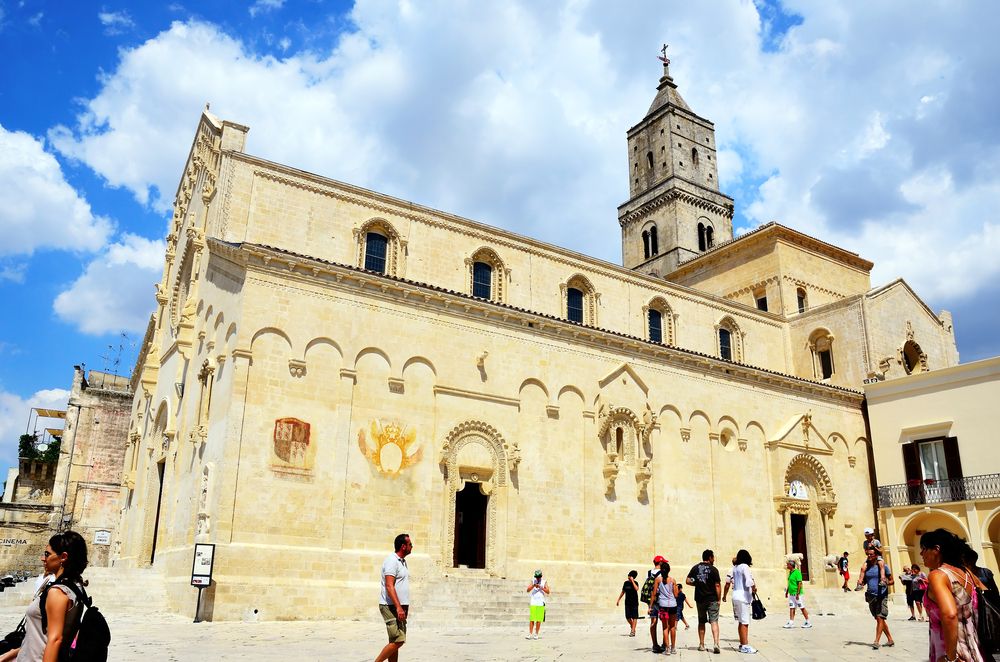
Matera Cathedral dominates the Civita ridge between Sasso Barisano and Sasso Caveoso.
Built in the 13th century in Apulian Romanesque style, it occupies the site of the city’s earlier defensive and religious nucleus. The exterior is relatively restrained, while the interior is richly decorated with later Baroque elements.
The cathedral square provides one of the most complete views over Sasso Barisano. From here, the architecture no longer resembles a collection of isolated caves; it becomes a continuous terraced city flowing down the slope.
The climb is steep from either Sasso, but it is essential for understanding Matera’s urban structure.
Discover Casa Noha
Casa Noha is one of the most effective introductions to Matera’s modern history.
Located near the cathedral, the restored residence hosts a multimedia presentation tracing the development, abandonment and recovery of the Sassi. Images and archival material are projected onto the walls of the old rooms.
It is not a conventional museum filled with objects. Instead, it offers a concise narrative that connects architecture with social conditions, political decisions and urban regeneration.
Visit early in your stay. The experience makes the rest of Matera easier to interpret and prevents the city’s poverty from being reduced to a decorative anecdote.
Visit MUSMA
The MUSMA – Museum of Contemporary Sculpture in Matera occupies Palazzo Pomarici in Sasso Caveoso.
Its collection includes Italian and international sculpture from the late 19th century onwards, displayed across noble rooms and seven underground spaces. The encounter between contemporary works and rough cave walls is unusually effective; the architecture does not merely contain the art but changes how it is perceived.
The museum currently lists daily opening from 10:00 to 20:00, with last admission one hour before closing. These times were published for the 2026 visitor season but should still be checked on the day of your visit.
MUSMA is particularly worthwhile for travellers who have already visited several churches and need a visual counterpoint to Matera’s religious heritage.
Explore the Rock Churches

Matera and the surrounding plateau contain an extraordinary concentration of chiese rupestri, churches excavated into the limestone.
Their origins and uses are more complex than the familiar story of isolated Byzantine monks. The official Murgia Materana Park records around 150 rock-cut religious sites dating from the early Middle Ages through the 19th century and connected with monasteries, parishes, sanctuaries and episcopal institutions.
Within the Sassi, important examples include:
Santa Lucia alle Malve, containing surviving medieval frescoes and evidence of a former religious community.
San Pietro in Monterrone, connected with Santa Maria de Idris.
Madonna delle Virtù and San Nicola dei Greci, a substantial multi-level complex frequently used for exhibitions and cultural events.
Do not attempt to visit every rock church. Choose two or three with different architectural characteristics and spend time examining the surviving paintings.
Cross into the Murgia Materana Park
The Parco della Murgia Materana occupies the plateau across the Gravina from the city.
From the Belvedere di Murgia Timone, Matera appears as a dense stone wall rising above the canyon. This is the classic panoramic view, particularly at sunset when the city begins to illuminate.
The park contains prehistoric sites, shepherds’ paths, fortified farmhouses and numerous rock churches. Official trails cross the plateau and descend into the Gravina, while guided routes reach more remote religious complexes.
The landscape is exposed and can become extremely hot. Carry water, use proper footwear and avoid leaving marked paths. The park also warns visitors that much of the territory is privately owned and that access to private land requires permission.
Walk Across the Tibetan Bridge
A suspension bridge crosses the Gravina below the Sassi, linking the city side with paths towards the Murgia plateau.
The route generally begins near Porta Pistola, descends steeply into the ravine and climbs again on the opposite side. The bridge itself is not technically difficult, but the complete walk involves uneven steps, loose surfaces and a considerable return ascent.
It should not be attempted casually in extreme heat, heavy rain or unsuitable shoes.
The reward is a changing view of Matera from below. Instead of looking down upon the Sassi, you see the settlement rising almost vertically from the rock.
Find the Best Viewpoints in Matera
Matera is a city of viewpoints rather than a single definitive panorama.
Belvedere Luigi Guerricchio, near Piazza Vittorio Veneto, offers an immediate view over Sasso Barisano and is ideal for a first orientation.
Piazzetta Pascoli frames Sasso Caveoso between elegant upper-city buildings and is especially attractive in the evening.
Piazza Duomo overlooks Sasso Barisano from the Civita ridge.
Piazza San Pietro Caveoso faces the ravine and the Monterrone rock.
Belvedere di Murgia Timone provides the widest view of the entire Sassi landscape from across the canyon.
Return to at least one viewpoint after dark. Matera changes when hundreds of small lights outline terraces, stairways and church towers.
Matera After Sunset
Many day visitors leave in the late afternoon, just as Matera becomes most evocative.
The limestone loses its harsh daytime glare, restaurants begin opening their doors and the illuminated Sassi resemble a stone constellation. Walk from Piazza Pascoli into Sasso Caveoso, cross Civita and return through Sasso Barisano.
Matera is generally quiet rather than nocturnal. There are wine bars, cocktail venues and occasional cultural events, but this is not a city built around clubs or late-night entertainment.
The most memorable evening activity is simply walking without a fixed route.
Matera and Cinema
Matera’s archaic appearance has made it one of Italy’s most recognisable film locations.
Directors have repeatedly used the Sassi to represent ancient Jerusalem and other biblical landscapes. Pier Paolo Pasolini filmed parts of The Gospel According to St. Matthew here, while Mel Gibson used Matera extensively for The Passion of the Christ.
The city also appeared in the James Bond film No Time to Die, where its streets and surrounding landscape became the setting for an elaborate chase sequence.
Cinema has brought international attention, but Matera is more interesting when treated as a real city rather than a film set. Locations are best visited as part of broader walks rather than through a rigid movie checklist.
What to Eat in Matera
Matera’s cuisine is rustic, resourceful and deeply tied to the agricultural traditions of Basilicata.
Pane di Matera
Pane di Matera IGP is the city’s defining food.
Made with durum wheat semolina and natural fermentation, the bread has a thick, dark crust and a golden, aromatic interior. Its distinctive shape recalls the Murgia landscape and traditional loaves were large enough to feed a family for several days.
Good Matera bread tastes of toasted grain, sourdough and warm cereal. Eat it with local olive oil, cheese, soups or simply on its own while still fresh.
Cialledda
Cialledda is a traditional dish designed to give old bread a second life.
The summer version usually combines soaked bread with tomatoes, onion, cucumber, oregano and olive oil. Winter versions may be warm, with vegetables, potatoes or eggs.
It resembles Puglian acquasale and Tuscan panzanella, but its identity depends heavily on the dense texture of Matera bread.
Crapiata
Crapiata is a thick soup made from mixed legumes and grains.
Its ingredients may include chickpeas, lentils, beans, broad beans, wheat and potatoes. Traditionally linked to the end of the harvest, it expresses the communal and agricultural character of Matera’s food culture.
This is not delicate restaurant cuisine. It is substantial, earthy and especially satisfying during colder months.
Peperoni Cruschi
Peperoni cruschi are thin, sweet red peppers dried and quickly fried until crisp.
They are one of Basilicata’s most distinctive ingredients. Crumbled over pasta, vegetables, cod or bread, they provide sweetness, roasted flavour and a fragile crunch.
The best examples should be crisp rather than oily or burnt.
Orecchiette and Handmade Pasta
Although orecchiette are strongly associated with neighbouring Puglia, they are also common in Matera and throughout eastern Basilicata.
Look for them with turnip greens, tomato, sausage, mushrooms or breadcrumbs. Other local pasta forms include strascinati, often served with lamb ragù or vegetables.
Lucanica Sausage
The name lucanica refers to a seasoned sausage traditionally linked with ancient Lucania.
Modern versions may contain pork, fennel seed, pepper and other spices. It appears grilled, crumbled into pasta sauces or served with vegetables.
Local Cheeses
Matera’s restaurants often serve pecorino lucano, caciocavallo podolico and fresh or aged goat cheeses.
Caciocavallo podolico is particularly intense, with savoury, herbal and sometimes spicy notes. It works well with local honey, preserves or an Aglianico del Vulture.
Where to Eat in Matera
Matera’s restaurant scene now ranges from traditional trattorias to ambitious tasting-menu destinations.
Vitantonio Lombardo is the city’s most prominent fine-dining restaurant, located inside an atmospheric cave environment. Its cooking reinterprets Basilicata ingredients through contemporary technique.
Dimora Ulmo combines refined regional cuisine with a carefully restored historic setting.
Baccanti remains a strong option for regional cooking in the Sassi, with a menu that draws on local pasta, meat and vegetables.
Radino Wine Bistrot, Aroma, DA MÓ and Calvi Ristorante are also included in the current Michelin selection for Matera and its surroundings.
For a more informal meal, choose a bakery, deli or simple trattoria outside the most photographed lanes. Restaurants with the grandest panoramic terrace are not automatically the most interesting kitchens.
What to Drink in Matera
The principal regional wine is Aglianico del Vulture, produced in northern Basilicata from vineyards around the extinct volcano Monte Vulture.
Aglianico gives structured reds with dark fruit, dried herbs, smoke, leather and firm tannins. Mature examples can be complex and elegant, while younger wines work well with lamb, sausage and aged cheese.
For a lighter red, look for Matera Primitivo or blends produced under the Matera DOC.
White options may include Greco, Malvasia Bianca di Basilicata and aromatic regional blends. Craft beer has also developed across Basilicata, often using local grains, herbs or citrus.
A useful introduction is to order a tasting of Lucanian wines rather than a generic national label already familiar from elsewhere in Italy.
Where to Stay in Matera
Inside the Sassi
A cave hotel provides the most distinctive Matera experience.
Rooms may include exposed stone, vaulted ceilings and deep excavated spaces. The atmosphere can be extraordinary, but cave accommodation has practical disadvantages: limited natural light, variable humidity, many stairs and difficult luggage access.
Check whether the hotel offers porter service, nearby parking or shuttle assistance.
Near Piazza Vittorio Veneto
The upper city is more convenient for travellers arriving by bus or car.
Hotels around Piazza Vittorio Veneto and Via del Corso provide easier access to shops, transport and restaurants while remaining within a few minutes’ walk of the Sassi.
This area is often a better choice for families, travellers with reduced mobility or anyone carrying heavy luggage.
Near Piazzetta Pascoli
The western edge of the historic centre offers excellent views over Sasso Caveoso and relatively convenient access to both the Piano and the old districts.
It is one of the best compromises between atmosphere and practicality.
How Many Days Do You Need in Matera?
One day is enough to see the principal viewpoints, walk through both Sassi and visit one cave house. It will feel compressed, and you will miss Matera after dark.
Two days allow time for the cathedral, rock churches, Casa Noha, the Palombaro Lungo and an evening in the Sassi.
Three days are ideal if you also want to explore the Murgia Materana, visit MUSMA, enjoy a long regional meal and move through the city without constantly checking the time.
Matera works particularly well as part of a wider journey through Basilicata and Puglia, but it should not be treated as a rushed half-day excursion from Bari.
A One-Day Matera Itinerary
Begin at Piazza Vittorio Veneto and visit the Palombaro Lungo.
Continue to the Belvedere Luigi Guerricchio, then descend through Sasso Barisano. Climb towards Civita and visit Matera Cathedral.
After lunch, walk through Sasso Caveoso, see a casa grotta and visit Santa Maria de Idris.
Finish at Piazzetta Pascoli for sunset, then return to the Sassi after dark before dinner.
A Two-Day Matera Itinerary
On the first day, follow the central itinerary through Piazza Vittorio Veneto, Sasso Barisano, Civita and Sasso Caveoso.
On the second morning, visit Casa Noha and MUSMA. After lunch, cross the Gravina on foot or travel to the Murgia Timone viewpoint.
Return before sunset and spend the evening exploring the quieter streets around Via Casalnuovo and San Pietro Caveoso.
How to Get to Matera
From Bari
Bari is the most common gateway to Matera.
Ferrovie Appulo Lucane, usually abbreviated to FAL, operates rail and bus services between Bari and Matera. The journey generally requires around 90 minutes to two hours depending on the service, and trains may be replaced or supplemented by buses during maintenance periods or non-school timetables.
In summer 2026, FAL continued to publish seasonal service changes and additional bus information, confirming that travellers should check the current timetable rather than rely on older journey planners.
FAL trains depart from their own platforms beside Bari Centrale rather than from the main Trenitalia concourse.
Direct airport buses also connect Bari Airport with Matera, often providing the simplest option for passengers arriving by air.
From Naples
Direct long-distance buses connect Naples with Matera, usually taking around three to four hours depending on traffic and stops.
There is no simple direct national rail service into central Matera. A journey by train normally involves reaching Ferrandina or Bari and continuing by bus or FAL service.
By Car
Driving offers the greatest flexibility, particularly when combining Matera with Alberobello, the Valle d’Itria, Castelmezzano or the Ionian coast.
Private vehicles are restricted in parts of the historic centre and cannot circulate freely through the Sassi. Use an authorised car park in the upper city and walk or take a shuttle to your accommodation.
Do not follow satellite navigation blindly into narrow streets or limited-traffic zones.
Getting Around Matera
Matera is best explored on foot.
Distances are not large, but elevation changes are constant. A route that looks short on a map may involve several flights of irregular stone steps.
Local buses are useful for reaching peripheral neighbourhoods, parking areas and some access points near the Murgia. Taxis can help with luggage or evening transfers, but they cannot enter every lane.
Comfortable shoes with good grip are essential. Smooth limestone becomes slippery when wet.
Best Time to Visit Matera
Spring
April and May offer comfortable temperatures, green landscapes and excellent walking conditions.
Rain remains possible, but the light is softer and the Murgia plateau is more colourful than during high summer.
Summer
June is warm and generally manageable. July and August can be intensely hot, particularly in exposed parts of Sasso Caveoso and the Murgia.
Plan outdoor walks early in the morning and late in the afternoon. Use the middle of the day for museums, churches and lunch.
Autumn
September and October are among the best months for Matera. Temperatures become more comfortable, restaurants remain active and the city is usually less crowded than in midsummer.
Winter
Winter brings cold evenings, occasional rain and a quieter atmosphere.
Snow is uncommon but possible, and the Sassi look especially dramatic under mist or winter light. Some attractions may reduce their opening hours.
Matera Events and Traditions
The city’s most important religious celebration is the Festa della Bruna, held annually on 2 July.
The festival honours the Madonna della Bruna with processions, lights, music and the spectacular destruction of an elaborate papier-mâché triumphal float. Crowds are immense, accommodation prices rise and the city operates very differently from an ordinary day.
Matera also hosts exhibitions, film events, music programmes and performances throughout the year. The cultural infrastructure created around its role as European Capital of Culture 2019 continues to influence the city’s contemporary programme.
For travel in 2026, consult Matera’s official municipal tourism portal shortly before arrival, as temporary exhibitions, closures and event dates are updated throughout the season.
Practical Information for Visiting Matera in 2026
The Sassi are free to enter and remain accessible throughout the day, but individual churches, museums and cave houses charge admission.
Combined tickets are often available for groups of rock churches. Check exactly which sites are included, as not every cave church belongs to the same circuit.
Summer heat is the main practical challenge. Carry water, wear a hat and avoid the Murgia plateau during the hottest hours.
Matera is not fully accessible to visitors with limited mobility. Parts of Sasso Barisano and the main panoramic areas can be reached along gentler routes, but many churches, cave homes and viewpoints involve steps.
Book restaurants and cave hotels well ahead for Easter, long weekends, July, August and the Festa della Bruna.

