
The Castle of Soncino: Renaissance Fortifications and Medieval History Near Cremona
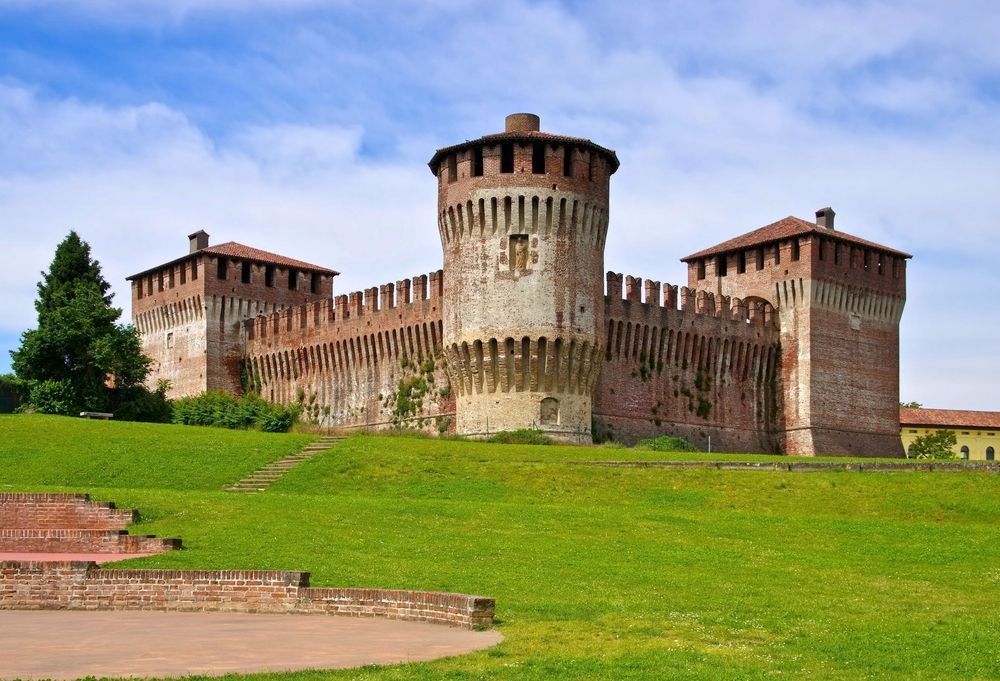
Soncino Castle (Rocca Sforzesca di Soncino) is one of the finest surviving examples of Renaissance military architecture in Lombardy. Built between 1473 and 1476 by order of Galeazzo Maria Sforza, Duke of Milan, the fortress rises at the edge of the medieval town of Soncino, near the Oglio River. Its enormous cylindrical and square towers, crenellated brick walls, fortified gateways and deep moat were designed to withstand artillery and defend the eastern frontier of the Duchy of Milan against the Republic of Venice.
Unlike the great residential castles of northern Italy, Soncino was conceived primarily as a military stronghold. Its compact plan, interconnected towers and defensive passages remain remarkably legible, making it an excellent place to understand how Italian fortifications adapted to the growing importance of gunpowder warfare during the fifteenth century.
The castle stands within walking distance of Soncino’s historic centre, one of Italy’s Most Beautiful Villages (Borghi più belli d’Italia). A visit takes around an hour, but the surrounding town deserves at least another two hours, particularly for its medieval walls, churches and extraordinary connection with the history of Hebrew printing.
Why Was Soncino Castle Built?
During the fifteenth century, the Duchy of Milan and the Republic of Venice competed for control of Lombardy. Soncino occupied a strategically sensitive position close to the Oglio River, which marked an important frontier between their territories.
The Peace of Lodi in 1454 established a temporary balance among the principal Italian powers, but it did not eliminate military tensions. Milan continued strengthening its eastern defences, particularly around fortified towns capable of controlling roads, crossings and agricultural territory.
Galeazzo Maria Sforza ordered the construction of a new fortress at Soncino in 1473. The project was directed by Bartolomeo Gadio, a military architect and engineer from Cremona who worked for the Sforza court.
The builders completed the formidable structure in approximately three years. Its design combined the defensive traditions of medieval Lombard castles with features suited to a period when cannon fire was becoming increasingly important.
A Fortress Built for Artillery Warfare
The first impression is the extraordinary mass of the brick fortifications. Soncino Castle is surrounded by a deep moat and protected by four principal towers, thick walls and carefully controlled entrances.
The towers have broad, sloping bases, known in Italian military architecture as scarpa. These strengthened the lower sections and helped the walls withstand attack.
The battlements retain the characteristic swallowtail profile commonly associated with Ghibelline architecture, although this form continued to be used long after the medieval conflicts between Guelphs and Ghibellines had lost their original political meaning.
Narrow openings allowed defenders to observe and fire towards approaching enemies. Underground rooms, protected stairs and interconnected passages made it possible to move through the fortress without crossing exposed courtyards.
Rather than displaying aristocratic wealth, the architecture concentrates on controlling movement, resisting attack and preserving the possibility of defence even if an outer position was captured.
The Moat and Fortified Entrance
The castle’s moat is particularly impressive when viewed from outside, where the full height of the walls and towers becomes apparent.
Historically, the moat was divided into different sectors, and water could be supplied through the local irrigation network. It was not necessarily filled uniformly at all times.
Entry was controlled by a sequence of bridges and fortified passages.
The first defensive enclosure, known as the ravelin, formed an additional barrier before the main courtyard. Attackers who reached this position would still have faced a second controlled entrance.
The surviving architecture makes the system easy to understand. The route turns and narrows, exposing approaching enemies to fire from the walls and towers.
The Courtyards and Defensive Layout
Soncino Castle develops around two fortified courtyards, with the principal inner courtyard enclosed by high brick walls.
The layout is deliberately compact. The towers are positioned to protect the walls and entrances, while internal staircases lead towards the battlements and lower defensive rooms.
A well stands in the principal courtyard, although the present structure dates from the twentieth century.
The relative simplicity of the open spaces reflects the original military purpose of the building. Unlike a princely palace, the courtyard was not designed as an elaborate ceremonial setting.
Its function was to connect soldiers, storage rooms, defensive posts and the castle’s operational spaces.
The Four Towers
The castle’s four towers are not identical.
The Torre del Capitano, or Captain’s Tower, was the principal stronghold. It could be isolated from other parts of the fortress, providing a final defensive position during a siege.
A substantial cylindrical tower occupies another corner. Its unusual configuration reflects the adaptation of an earlier defensive structure belonging to Soncino’s medieval fortifications.
The two remaining towers have square plans and similar dimensions. Internal brick staircases connect their lower rooms, upper levels and battlements.
One of the square towers was subsequently adapted to contain a chapel when the fortress acquired a more residential character.
The differences between the towers reveal how late medieval military architecture often combined new construction with practical adaptations to existing defences.
The Captain’s Tower and Underground Passages
The Captain’s Tower is among the most interesting parts of the castle.
It contained the quarters associated with the fortress commander and was designed to remain defensible even if other areas were compromised.
Steep staircases connect the different levels, while underground passages formed part of the castle’s protected circulation system.
An escape route traditionally connected the tower with an exit towards the countryside, providing another possibility for movement during an attack.
The masonry, narrow openings and enclosed staircases convey the cramped conditions of a functioning military stronghold more effectively than any elaborate museum reconstruction.
Some passages and elevated sections involve steep stairs and uneven surfaces, so access may be restricted according to visitor safety requirements.
The Battlements and Views over Soncino
Walking along the accessible ramparts is one of the highlights of a visit.
From above, the geometry of the fortress becomes clear: towers protect the corners, battlements follow the walls, and the deep moat separates the castle from the surrounding ground.
The views extend across Soncino’s terracotta rooftops, medieval walls and the flat agricultural landscape of the Oglio Valley.
This panorama helps explain the strategic position of the castle. The surrounding countryside offered few substantial natural obstacles, making fortified settlements and river crossings particularly important.
The exterior views are equally rewarding. The massive round tower and sloping brick walls are especially impressive from the moat.
From the Sforza to the Stampa Family
The political history of Soncino changed repeatedly after the fortress was completed.
The town passed under Venetian control in 1499, before returning to the shifting struggles involving Venice, France and Milan during the Italian Wars.
In the sixteenth century, the Duchy of Milan came under Spanish Habsburg rule.
In 1536, Emperor Charles V granted Soncino as a marquisate to the Stampa family. The new lords gradually transformed parts of the fortress into a residence.
Rooms were adapted for domestic use, and decorative programmes softened the original military character.
The castle nevertheless retained its formidable exterior, creating a contrast between Renaissance residential additions and the earlier Sforza defences.
Frescoes and the Castle Chapel
The Stampa family commissioned decorative works during the sixteenth century.
The painters Bernardino Gatti and Uriele Gatti are associated with frescoes in different areas of the fortress, although much of their work has disappeared.
The surviving fragments provide evidence of the castle’s transformation from military outpost to aristocratic residence.
A chapel was created in the southeastern tower, where traces of devotional painting remain, including a representation of the Madonna and Child.
These fragments are modest compared with the fortress’s military architecture, but they belong to an important second phase of its history.
Abandonment and Restoration
As Soncino lost its strategic importance, the fortress entered a long period of decline. Parts of the complex were used for practical purposes, including timber storage.
In 1876, the last Marquis Stampa, Massimiliano Cesare Stampa, left the castle to the municipality.
Restoration began in 1886 under the direction of the Milanese architect Luca Beltrami, who was also involved in major work on Milan’s Castello Sforzesco.
The restoration, completed in the 1890s, removed several later additions, reconstructed sections of the battlements and repaired the towers.
Consequently, some of the castle’s present appearance reflects nineteenth-century restoration rather than entirely untouched fifteenth-century masonry.
The essential defensive layout, however, remains exceptionally clear.
The Archaeological Museum
The fortress houses the Museo Civico Archeologico Aquaria, which presents archaeological material connected with Soncino and its surrounding territory.
The collections help place the Renaissance fortress within a much longer history of settlement in the Oglio Valley.
Another exhibition area is dedicated to military history, including the Italian Risorgimento and the two World Wars.
Both are included in the standard cumulative admission ticket.
They provide useful additions to the castle visit, although the architecture itself remains the principal attraction.
What Else to See in Soncino
The castle is the most prominent monument in Soncino, but it would be a mistake to leave immediately after the visit.
The medieval town preserves substantial stretches of its defensive walls, historic streets and religious buildings.
The Pieve di Santa Maria Assunta is one of the principal churches, with origins reaching back well before the Renaissance.
The Church of San Giacomo is another important religious monument, notable for its long architectural history and distinctive tower.
The most unusual cultural attraction is the Museo della Stampa, dedicated to the Soncino family of Hebrew printers.
During the fifteenth century, this family established a printing business that became internationally influential. In 1488, the Soncino press produced an important early complete printed edition of the Hebrew Bible with vowel points and accents.
The museum preserves the history of this remarkable printing dynasty and the spread of Hebrew movable-type printing in Renaissance Italy.
It is an excellent second stop after the castle, particularly because it reveals a very different side of Soncino’s fifteenth-century prosperity.
Visiting Soncino Castle
The Rocca Sforzesca is open to visitors on regular museum days, with seasonal variations.
For September and October 2026, the visiting schedule is:
- Tuesday–Friday: 10:00–13:00 and 14:00–16:00
- Saturday, Sunday and public holidays: 10:00–13:00 and 14:00–18:00
- Monday: normally closed
The cumulative ticket includes the fortress, the Aquaria Archaeological Museum, the military-history collection and participating historic churches.
Admission:
- Adults: €7
- Reduced admission, ages 6–14 and over 65, plus eligible cardholders: €5
- Family ticket, two adults with minor children: €16
The Printing Museum has a separate admission of €3.
The fortress contains stairs, narrow passages and uneven historic surfaces. Accessibility is partial, particularly for the towers and upper ramparts.
Allow around 60–90 minutes for the castle and its museums, or three hours for the fortress, historic centre and Printing Museum.
How to Get to Soncino Castle
Soncino is in the province of Cremona, eastern Lombardy, close to the Oglio River.
The fortress stands immediately beside the historic centre and is easily reached on foot after parking nearby.
By car, Soncino is approximately 35 kilometres from Cremona, 40 kilometres from Brescia and 65–75 kilometres from Milan, depending on the departure point and route.
Public transport is less convenient than driving. Regional bus connections serve Soncino from surrounding towns, but there is no railway station in the historic centre.
For visitors exploring the smaller towns and castles of Lombardy, a car is the most practical option.
Is Soncino Castle Worth Visiting?
Soncino is an excellent choice for anyone interested in the transition from medieval castles to Renaissance artillery fortresses.
The impressive sloping towers, deep moat, ravelin and protected internal circulation show how military engineers responded to changing methods of warfare during the fifteenth century. Later residential adaptations and nineteenth-century restoration add further historical layers without obscuring the original defensive structure.
The castle is also compact enough to explore without dedicating an entire day to it. Combined with Soncino’s medieval streets, surviving walls and Printing Museum, it makes a substantial half-day excursion in a part of Lombardy that receives far fewer international visitors than Milan, Bergamo or Lake Garda.
Useful Information
- Official name: Rocca Sforzesca di Soncino
- English name: Soncino Castle / Soncino Fortress
- Location: Soncino, province of Cremona, Lombardy, Italy
- Address: Piazza Prof. Enea Ferrari, 26029 Soncino (CR)
- Construction: 1473–1476
- Commissioned by: Galeazzo Maria Sforza, Duke of Milan
- Architect: Bartolomeo Gadio
- Original function: Military defence of Milan’s eastern frontier
- Main architectural features: Four towers, ravelin, moat, two fortified courtyards, battlements and underground rooms
- Later owners: Stampa family, from 1536
- Major restoration: Luca Beltrami, 1886–1895
- Museums inside: Aquaria Archaeological Museum and military-history collection
- Adult cumulative ticket: €7
- Reduced ticket: €5
- Family ticket: €16
- Opening, September–October 2026: Tuesday–Friday 10:00–13:00 and 14:00–16:00; weekends and holidays 10:00–13:00 and 14:00–18:00
- Monday: normally closed
- Tourist information: +39 0374 837840 / +39 0374 83188
- Tourism email: [email protected]
- Guided visits – Pro Loco Soncino: +39 0374 84883
- Guided visit email: [email protected]
- Recommended castle visit: 60–90 minutes
- Recommended total visit: Half a day
- Accessibility: Partial; towers and historic stairs present barriers
- Nearby attraction: Museo della Stampa, dedicated to the Soncino family of Hebrew printers

