
Kriek Beer: Belgium’s Wild Cherry Lambic, from Sour Tradition to Sweet Modern Brews

Imagine biting into a handful of ripe sour cherries, stones and all, while drinking a glass of mature Belgian Lambic. The fruit is sharp, dark and intensely aromatic; the beer is dry, acidic and filled with the peculiar fragrance of old oak, wild fermentation and damp hay. Put the two together, give them several months to ferment, and something extraordinary happens. The cherry sugars disappear, the beer turns crimson, and the fruit acquires an almost wine-like intensity.
This is Kriek, one of Belgium’s most distinctive beer traditions. Its historical heart lies in Brussels and the surrounding Pajottenland, where brewers have long added sour cherries to spontaneously fermented Lambic. The finest traditional examples are anything but sweet: they are dry, tart, complex and sometimes remarkably austere, with flavours of cherry skins, bitter almonds, citrus and aged wood.
Yet Kriek also exists in another, far more familiar form. Walk into a Belgian supermarket and you will find bright-red cherry beers that are sweet, approachable and considerably less acidic. Some still contain Lambic; others rely on different beer bases. They share the cherry character, but they offer an entirely different drinking experience.
Understanding Kriek means learning to distinguish traditional Oude Kriek from sweet commercial cherry beer, recognising the importance of the fruit itself and appreciating why producers such as Cantillon, 3 Fonteinen, Boon and Oud Beersel have turned a seemingly simple combination into one of the most complex expressions of Belgian brewing.
The Basics
- Origin: Belgium, particularly Brussels and the Pajottenland
- Beer family: Traditional fruit Lambic, with other Belgian cherry-beer interpretations
- Meaning of the name: Kriek is Dutch for sour cherry
- Traditional fruit: Sour cherries, historically including Schaerbeek cherries
- Principal beer base: Spontaneously fermented Lambic
- Fermentation: Fermentation of the Lambic followed by renewed fermentation with cherries
- Maturation: Usually several months of fruit contact, sometimes followed by bottle conditioning
- Typical alcohol: Approximately 4–8% ABV, depending on the producer
- Colour: Ruby red, crimson or deep garnet
- Traditional flavour: Sour cherry, citrus, almond, oak and rustic fermentation notes
- Traditional finish: Dry, tart and persistent
- Sweet commercial versions: Softer, fruitier and often lower in alcohol
- Important producers: Cantillon, 3 Fonteinen, Boon, Oud Beersel, Lindemans, De Cam and Liefmans
- Serving temperature: Approximately 8–15°C, depending on the beer
- Best pairings: Duck, roast pork, aged cheese, dark chocolate and cherry desserts
What Is Kriek Beer?
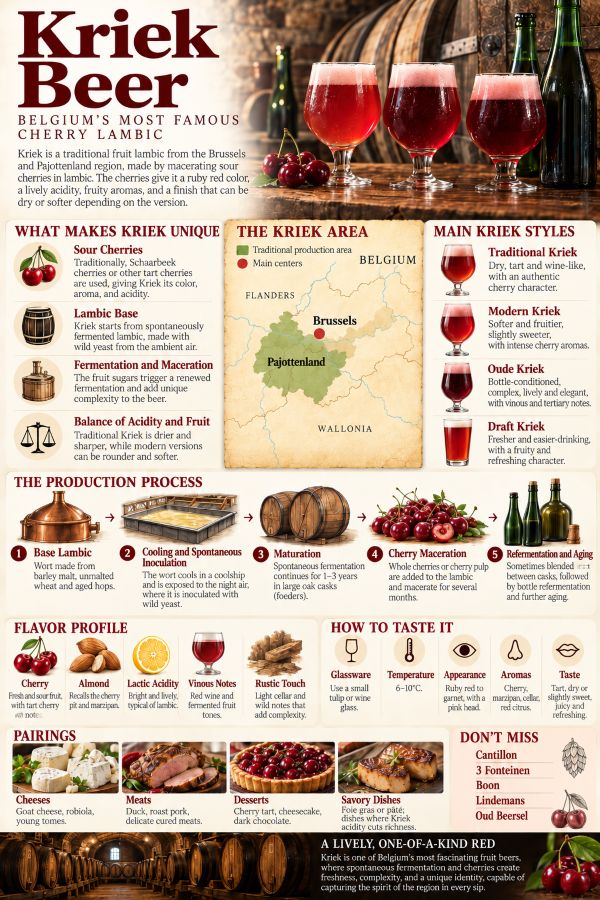
Kriek is a Belgian cherry beer traditionally made by adding sour cherries to Lambic, the spontaneously fermented beer associated with Brussels and its surrounding countryside.
Lambic begins with a mixture of malted barley and unmalted wheat, flavoured with aged hops. After boiling, the wort cools in shallow vessels where microorganisms from the brewery environment establish fermentation. It then matures in wooden barrels, developing acidity and a complex combination of fruity, earthy and sometimes leathery aromas.
To make traditional Kriek, brewers introduce cherries into this mature or maturing beer.
The fruit contributes colour, acidity, tannins and aromatic compounds. Its natural sugars also encourage renewed fermentation, creating a beer that can be intensely fruity without retaining the sweetness of fresh cherries.
However, the name Kriek is also used for cherry beers produced through other methods. Some are based on sweetened Lambic, while others use mixed-fermentation brown ales.
Not every beer labelled Kriek is a traditional fruit Lambic, and that distinction is fundamental when choosing a bottle.
The History of Kriek: From Brussels Orchards to Belgian Beer Culture
Kriek developed in the rural and agricultural landscape surrounding Brussels, where fruit cultivation and Lambic brewing existed side by side.
Sour cherries were grown in orchards around the capital, particularly in the Pajottenland and neighbouring districts. Adding fruit to beer provided a way to preserve and transform part of the harvest, while the cherries introduced flavour, colour and fermentable sugars.
The practice has a long history, although the frequently repeated claim that modern Kriek recipes date unchanged from the sixteenth century is difficult to substantiate.
Records show that local sour cherries were being sold to brewers around Brussels by the late eighteenth century. Detailed Kriek recipes are documented by the early twentieth century, including one from 1907 that describes the addition of cherries to mature Lambic, several months of maceration and subsequent bottle conditioning.
This was not merely a matter of pouring cherry juice into beer. The fruit was part of an extended fermentation and maturation process.
During the twentieth century, changing consumer preferences encouraged the development of sweeter and more accessible cherry beers. Filtering, pasteurisation and fruit concentrates made it possible to produce consistent products for larger markets.
Traditional producers nevertheless preserved the older methods, and renewed international interest in sour beer eventually brought Oude Kriek back into the spotlight.
Schaerbeek Cherries: The Fruit Behind Traditional Kriek
One of the most important ingredients in the history of Kriek is the Schaerbeek cherry, known in Dutch as Schaarbeekse kriek.
It is a small, dark, intensely sour cherry traditionally associated with the Brussels area.
Unlike large dessert cherries, Schaerbeek cherries have a pronounced acidity, concentrated flavour and relatively substantial stones.
These characteristics make them particularly suitable for fermentation with Lambic.
The fruit’s acidity reinforces the naturally sour beer, while its skins release deep red pigments. The stones contribute delicate almond-like aromas that can become increasingly noticeable during maturation.
Historically, Schaerbeek cherries became difficult to obtain in sufficient quantities. Traditional orchards declined, and producers increasingly turned to other sour-cherry varieties, including fruit grown elsewhere in Belgium and abroad.
Today, several respected Kriek producers use other varieties of sour cherries without sacrificing the quality or traditional character of their beer.
The important point is not that every authentic Kriek must contain fruit from Schaerbeek, but that the cherries need enough acidity, flavour concentration and structural character to withstand fermentation.
How Traditional Kriek Is Made
Kriek production begins with Lambic, but the addition of cherries creates a second phase of fermentation that changes the beer substantially.
1. Brewing the Lambic
Traditional Lambic is made with malted barley, a significant proportion of unmalted wheat and aged hops.
The wort is usually produced through a demanding brewing process that can include turbid mashing, a technique designed to retain complex carbohydrates that support prolonged microbial activity.
After boiling, the wort is cooled in an open vessel called a coolship.
Naturally occurring microorganisms establish themselves during cooling and subsequent fermentation.
The beer then matures in wooden barrels, where yeasts and bacteria gradually create the acidity and aromatic complexity characteristic of Lambic.
2. Selecting the Cherries
Traditional producers favour sour cherries with pronounced acidity and concentrated aroma.
The fruit may be used fresh or frozen, depending on the brewery and harvest conditions.
Freezing allows brewers to preserve cherries until suitable Lambic barrels are available.
The stones are frequently retained, contributing subtle almond-like aromas during contact with the beer.
The amount of fruit varies considerably.
Cantillon uses approximately 200 grams of sour cherries per litre, while Boon Oude Kriek and Oud Beersel Oude Kriek use around 400 grams per litre.
These are substantial quantities, particularly considering that the cherries must be sourced, handled and fermented rather than simply added as a flavouring concentrate.
3. Fermentation with Fruit
The cherries are added to Lambic, often after the beer has already spent a considerable period in oak.
Microorganisms present in the beer begin fermenting the sugars released by the fruit.
This renewed fermentation changes the beer’s composition while extracting colour, aroma and acidity.
The process generally lasts several months, although the precise duration depends on the fruit, brewery and desired result.
Cantillon, for example, allows its sour cherries to macerate for approximately two to three months.
During this period, the beer develops its characteristic red colour and acquires a much more concentrated cherry profile.
4. Blending and Bottle Fermentation
After fruit maceration, the beer may be separated from the cherries and blended with additional Lambic.
Younger beer can contribute fermentable material needed for natural bottle conditioning.
The bottled Kriek then undergoes further fermentation, producing carbonation.
Traditional Oude Kriek is generally unfiltered and develops naturally in the bottle.
The result is a lively, acidic beer in which cherry fruit and Lambic fermentation character are closely integrated.
Why Traditional Kriek Is Not Sweet
Fresh cherries contain sugar, so it might seem logical that adding them to beer would produce a sweeter drink.
Traditional Kriek demonstrates the opposite.
When cherries are added to mature Lambic, the microorganisms present in the beer ferment much of the fruit’s natural sugar.
The cherry aroma, acidity, colour and some of its structural compounds remain, but the sweetness largely disappears.
The result can be surprisingly dry.
This explains why someone expecting a sweet cherry-flavoured beer may find their first Oude Kriek almost shocking.
The palate can be intensely sour, with astringency from the fruit, subtle bitter-almond notes and the earthy complexity of mature Lambic.
A well-made example should nevertheless remain balanced. Acidity should refresh rather than become aggressive, and cherry character should remain clearly recognisable.
Oude Kriek vs Sweet Kriek
This is the most important distinction in the entire category.
Oude Kriek: The Traditional Style
Oude Kriek is produced according to a recognised traditional method involving spontaneously fermented Lambic, cherries and natural fermentation.
The name forms part of a European system protecting traditional specialities. The protection concerns the production method and characteristics of the beer, rather than establishing an exclusive geographical designation for one brewery.
Traditional Oude Kriek is generally:
- Dry and distinctly acidic
- Made with a genuine Lambic base
- Fermented with cherries
- Complex, with oak and wild-fermentation aromas
- Naturally bottle-conditioned
- Free from the pronounced syrup-like sweetness of many commercial fruit beers
The expression Oude, meaning old, should not be confused with the age of a bottle sitting on a shop shelf. It identifies a traditional production category.
Sweet Commercial Kriek
Sweeter Kriek is designed around a different sensory balance.
Producers may use cherry juice, concentrates or additional sweetening ingredients, together with filtering or pasteurisation to create a stable and approachable product.
These beers are often lower in alcohol and less acidic.
Their flavour may suggest cherry juice, red-fruit sweets or lightly tart fruit preserves.
Some are based on Lambic, but the spontaneous-fermentation character is generally less prominent.
There is no reason to pretend that every sweet Kriek is unpleasant. A good example can be refreshing and enjoyable, particularly for someone who dislikes intense acidity.
It is simply a different drinking experience from traditional Oude Kriek.
What Does Kriek Taste Like?
The answer depends greatly on the type of Kriek.
A traditional Oude Kriek usually pours ruby red to deep crimson, often with a pink foam.
The aroma combines sour cherries, cherry skins, lemon, almond and the complex fermentation character of Lambic.
Older examples may show oak, hay, leather, dried fruit and earthy notes.
The palate is typically dry and acidic, with relatively little conventional hop bitterness.
Cherry acidity and the beer’s own fermentation-derived acids create a sharp, refreshing profile, while the finish can reveal almond-like notes from the stones.
Sweet commercial Kriek is usually softer and more immediately fruity, with pronounced sweetness and less aggressive acidity.
The contrast can be dramatic enough that the two beers barely seem to belong to the same family.
Kriek vs Gueuze
Both belong to the Lambic tradition, but their production and flavour differ.
Gueuze is produced by blending Lambics of different ages and allowing the mixture to undergo natural bottle fermentation.
It generally contains no added fruit.
Its complexity comes from the interaction of young and mature Lambic, with aromas of citrus, green apple, oak and rustic fermentation.
Kriek introduces sour cherries into the process, creating additional acidity, colour and fruit aromas.
A traditional Kriek can retain much of Gueuze’s dryness and fermentation complexity, but cherry character becomes a defining feature.
The comparison is particularly interesting because it demonstrates how fruit changes Lambic without necessarily making it sweeter.
Kriek vs Framboise
Framboise is another fruit Lambic, traditionally made with raspberries.
Both beers can be dry, acidic and deeply aromatic.
The main difference comes from the fruit.
Cherries generally produce deeper red colour, a fuller fruit character and subtle almond-like notes associated with the stones.
Raspberries bring a more delicate, fragrant profile, often with sharper berry acidity.
The underlying Lambic remains important in both styles.
A mature fruit Lambic should not taste simply like fruit juice blended with sour beer.
Kriek vs Flemish Red and Oud Bruin Cherry Beers
Not every Belgian cherry beer begins with Lambic.
Some breweries use Flemish brown ale or mixed-fermentation beer as the base.
These beers may contain more malt-derived flavours, including caramel, dark bread and subtle toasted notes.
The best-known example is Liefmans Kriek-Brut.
Its production involves blending Oud Bruin and pale beer aged with cherries, creating a beer that differs considerably from traditional Lambic-based Oude Kriek.
This distinction is particularly important for buyers.
A beer can have a genuine Belgian cherry-beer tradition without belonging to the classic spontaneous-fermentation Lambic family.
The Best Kriek Beers to Try
Cantillon Kriek — 5.5% ABV
Brasserie Cantillon, founded in Brussels in 1900, produces one of the most distinctive traditional Krieks.
Its beer uses approximately 200 grams of sour cherries per litre, added to Lambic with an average age of around 20 months.
The cherries currently come from certified organic cultivation in Turkey.
Following two to three months of maceration, the beer develops a vivid crimson colour and a complex aroma of sour cherry, red fruit and subtle almond.
The palate is dry and lively, with pronounced acidity and the recognisable rustic character of Cantillon’s Lambic.
It is particularly attractive when relatively young, as the cherry aromas gradually become less prominent with prolonged bottle ageing.
3 Fonteinen Oude Kriek — Traditional Belgian Lambic
3 Fonteinen, based in Beersel, is one of the most respected producers and blenders of traditional Lambic.
Its Oude Kriek is made by macerating sour cherries in mature Lambic, with fruit selection and proportions varying between blends.
The resulting beer is typically deep red, intensely fruity and firmly acidic, with considerable oak and fermentation complexity.
3 Fonteinen is especially interesting because blending plays such an important role in its identity.
Different batches can express distinct combinations of cherry fruit, acidity and barrel character.
Boon Oude Kriek — 6.5% ABV
Brouwerij Boon, based in Lembeek, produces one of the most accessible introductions to traditional Oude Kriek.
Its beer is made by fermenting approximately 400 grams of fresh cherries per litre of Lambic.
The resulting cherry Lambic is blended with younger Lambic and bottle-conditioned.
The colour is deep red with a pink head, while the aroma offers intense cherry fruit and a relatively restrained rustic background.
The finish is dry and acidic, but the fruit concentration creates a particularly generous impression.
Boon is a useful starting point for anyone wanting to explore traditional Kriek without beginning with the most austere examples.
Oud Beersel Oude Kriek — 6% ABV
Oud Beersel Oude Kriek is another benchmark for the traditional style.
Made using approximately 400 grams of sour cherries per litre, it combines pronounced cherry concentration with the depth of mature Lambic.
The beer is ruby red, with aromas of sour cherry, almond and gentle oak.
It contains no added sugar and undergoes traditional natural fermentation.
Its balance between fruit intensity and dry acidity makes it one of the clearest demonstrations of what Oude Kriek can achieve.
De Cam Oude Kriek
De Cam, based in Gooik, is a traditional Lambic blending house associated with particularly expressive fruit beers.
Its Oude Kriek is known for substantial cherry character, assertive acidity and the rustic complexity of mature Lambic.
Production is relatively limited, and availability can be difficult outside specialist Belgian beer retailers.
De Cam is particularly rewarding for experienced Lambic drinkers who appreciate strong fermentation character and pronounced fruit acidity.
Lindemans Kriek — The Sweeter Alternative
Lindemans Kriek represents the more approachable side of Belgian cherry beer.
The producer has historic roots in the Pajottenland and maintains a broad range of Lambic-based fruit beers.
Its familiar sweet Kriek is markedly different from traditional Oude Kriek, emphasising ripe cherry flavour, sweetness and refreshing acidity.
It is a useful introduction for drinkers who prefer fruit-driven beer without the intense sourness of traditional Lambic.
Lindemans also produces Kriek Cuvée René, a traditional expression that belongs to the drier, more complex side of the category.
Liefmans Kriek-Brut — 6% ABV
Liefmans Kriek-Brut demonstrates that Belgian cherry beer is not limited to Lambic.
It combines Oud Bruin and pale beer aged with cherries, with maturation lasting approximately eighteen months.
The result is a deep reddish-brown beer with cherry, wood and almond notes, balanced by gentle sweetness and acidity.
Its flavour is rounder and more malt-influenced than a classic Oude Kriek.
Liefmans is particularly interesting for exploring how different Belgian fermentation traditions can produce distinctive cherry beers.
How Much Does Kriek Beer Cost?
The price depends heavily on production method.
Sweet commercial Kriek is generally relatively affordable, particularly in Belgium, where familiar fruit beers are widely sold in supermarkets and bars.
Traditional Oude Kriek is more expensive because production involves mature Lambic, substantial quantities of cherries, barrel space and prolonged fermentation.
As a practical reference, Oud Beersel Oude Kriek 37.5 cl is sold at approximately €6.20, while a standard 75 cl bottle can cost around €12.40 in the producer’s own retail selection.
How to Serve Kriek
Serving temperature should reflect the beer’s character.
Sweet commercial Kriek is generally best enjoyed relatively cold, often around 5–8°C.
The cool temperature highlights freshness and helps balance sweetness.
Traditional Oude Kriek benefits from slightly warmer service, commonly 8–12°C, allowing cherry, oak and fermentation aromas to develop.
Cantillon recommends approximately 15°C for its Kriek, reflecting the complexity of its mature Lambic base.
A tulip glass or medium-sized wine glass is particularly suitable.
Avoid excessive chilling of complex traditional examples, since very low temperatures can suppress the delicate aromas that justify their long maturation.
Pour carefully if the beer contains natural sediment, particularly when opening a bottle-conditioned Oude Kriek.
Food Pairings: What to Eat with Kriek
Traditional Kriek is an excellent food beer because its acidity can cut through fat while its cherry character complements roasted meat and savoury sauces.
Duck breast with sour-cherry reduction is one of the most convincing pairings. A dry Oude Kriek reinforces the fruit while balancing the richness of the meat.
Another excellent match is roast pork belly with crisp crackling and braised red cabbage. The beer’s acidity refreshes the palate, while its cherry notes work naturally with the cabbage.
For a lighter dish, try smoked duck salad with walnuts and a restrained raspberry vinaigrette, where the fruit and earthy fermentation aromas create a particularly interesting contrast.
Cheese offers equally rewarding possibilities.
Brie de Meaux AOP, aged Comté AOP and Stilton provide three different approaches. Brie contributes creaminess, Comté brings nutty savoury depth, and Stilton creates a powerful contrast between salt, blue mould and sour fruit.
For dessert, choose dark chocolate tart with sour cherries or almond frangipane with roasted cherries.
A sweet commercial Kriek may work more easily with desserts, while a sharply acidic Oude Kriek can provide a stronger contrast to chocolate and rich pastry.
Can Kriek Be Aged?
Traditional Oude Kriek can evolve considerably in the bottle.
Natural fermentation, acidity and mature Lambic provide the structure needed for extended ageing.
However, fruit aromas do not remain unchanged.
Young Kriek generally offers the most vivid cherry character, while older bottles may develop more prominent oak, earthy fermentation notes and oxidative complexity.
Cantillon explicitly emphasises that its Kriek is particularly fruity when young and becomes more Lambic-dominated with age.
This is an important distinction from Gueuze, where prolonged bottle ageing can be a central part of the drinking experience.
A fine Oude Kriek may remain enjoyable for many years, but that does not mean its fruit character necessarily improves.
For most drinkers, trying a relatively fresh bottle provides the clearest impression of the interaction between cherries and Lambic.
How to Choose a Good Kriek
The first step is deciding whether you want a traditional dry fruit Lambic or a sweet cherry beer.
For the traditional style, look for Oude Kriek on the label and choose producers known for spontaneous fermentation and genuine fruit maceration.
Boon, Oud Beersel, Cantillon and 3 Fonteinen are particularly useful reference points.
A good Oude Kriek should offer recognisable cherry aroma, integrated acidity and an expressive Lambic background.
The beer may be intensely sour, but it should not taste aggressively vinegary or dominated by unpleasant solvent-like notes.
For a sweeter, more accessible experience, producers such as Lindemans offer fruit beers designed around immediate cherry flavour and a softer palate.
Liefmans Kriek-Brut provides a further alternative, combining cherry fruit with the richer character of Belgian mixed-fermentation brown beer.
The most important mistake is assuming that all these bottles will taste alike.

