
Gurdwara Bangla Sahib Delhi: History, Langar and Visitor Guide
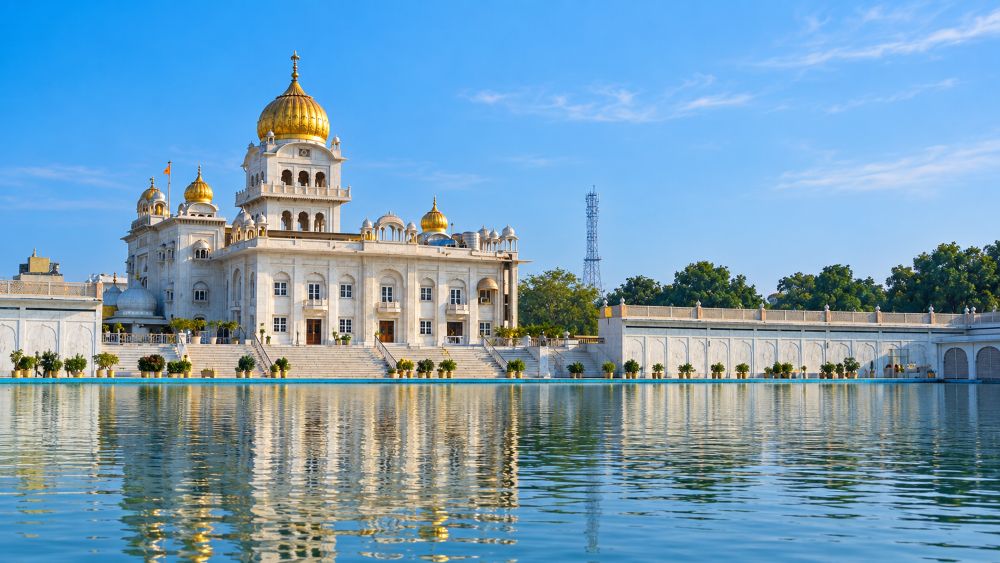
Gurdwara Bangla Sahib is one of New Delhi’s most important Sikh places of worship and one of the city’s most moving religious spaces. Its white marble façades, golden domes and large rectangular sarovar create an image of serenity only a short distance from Connaught Place, but architecture is only part of the experience. The real identity of Bangla Sahib lies in seva, voluntary service: hymns are sung in the prayer hall, food is prepared continuously in the communal kitchen, volunteers wash dishes and clean floors, and visitors of every religion are welcomed without charge.
The gurdwara is associated with Guru Har Krishan, the eighth Sikh Guru, who stayed here during a visit to Delhi in 1664. At the time, the site was a residence belonging to Raja Jai Singh of Amber. During an epidemic that affected the city, Sikh tradition remembers the young Guru caring for the sick and providing water to those suffering around him. The water source became associated with healing, compassion and the Guru’s service to others, and the present sarovar remains one of the most sacred parts of the complex.
Bangla Sahib is open 24 hours a day, and there is no admission fee. Allow around one to two hours, longer if you join the langar, sit through a period of kirtan or spend time understanding how the complex functions.
Guru Har Krishan and the Origins of Bangla Sahib
Guru Har Krishan became the eighth Sikh Guru while still a child.
He was born in 1656 and succeeded his father, Guru Har Rai, in 1661. His guruship lasted only a few years, yet his brief life became closely associated with compassion and service.
In 1664 he travelled to Delhi. Through the intervention of Raja Jai Singh, the Kachhwaha ruler connected with Amber, the Guru stayed at the royal residence that occupied the site of the present gurdwara.
Delhi was experiencing a severe epidemic, traditionally described as smallpox and other infectious disease. Guru Har Krishan cared for the sick and distributed water to those seeking relief.
He himself later became ill and died in Delhi at a very young age.
For Sikhs, his actions transformed the site from a royal residence into a place associated with selfless compassion.
From Royal Bungalow to Gurdwara
The name Bangla Sahib preserves the memory of the original building.
Bangla refers to the bungalow or residence where Guru Har Krishan stayed, while Sahib is an honorific.
The site developed gradually after the Guru’s death. In 1783, the Sikh military leader Sardar Baghel Singh entered Delhi and established several gurdwaras connected with important events in Sikh history. A shrine commemorating Guru Har Krishan’s stay was created here as part of that wider effort.
The monumental white-marble complex visible today is the result of later rebuilding and enlargement rather than a seventeenth-century palace preserved intact.
What remained constant was the association with the Guru and the water source.
What Is a Gurdwara?
A gurdwara is a Sikh place of worship.
The word can be translated roughly as “doorway to the Guru,” but the centre of a gurdwara is not a statue or an altar.
At its heart is the Guru Granth Sahib, the sacred scripture regarded by Sikhs as the eternal Guru.
After the death of Guru Gobind Singh, the tenth human Guru, in 1708, spiritual authority passed permanently to the Guru Granth Sahib.
This means the scripture is treated not simply as a book containing teachings but with profound ceremonial reverence.
In Bangla Sahib’s main prayer hall, everything is organised around its presence.
The Guru Granth Sahib
The Guru Granth Sahib contains hymns written by Sikh Gurus as well as compositions from other spiritual figures whose teachings aligned with the Sikh emphasis on devotion to one God.
The text is written largely in Gurmukhi script and draws on several linguistic traditions from northern India.
During worship it rests beneath a richly decorated canopy.
A granthi or attendant performs ceremonial service around the scripture, while musicians sing passages from the text.
Visitors do not need to understand Punjabi to appreciate the atmosphere.
Music carries much of the experience.
The Darbar Sahib
The main prayer hall is known as the Darbar Sahib.
Before entering, visitors remove their shoes, wash their feet and cover their heads.
Inside, worshippers sit on the floor facing the Guru Granth Sahib. The arrangement has an important symbolic meaning: sitting at ground level reduces visible distinctions of social status.
People bow before the scripture, offer donations if they wish and then sit for as long as they like.
There is no obligation for non-Sikhs to perform religious gestures.
Quiet observation is perfectly acceptable.
Kirtan
One of the strongest reasons to spend time inside Bangla Sahib is kirtan, the musical singing of sacred hymns.
The verses come from the Guru Granth Sahib and are performed by musicians traditionally known as ragis.
Music holds a central place in Sikh worship because much of the scripture was composed to be sung according to specific melodic frameworks.
At Bangla Sahib, extended periods of live kirtan take place throughout the day, including early-morning and evening sessions.
The constant interaction between voice, harmonium, tabla and scripture gives the prayer hall an atmosphere completely different from a silent monument.
Do not simply enter, bow and leave.
Sit for ten or fifteen minutes.
The building makes much more sense once the music has time to work.
The Sarovar
Beside the main shrine lies the large sacred pool known as the sarovar.
Its calm water reflects the white marble buildings and golden domes, creating the most recognisable view of Bangla Sahib.
For devotees, however, the pool carries far deeper meaning.
It recalls the water associated with Guru Har Krishan’s service during the epidemic of 1664. Sikh tradition attributes spiritual significance and healing associations to the water, which is regarded as amrit by many devotees.
The historical importance lies less in medical claims than in the memory of the Guru’s compassion.
Water becomes a symbol of service.
Walking Around the Sarovar
A broad marble walkway surrounds the pool.
This is one of the quietest parts of the complex, particularly early in the morning or later in the evening.
Devotees sit near the water, pray or move slowly around its perimeter.
The golden dome reflected in the sarovar is particularly beautiful after sunset, when the illuminated shrine appears twice: once in marble and once in water.
The pool also changes the atmosphere physically.
Even in central Delhi, the openness of the water creates an unexpected sense of space.
The Golden Dome
Bangla Sahib’s most recognisable architectural feature is its large gilded dome, accompanied by smaller domed elements above the white marble structure.
The composition belongs to the broad architectural vocabulary of Sikh gurdwaras: white marble, curved arches, projecting balconies and gilded domes create a visual language immediately associated with major Sikh sacred buildings.
The dome does not mark a tomb.
It identifies the sacred assembly space below.
Its warm gold contrasts sharply with the white marble, particularly in early-morning or evening light.
The Nishan Sahib
Outside the gurdwara stands a very tall flagstaff bearing the Nishan Sahib, the Sikh flag.
It is one of the easiest ways to identify a gurdwara from a distance.
The flag is generally saffron or deep yellow-orange and bears the Khanda, a Sikh emblem composed of several weapons: a central double-edged sword, a circular chakkar and two curved kirpans.
The Nishan Sahib has a practical symbolic meaning.
Historically, it announced that a Sikh institution stood here and that travellers, pilgrims and anyone in need could expect food, shelter and assistance.
The flag therefore represents welcome as much as identity.
Langar: The Communal Kitchen
The most important experience beyond the prayer hall is the langar.
A langar is the free communal meal served in a gurdwara to everyone, regardless of religion, caste, nationality, wealth or social position.
The tradition is fundamental to Sikhism.
Guru Nanak emphasised equality and communal eating, and later Gurus institutionalised the practice more fully. Sharing food while sitting together removes distinctions that historically divided communities.
At Bangla Sahib, large numbers of meals are prepared every day.
No ticket is required.
No religious affiliation is expected.
And payment is not requested.
What Is Served in the Langar
The meal is intentionally simple and vegetarian so that it can be shared by the widest possible range of people.
Typical dishes include dal, vegetable curry, chapati and rice, although the exact menu varies.
Volunteers move continuously through the hall carrying buckets or containers, serving food to people seated in rows.
Meals are eaten together rather than at individual restaurant tables.
The experience can be brief, but its meaning is substantial.
Equality is not explained through an exhibition.
It is practised through lunch.
Why Everyone Sits Together
The Sikh tradition of pangat refers to sitting together in rows to share food.
Historically, this challenged caste hierarchies that determined who could eat with whom.
A king, farmer, labourer and pilgrim were theoretically reduced to the same position when seated beside one another for langar.
This social principle remains visible today.
You may find tourists, office workers, families, labourers, elderly devotees and people experiencing homelessness sitting in the same hall.
The meal is therefore a religious practice even though no ritual is required from the person eating it.
Seva
Langar depends on seva, selfless voluntary service.
Visitors can see volunteers preparing vegetables, rolling chapatis, cooking enormous quantities of dal, serving food, collecting metal plates and washing dishes.
Some volunteers work only briefly.
Others contribute regularly.
Seva is not limited to the kitchen. Cleaning marble floors, organising shoes, distributing water and helping manage the congregation can all become forms of service.
The concept is central to Sikh ethics because spiritual practice is understood through action as well as prayer.
Bangla Sahib is one of the easiest places in Delhi to see that idea operating at scale.
Joining the Seva
Visitors are generally welcome to help with simple tasks when appropriate.
Rolling chapatis or assisting with food preparation is the activity most travellers notice, but less visible jobs are equally important.
If you participate, follow the instructions of the volunteers already working there.
The point is not to stage an experience for photographs.
Seva works precisely because the individual contribution disappears into collective effort.
Karah Prasad
After paying respects in the prayer hall, visitors may receive karah prasad.
This warm sacred offering is made from a simple mixture traditionally based on wheat flour, ghee and sugar.
It is distributed to everyone without distinction.
Receive it respectfully with cupped hands.
Karah prasad should not be confused with langar.
Langar is the communal meal.
Karah prasad is a blessed offering connected directly with worship.
Covering the Head
Everyone entering the sacred area must cover the head.
This applies equally to men and women, Sikhs and non-Sikhs.
Visitors without their own scarf or head covering can use the cloth coverings provided near the entrance.
A baseball cap is not always considered the most appropriate solution; a scarf or supplied head cloth is better.
Shoes and socks are removed and deposited before entering the principal sacred courtyard.
Visitors then pass through a shallow channel or washing area to clean their feet.
These gestures mark the transition into sacred space.
The Meaning of Equality
Several Sikh practices visible at Bangla Sahib reinforce the same principle.
People enter through common doors.
They sit on the floor together.
Anyone can listen to kirtan.
Anyone can receive karah prasad.
Anyone can eat in the langar.
Anyone can perform seva.
The gurdwara therefore communicates theology partly through organisation rather than through sculpture.
Its most important ideas are experienced socially.
No Idol Worship
Visitors coming from Hindu temples sometimes expect to find statues of Sikh Gurus.
There are none at the centre of Sikh worship.
The Guru Granth Sahib occupies the place of authority.
Portraits and historical images may appear in educational spaces, but they are not worshipped as divine idols.
This distinction is fundamental to understanding Sikh sacred architecture.
The prayer hall is built around scripture, music and congregation.
The Baba Baghel Singh Museum
The complex includes the Baba Baghel Singh Museum, devoted to Sikh history.
Baghel Singh played a decisive role in establishing Sikh shrines in Delhi during the eighteenth century, including the early commemorative structure at Bangla Sahib.
The museum uses paintings and historical displays to introduce episodes from the lives of the Sikh Gurus, important battles, martyrdom traditions and the development of the Sikh community.
It is useful for visitors arriving with little background in Sikh history because the main gurdwara itself contains relatively little explanatory material.
The worship spaces assume devotion.
The museum supplies context.
Sikhism in Brief
Sikhism emerged in Punjab during the late fifteenth century around the teachings of Guru Nanak, born in 1469.
He taught devotion to one God, rejected rigid religious formalism and criticised distinctions based on caste and social status.
Nine human Gurus followed him.
Their teachings gradually shaped Sikh institutions, scripture and community life.
The tenth Guru, Guru Gobind Singh, established the Khalsa in 1699 and later declared that after him the Guru Granth Sahib would become the permanent spiritual Guru.
Bangla Sahib belongs directly to this historical lineage because it commemorates the eighth Guru.
Guru Har Krishan: The Child Guru
Guru Har Krishan’s age is essential to understanding the emotional power of the site.
He became Guru at around five years old and died before reaching his eighth birthday.
Sikh tradition remembers him less for political leadership than for humility, spiritual wisdom and compassion shown despite his youth.
His association with the sick of Delhi became the defining memory of his brief guruship.
Bangla Sahib therefore commemorates service rather than military victory or royal patronage.
That gives the shrine a character distinct from many historical monuments in Delhi.
Raja Jai Singh and the Site
The original residence belonged to Raja Jai Singh of Amber, placing the site within a broader seventeenth-century political world linking Delhi with the Rajput courts of Rajasthan.
Jai Singh had close connections with the Mughal court and provided accommodation for Guru Har Krishan during his stay in the capital.
The original bungalow disappeared as the sacred complex developed.
Yet its memory remains embedded in the name Bangla Sahib.
A royal residence ultimately became better known for a child Guru who used it to serve people suffering outside the court.
Sardar Baghel Singh and Sikh Delhi
The next major historical layer belongs to Baghel Singh.
In 1783 his Sikh forces entered Delhi, and he negotiated arrangements that allowed important sites associated with the Sikh Gurus to be commemorated with gurdwaras.
Several of Delhi’s great Sikh shrines are linked with this period.
Bangla Sahib commemorates Guru Har Krishan.
Sis Ganj Sahib in Chandni Chowk marks the martyrdom site of Guru Tegh Bahadur.
Rakab Ganj Sahib is associated with the cremation of Guru Tegh Bahadur’s body.
Together they form an extraordinary sacred geography of Sikh history within the Mughal capital.
Bangla Sahib and the Idea of Healing
The gurdwara’s association with healing survives strongly in devotional culture.
Pilgrims collect small quantities of water from the sarovar or approach it with particular reverence.
The historical foundation of this belief lies in the story of Guru Har Krishan giving water and aid to people during Delhi’s epidemic.
For a visitor, the most meaningful interpretation is therefore symbolic rather than medical.
The sacred water remembers an ethical act.
Healing is connected with compassion.
Architecture and Atmosphere
Bangla Sahib does not overwhelm through sculptural detail.
Its visual language is much simpler than that of Akshardham or a large Hindu mandir.
White marble creates broad clean surfaces.
Golden domes introduce focal points.
The sarovar opens the complex towards the sky.
Arcaded walkways frame the water.
Inside, richly decorated fabrics and chandeliers concentrate attention towards the Guru Granth Sahib.
The architectural restraint allows people, sound and ritual to remain dominant.
Early Morning
Early morning is one of the strongest times to visit.
The surrounding streets are quieter, marble surfaces remain cool and the first light catches the golden dome before the intensity of Delhi’s day begins.
Devotional activity is already underway.
The gurdwara never really sleeps, so arriving early does not mean entering an empty monument waiting to open.
You enter an institution already functioning.
Evening
Evening produces a completely different atmosphere.
The illuminated shrine reflects across the dark sarovar while kirtan continues inside.
Office workers, local families and devotees arrive after the heat of the day.
The atmosphere becomes more communal and visually dramatic.
For photography around the exterior, dusk is usually the most rewarding period.
For quiet observation, dawn is stronger.
Photography and Respect
The courtyard and sarovar are highly photogenic, but Bangla Sahib is first and foremost a functioning place of worship.
Photograph architecture rather than treating worshippers as visual props.
Avoid photographing people closely while they pray, bathe or receive prasad.
Inside the prayer hall, follow current instructions and any restrictions displayed by the gurdwara.
Even where photography is technically possible, restraint is often the better choice.
Dress and Behaviour
Wear clothing appropriate to a religious site.
Shoulders and knees should be covered.
Head covering is compulsory.
Shoes and socks are removed before entering the sacred areas.
Do not enter under the influence of alcohol or tobacco, and do not carry cigarettes or other tobacco products into the sacred precinct.
Sit on the floor in the prayer hall rather than pointing your feet directly towards the Guru Granth Sahib.
Speak quietly.
There is no need to imitate gestures you do not understand.
Respectful observation is enough.
Eating in the Langar
If you join the langar, take only as much food as you can finish.
More is always available.
Wasting food contradicts the spirit of the meal.
Sit where volunteers indicate and allow servers to move efficiently through the rows.
When finished, take your plate to the collection area.
The process is simple because enormous numbers of people use it every day.
Follow the flow rather than trying to create your own.
How Long Do You Need?
A quick visit to the prayer hall and sarovar takes around 45 minutes.
A meaningful first visit should take one to two hours.
Add more time if you eat in the langar, visit the museum or sit through an extended period of kirtan.
Bangla Sahib is one of those places where slowing down matters more than seeing additional rooms.
There are relatively few architectural components.
The depth comes from understanding what happens within them.
Opening Hours
Gurdwara Bangla Sahib is open 24 hours a day, seven days a week.
Entry is free.
The complex remains active throughout the night, although individual services, museum spaces and administrative facilities follow their own schedules.
Live kirtan occupies substantial portions of the early morning and evening.
The continuous opening reflects the underlying idea that a gurdwara should remain available to people seeking prayer, food or assistance.
Getting There
Bangla Sahib stands close to Connaught Place in central New Delhi, near Baba Kharak Singh Marg.
The location makes it easy to include within a central Delhi itinerary.
Rajiv Chowk and Patel Chowk Metro stations are both practical approaches depending on the direction of travel, followed by a walk or short auto-rickshaw journey.
Connaught Place, Jantar Mantar and the cathedral district around Gol Dak Khana lie nearby.
The gurdwara is particularly easy to visit in the late afternoon before continuing towards central Delhi in the evening.
A Strong First Visit
Begin by depositing your shoes and covering your head.
Wash your feet before entering the marble courtyard.
Go first into the Darbar Sahib and sit through at least ten minutes of kirtan.
Receive karah prasad if it is offered.
Then walk slowly around the sarovar, looking back towards the golden dome from the opposite side.
Continue to the langar hall and join the communal meal if time permits.
Finish at the museum or simply remain near the water.
There is no reason to rush.
Bangla Sahib and the Golden Temple
The inevitable comparison is with Harmandir Sahib, the Golden Temple in Amritsar.
Both combine a sacred pool, continuous devotional life, kirtan and langar.
But their historical and architectural importance differs.
Harmandir Sahib is Sikhism’s most celebrated shrine and is intimately connected with the history of the Guru Granth Sahib, the Sikh Gurus and the development of Amritsar.
Bangla Sahib is specifically a memorial to Guru Har Krishan’s presence and service in Delhi.
Its emotional centre is therefore not royal scale or architectural magnificence.
It is compassion.
Bangla Sahib and Sis Ganj Sahib
For travellers interested in Sikh history, combining Bangla Sahib with Gurdwara Sis Ganj Sahib creates a powerful contrast.
Bangla Sahib remembers the eighth Guru caring for Delhi’s sick.
Sis Ganj marks the place where Guru Tegh Bahadur, the ninth Guru, was executed in 1675 after refusing to abandon his defence of religious freedom.
One site is associated with service.
The other with martyrdom.
Together they introduce two central strands of Sikh historical memory within the same city.
What Most Visitors Miss
The first mistake is treating Bangla Sahib primarily as a photogenic white-and-gold temple. Architecture is secondary to the practices taking place inside.
The second is visiting the prayer hall without sitting through kirtan.
The third is photographing the langar but not eating there or understanding why everyone sits together.
The fourth is seeing the sarovar simply as a reflecting pool. Its significance comes from the memory of Guru Har Krishan’s service during the epidemic.
The fifth is confusing the Guru Granth Sahib with a sacred object displayed in a shrine. For Sikhs, it is the living spiritual Guru.
And the sixth is assuming that seva belongs only to committed Sikh devotees.
The entire institution survives because service is shared.
Is Gurdwara Bangla Sahib Worth Visiting?
It is one of the essential religious experiences in Delhi.
Not because the building is older than the Mughal monuments or more architecturally complex than the city’s great mosques and temples.
Its power comes from something more direct.
Music continues for hours.
Food is prepared for strangers.
People sit beside one another without being separated by religion or social status.
Volunteers work without asking who deserves the meal.
Sacred water recalls a child Guru caring for the sick more than three and a half centuries ago.
And the institution remains open day and night.
Bangla Sahib is beautiful when its golden dome is reflected in the sarovar.
It becomes memorable when you understand why the kitchen behind it never stops.
Useful Information
- Name: Gurdwara Sri Bangla Sahib
- Location: Central New Delhi, near Connaught Place
- Religion: Sikhism
- Associated Guru: Guru Har Krishan, eighth Sikh Guru
- Guru Har Krishan’s stay in Delhi: 1664
- Original site: residence of Raja Jai Singh of Amber
- Early Sikh shrine established: 1783
- Important historical figure: Sardar Baghel Singh
- Main sacred focus: Guru Granth Sahib
- Sacred pool: Sarovar
- Main devotional practice: Kirtan
- Communal meal: Langar
- Sacred offering: Karah prasad
- Core Sikh principle visible here: Seva, selfless service
- Opening: 24 hours daily
- Entry: free
- Langar: free and open to everyone
- Head covering: compulsory
- Footwear: shoes and socks removed before entering sacred areas
- Dress: modest clothing recommended
- Recommended visit: 1–2 hours
- Best quiet visit: early morning
- Best visual atmosphere: dusk and evening
- Museum: Baba Baghel Singh Museum
- Nearest useful Metro stations: Rajiv Chowk and Patel Chowk
- Official contact: +91 11 2334 0174 / +91 11 2334 0175

