
Why Visit Pha That Luang? The Story Behind Laos’s Great Golden Stupa
Pha That Luang is not simply the most famous monument in Vientiane. It is one of the central symbols of Laos itself: a sacred Buddhist stupa, a national emblem and a monument whose history has been repeatedly reshaped by war, invasion and reconstruction.
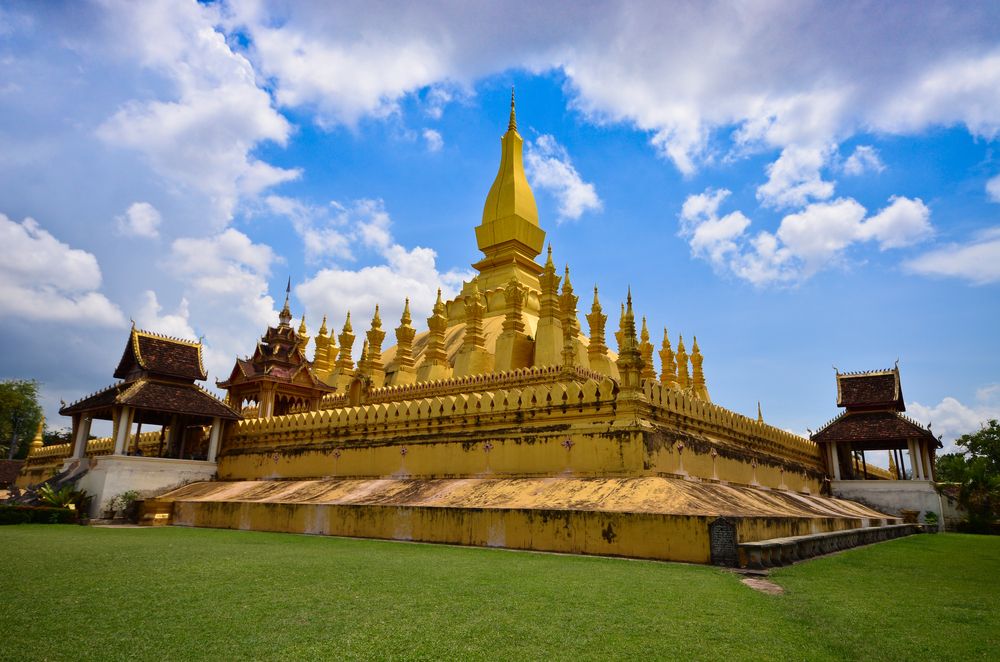
Seen from a distance, the structure is almost abstract. A huge golden central stupa rises above a broad square base, surrounded by smaller stupas and enclosed galleries. The design is austere compared with the richly decorated temples of Luang Prabang, but that restraint gives Pha That Luang its authority. It feels less like a temple building and more like a sacred geometric object.
The current monument is closely associated with King Setthathirath, who rebuilt the site in 1566, only a few years after moving the capital of Lan Xang from Luang Prabang to Vientiane. The decision was political, religious and symbolic at the same time. A new capital needed a monument capable of anchoring royal power, Buddhist legitimacy and national identity in one place.
Today Pha That Luang remains the most important national cultural monument in Laos and the focal point of the country’s major Buddhist festival.
What to See at Pha That Luang
- The Great Golden Stupa
- The central lotus-bud form
- The surrounding smaller stupas
- The cloister and enclosed terraces
- The ceremonial square
- The statue of King Setthathirath
- Wat That Luang Neua
- Wat That Luang Tai
- The reclining Buddha
- The festival grounds
- The architectural symbolism of the monument
- The view of the stupa from the outer precinct
The Origins of Pha That Luang
The religious history of the site is much older than the monument visible today. Lao tradition connects the location with an ancient stupa supposedly established centuries before the Christian era and associated with relics of the Buddha. These very early dates belong partly to religious tradition rather than securely documented architectural history, but they show how strongly the site has been embedded in sacred memory.
What can be stated more clearly is that King Setthathirath constructed the major stupa here in 1566, during the transformation of Vientiane into the capital of Lan Xang. Setthathirath was one of the defining rulers of Lao history, responsible not only for shifting the political centre south but also for major religious projects such as Wat Xieng Thong in Luang Prabang and Haw Phra Kaew in Vientiane.
Pha That Luang therefore belongs to a much larger programme in which architecture helped consolidate a new royal capital.
King Setthathirath and the New Capital
Setthathirath moved the Lan Xang capital from Luang Prabang to Vientiane around 1560, largely because Vientiane occupied a more strategic position along the Mekong and offered better protection against pressure from Burmese forces.
The transfer created a problem of legitimacy. Luang Prabang possessed deep royal and religious prestige, while Vientiane needed new monuments capable of giving the capital sacred weight. Haw Phra Kaew housed the Emerald Buddha, Wat Si Muang became associated with the city pillar and protective spirits, and Pha That Luang emerged as the grand national stupa.
The architecture communicated something very clear: political authority might have moved south, but Buddhist legitimacy had moved with it.
What Pha That Luang Means
A stupa is not a temple in the Western architectural sense. Its central purpose is commemorative and reliquary rather than congregational. In Buddhist tradition, stupas may contain sacred relics, mark important locations or represent the presence and teachings of the Buddha through architecture.
Pha That Luang is traditionally believed to enshrine a relic of the Buddha, making it a pilgrimage site as well as a national monument. The exact archaeological history of the relic cannot be treated in the same way as a modern museum inventory, but religious significance does not depend on scientific verification alone.
For Lao Buddhists, the stupa represents merit, sacred protection and continuity. For the modern Lao state, it also functions as a visual shorthand for national identity.
That combination explains why its silhouette appears so frequently on official emblems, currency, government imagery and public architecture.
The Architecture
The monument rises to approximately 45 metres and is organised as a sequence of square terraces supporting the elongated central stupa.
Unlike the rounded hemispherical stupas common in early Indian Buddhism, Pha That Luang uses a distinctly Lao vertical profile. The central form narrows upward like an elongated lotus bud, one of Buddhism’s most enduring symbols of purity and spiritual awakening.
The outer terraces are lined with smaller stupas, producing a repeated rhythm around the central mass. This creates a strong geometric hierarchy: many smaller sacred forms surrounding one dominant central element.
The building is not covered entirely in solid gold. The upper pinnacle contains real gilding, while much of the visible exterior is finished in golden colour, a practical distinction often lost in travel descriptions.
Seen under intense tropical sunlight, the difference matters very little visually.
The Lotus Symbolism
The lotus grows from muddy water but opens into a clean flower above the surface, making it a natural Buddhist metaphor for spiritual transformation.
At Pha That Luang, the elongated central profile resembles a closed or partially opened lotus bud rather than a naturalistic flower. The symbolism is therefore embedded in the overall geometry rather than added as decoration.
This helps explain why the monument feels unusually pure compared with highly ornamented temples elsewhere in Laos. Its meaning depends on form, proportion and repetition rather than dense narrative carving.
The effect becomes particularly strong at sunset or immediately after rain, when the gold surface contrasts sharply with dark clouds.
The Thirty Smaller Stupas
Around the central structure stand thirty smaller stupas, creating one of the most distinctive features of the monument.
The number is generally connected with Buddhist teachings and the idea of accumulated spiritual perfection, although interpretations vary. The repeated forms also reinforce the scale of the central stupa: each small element acts almost like a visual unit showing how much larger the main structure is.
Look at the monument obliquely rather than only from directly in front. From the corners, the overlapping smaller stupas create a dense rhythm that is almost invisible in the classic symmetrical photograph.
The Three Levels
Pha That Luang is organised through three major levels, a structure frequently interpreted in relation to Buddhist cosmology and stages of spiritual progression.
The lowest level creates the physical base and separates the sacred monument from ordinary ground. The next level narrows the space and increases the sense of enclosure, while the upper structure leads visually towards the central pinnacle.
Even if you do not read every level through formal Buddhist symbolism, the architectural effect is clear: movement shifts from broad horizontal stability towards increasingly concentrated vertical ascent.
The monument becomes less earthly as it rises.
The Cloister and Outer Enclosure
The main stupa is surrounded by an enclosed gallery and walls that create a protected sacred precinct. These boundaries matter because Southeast Asian religious complexes often rely on successive thresholds rather than a single dramatic entrance.
Walking around the enclosure gives time to see the stupa from multiple perspectives. The geometry changes considerably as the smaller stupas overlap and separate, while the central form remains visually dominant from almost every position.
Do not simply enter, photograph the front and leave. Circumambulation is part of Buddhist devotional practice, and walking slowly around the monument also happens to be the best way to understand its architecture.
The Destruction of Vientiane
Pha That Luang’s current appearance should not be mistaken for uninterrupted sixteenth-century survival.
Vientiane suffered repeated warfare, and the stupa was damaged more than once. The most destructive period came during nineteenth-century conflict with Siam, particularly around the suppression of King Anouvong’s rebellion in 1827–28, when large sections of Vientiane were destroyed.
The monument fell into serious decline, and treasure hunters and military activity contributed further damage.
This history makes Pha That Luang part of the same fractured architectural story as the rest of Vientiane. Many monuments in the capital look ancient but contain substantial twentieth-century reconstruction because the nineteenth century was so destructive.
French Reconstruction
French colonial authorities became involved in the restoration of Lao monuments after establishing control over the territory in the late nineteenth century.
Early attempts to reconstruct Pha That Luang did not always satisfy Lao religious or aesthetic expectations. Restorers were working from incomplete evidence, damaged architecture and the assumptions of colonial archaeology.
Later reconstruction campaigns attempted to recover a form closer to the traditional Lao monument. Major twentieth-century work culminated in the restoration of 1953, which strongly shaped the appearance visitors see today.
This is important because Pha That Luang is simultaneously sixteenth-century in identity and twentieth-century in much of its physical fabric.
That does not make it less authentic. Sacred monuments across Asia have often been rebuilt repeatedly because religious continuity mattered more than preserving every original brick.
The Golden Surface
The gleaming exterior is central to the monument’s visual power, but the word “golden” can create the wrong impression.
The entire stupa is not constructed from gold or covered uniformly in thick gold leaf. The pinnacle carries genuine gilding, while much of the larger structure is coated in a gold-coloured finish.
Maintenance is therefore crucial. Tropical weather, heat and heavy monsoon rain constantly affect the surface, requiring periodic repainting and restoration.
This repeated renewal is one reason the monument can look exceptionally bright in some years and slightly more subdued in others.
King Setthathirath’s Statue
In front of the stupa stands a statue of King Setthathirath, seated with royal regalia and a sword.
His placement is entirely appropriate. Few rulers are more closely linked with Vientiane’s monumental identity.
Setthathirath founded or rebuilt major religious sites, defended Lan Xang during a period of severe external pressure and moved the capital to Vientiane. His reign connects Luang Prabang and Vientiane more strongly than almost any other figure in Lao history.
The statue is not simply decorative commemoration. It visually positions the ruler between modern visitors and the monument he created.
Wat That Luang Neua
On the northern side of the great stupa stands Wat That Luang Neua, an active monastery that adds a living religious dimension to the monumental precinct.
The temple is associated with senior members of the Lao Buddhist clergy and remains an important monastic institution. Its architecture is more richly decorated and recognisably temple-like than the austere stupa nearby, making the contrast useful.
The great golden monument represents national sacred authority. The monastery shows the daily religious community that surrounds it.
Spend a few minutes here rather than treating the complex as a single isolated stupa.
Wat That Luang Tai
To the south lies Wat That Luang Tai, another monastery within the broader sacred landscape.
The temple is especially memorable for the large reclining Buddha outside, whose golden figure provides a completely different visual language from the strict geometry of Pha That Luang.
Reclining Buddha images commonly represent the Buddha entering Parinirvana, the final passing beyond the cycle of rebirth.
The sculpture is considerably more approachable and human in scale than the main stupa, making the southern temple an effective counterpoint to the national monument.
The Reclining Buddha
The reclining Buddha is one of the most photographed secondary features around Pha That Luang, yet many visitors rush past it after seeing the main stupa.
Its posture is not one of sleep. The Buddha lies on his right side with the head supported, representing the final moments before entry into Parinirvana.
That distinction matters because Buddhist sculpture communicates through posture. Standing, seated, walking and reclining Buddhas often represent different episodes or spiritual ideas rather than simply different artistic preferences.
The image also makes an excellent stop late in the day, when the lower sun creates deeper shadows across the figure.
The That Luang Festival
Pha That Luang becomes completely different during Boun That Luang, the most important annual festival in Vientiane and one of the major religious celebrations in Laos.
The festival lasts several days around the full moon, usually in November. In 2026, the main festival period falls on 26–27 October, following the lunar calendar.
One of the defining traditions is the Phasat Pheung procession, involving elaborate wax castles decorated with flowers, candles, incense and offerings. The procession begins from Wat Si Muang and continues towards Pha That Luang.
Pilgrims arrive from across the country, monks gather in large numbers, and the normally spacious precinct becomes dense with people, food stalls, ceremonies and markets.
If you want quiet architecture, avoid the festival.
If you want to understand why the monument matters, come during it.
The Dawn Alms Ceremony During the Festival
One of the most powerful moments occurs early in the morning, when huge numbers of worshippers gather to offer food and donations to monks.
Rows of monks receive alms while families kneel with baskets of sticky rice and other offerings. The ceremony operates on a completely different scale from the intimate Tak Bat of Luang Prabang.
This is not staged folklore. Merit-making remains central to Lao Buddhist practice, and the festival intensifies an activity that occurs daily across the country.
Visitors should stand back unless they understand how to participate correctly.
Ti Khee: The Festival Game
One of the more unusual traditions associated with That Luang Festival is Ti Khee, a game played using a ball and long curved sticks.
It resembles a traditional form of hockey and adds a surprisingly secular, communal element to the religious festival.
This mixture is typical of major Southeast Asian Buddhist celebrations, where pilgrimage, prayer, trade, music, food and entertainment coexist rather than occupying rigidly separate spaces.
The sacred and social dimensions strengthen each other.
Wax Castles and Merit-Making
The festival’s wax castles, or Phasat Pheung, are among its most visually distinctive objects.
These ceremonial structures are decorated with wax, flowers and offerings and carried towards Pha That Luang as acts of devotion. The practice combines craftsmanship with merit-making, transforming temporary objects into religious gifts.
The fact that they are ephemeral is part of the meaning. Buddhist ritual frequently values the act of offering rather than the permanent survival of the object.
During the procession, colour and movement temporarily overwhelm the severe golden geometry of the stupa.
National Symbol and Political Symbol
Pha That Luang belongs simultaneously to religion and state identity.
Its silhouette appears widely in official imagery and has been used on national symbols and currency. State ceremonies and major public events frequently employ the monument as a backdrop or visual reference.
This dual role became particularly significant in modern Laos. A post-revolutionary state needed national symbols capable of transcending regional differences and dynastic history, and Pha That Luang provided exactly that: ancient enough to represent continuity, Buddhist enough to connect with the majority population and monumental enough to function politically.
The result is one of those rare landmarks embraced by both religious tradition and secular national symbolism.
Pha That Luang and Lao Identity
The monument’s importance becomes clearer when compared with Laos’s other famous religious sites. Wat Xieng Thong is arguably more beautiful. Vat Phou is archaeologically older. Pak Ou possesses a more dramatic natural setting.
None carries the same national weight.
Pha That Luang represents not simply Buddhism but Laos as a political and cultural idea. It links the Lan Xang kingdom, Setthathirath, Vientiane, Theravada Buddhism and the modern Lao state in one image.
That is why understanding the history matters more here than identifying every decorative detail.
Best Time of Day to Visit
Early morning is excellent for cooler temperatures, softer light and fewer visitors. The golden surface looks particularly strong against a clear blue sky before tropical haze increases.
Late afternoon is more atmospheric, especially when the sun warms the west-facing surfaces. The surrounding temples and reclining Buddha also become better photographic subjects as shadows lengthen.
Avoid the middle of the day if possible. The precinct offers limited shade and the reflected heat from paved surfaces can be intense.
The stupa is normally closed during the midday break anyway, which naturally encourages a better rhythm.
How Long Do You Need?
Allow around 45–60 minutes for the main stupa and immediate precinct.
Add another thirty minutes if you want to explore Wat That Luang Neua, Wat That Luang Tai and the reclining Buddha properly.
During That Luang Festival, forget normal timings. Crowds, processions and ceremonies can easily turn the visit into half a day.
For architecture alone, one hour is sufficient. For context, give it longer.
How to Visit Pha That Luang in 2026
Pha That Luang is currently open Tuesday to Sunday, from 08:00–12:00 and 13:00–16:00. It is normally closed on Monday.
Admission is around 30,000 kip per person.
The precinct is straightforward to visit independently, and there is no need for a guide unless you want deeper religious or historical interpretation.
Dress respectfully. Shoulders and knees should be covered, especially when entering the surrounding monasteries, and shoes must be removed where indicated.
Getting There
Pha That Luang lies a few kilometres northeast of the Mekong riverfront and historic centre.
Walking from central Vientiane is possible but not particularly attractive in hot weather. A tuk-tuk, taxi or ride-hailing service is usually more sensible.
Combine it with Patuxai, which lies along the same broad urban axis. The two monuments work well together because they represent completely different ideas of national identity: Pha That Luang is sacred, royal and Buddhist; Patuxai is modern, political and post-colonial.
A Good Half-Day Route
Begin at Wat Si Muang, where religious practice feels intimate and active. Continue to Pha That Luang before midday, exploring both the main stupa and southern temple.
After lunch, visit Patuxai and climb to the upper terrace.
The sequence creates a useful narrative:
Wat Si Muang represents the spiritual protection of the city.
Pha That Luang represents national Buddhism.
Patuxai represents modern independence.
Three monuments, three very different versions of Vientiane.
Photography
The classic frontal photograph works, but it is not the most interesting angle.
Walk towards the corners of the enclosure, where the thirty smaller stupas overlap and create stronger depth. Include monks or worshippers only when doing so respectfully and without turning private religious activity into a prop.
Morning light generally produces cleaner colour. Late afternoon creates more dramatic shadows.
During the festival, concentrate on processions, wax castles and the interaction between people and monument rather than trying to reproduce an empty postcard image that no longer exists.
What Most Visitors Miss
The first mistake is assuming the whole monument is covered in solid gold. It is not.
The second is photographing only the central stupa and ignoring the surrounding monasteries, which reveal that Pha That Luang remains part of an active religious complex.
The third is reading the monument as purely ancient. Much of what you see has been reconstructed and restored after centuries of warfare.
And the fourth is missing the political meaning. Pha That Luang is not simply a beautiful Buddhist monument. It is one of the principal visual symbols through which Laos represents itself.
Is Pha That Luang Worth Visiting?
Absolutely.
Vientiane has temples that are older and interiors that are richer, but no other monument explains the city and the country as efficiently as Pha That Luang.
The stupa connects the sixteenth-century ambitions of Setthathirath with Buddhist relic tradition, nineteenth-century destruction, twentieth-century reconstruction and modern national identity. Its geometry is simple enough to be instantly recognisable, yet the history behind that simplicity is anything but straightforward.
Come early, walk around the stupa rather than photographing it from one angle, visit the nearby monasteries and remember that this is not merely Vientiane’s most famous monument.
It is one of the places where Laos explains itself.
Useful Information
- Name: Pha That Luang
- Meaning: Great Sacred Stupa
- Location: Vientiane, Laos
- Main construction: 1566
- Royal patron: King Setthathirath
- Height: approximately 45 metres
- Religious tradition: Theravada Buddhism
- Sacred significance: traditionally believed to contain a relic of the Buddha
- Main architectural motif: elongated lotus-bud stupa
- Secondary features: thirty smaller stupas
- Major restoration: 1953
- Opening: Tuesday–Sunday
- Morning hours: 08:00–12:00
- Afternoon hours: 13:00–16:00
- Closed: Monday
- Admission: around 30,000 kip
- Recommended visit: 45–90 minutes
- Best time: early morning or late afternoon
- Main annual event: That Luang Festival
- 2026 festival period: 26–27 October
- Nearby sights: Wat That Luang Neua, Wat That Luang Tai, reclining Buddha and Patuxai
- Dress: shoulders and knees covered

