
Vientiane Beyond the Mekong: Ancient Temples, Colonial Streets and Laos’s Strangest Sculpture Garden

Vientiane is a capital that refuses to behave like one. There are no frantic walls of skyscrapers, no relentless traffic canyons and none of the sensory overload associated with Bangkok, Hanoi or Ho Chi Minh City. Instead, the Lao capital stretches lazily along a bend of the Mekong River, mixing gilded Buddhist temples, broad French-planned avenues, low-rise neighbourhoods, coffee shops, government buildings and evening food stalls into a city whose greatest luxury is space.
That apparent calm hides a surprisingly violent history. Vientiane became the capital of the Lan Xang kingdom under King Setthathirath in the sixteenth century, was repeatedly attacked, virtually destroyed by Siamese forces in the nineteenth century and then rebuilt under French colonial rule. Its religious monuments therefore range from ancient foundations to reconstructions, while modern landmarks such as Patuxai add another layer of twentieth-century nationalism.
Give Vientiane two full days if possible. One day covers the core temples, Patuxai and the Mekong; a second allows time for Buddha Park, museums, markets and slower exploration. The city does not reward aggressive sightseeing. It works best when you alternate architecture with strong Lao coffee, temple courtyards with noodle soup and late-afternoon heat with a Beerlao beside the river.
What to See in Vientiane
- Pha That Luang
- Patuxai
- Wat Si Saket
- Haw Phra Kaew
- Wat Si Muang
- That Dam
- Presidential Palace exterior
- COPE Visitor Centre
- Mekong Riverside
- Vientiane Night Market
- Talat Sao
- Buddha Park – Xieng Khuan
- Wat Ong Teu
- Wat Mixai
- Wat Inpeng
- Chao Anouvong Park
A Short History of Vientiane
Vientiane developed on the fertile alluvial plains beside the Mekong long before becoming a national capital. Its decisive rise came in the sixteenth century, when King Setthathirath moved the capital of Lan Xang from Luang Prabang to Vientiane around 1560, partly because the location offered better strategic control over southern territories and improved protection from Burmese pressure.
The city became a major religious and political centre, with important monasteries, royal buildings and Pha That Luang reinforcing its status. After Lan Xang fragmented in the early eighteenth century, Vientiane became the centre of its own kingdom, increasingly squeezed between more powerful neighbours. The final disaster came under King Anouvong, whose failed rebellion against Siam ended with the destruction of Vientiane in 1827–28 and the deportation of much of its population.
French colonial expansion transformed the city again from the late nineteenth century. Streets were laid out more systematically, administrative buildings appeared and many religious monuments were repaired or reconstructed. The twentieth century brought independence, war and revolution, culminating in the establishment of the Lao People’s Democratic Republic in 1975. Modern Vientiane still carries every one of these layers, although rarely in a theatrical way.
Pha That Luang: The National Symbol of Laos
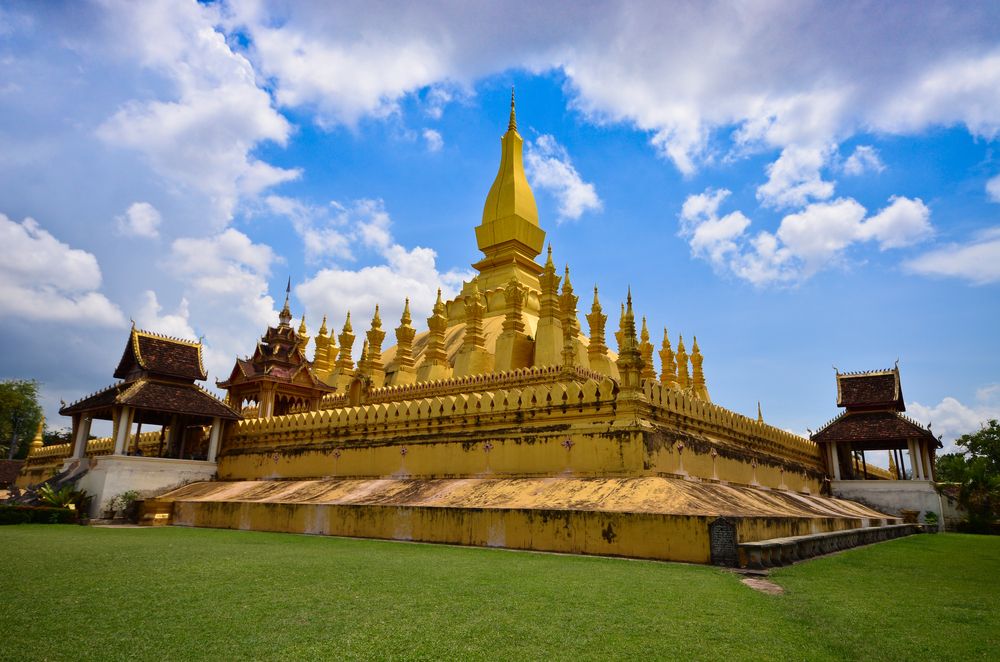
If Vientiane has one monument that goes beyond tourism, it is Pha That Luang, the great golden stupa that functions simultaneously as religious monument, national emblem and political symbol. Its current form is closely associated with King Setthathirath, who rebuilt the sanctuary in 1566 after transferring the capital to Vientiane.
Tradition pushes the sacred history of the site much further back, linking it with Buddhist relics and an earlier sanctuary, although the monument visible today reflects repeated destruction and reconstruction. The stupa was badly damaged during nineteenth-century conflicts and later restored, with major twentieth-century interventions giving it the appearance seen now.
The central structure rises to roughly 45 metres, surrounded by smaller stupas and a cloister-like enclosure. The design is distinctively Lao rather than simply another variation on a Thai chedi: the elongated golden central form rises in successive geometric stages, creating an unusually solid, almost architectural sense of mass.
Pha That Luang is usually open Tuesday to Sunday from 08:00–12:00 and 13:00–16:00, with an admission charge currently around 30,000 kip. Dress conservatively; shoulders and knees should be covered.
That Luang Festival
The best time to understand what Pha That Luang means to Lao people is during the That Luang Festival, held around the full moon in November. Pilgrims, monks and visitors gather for religious ceremonies, processions, offerings and a large trade fair, turning the normally calm precinct into one of the most important annual events in Laos.
One of the most distinctive traditions is the wax castle procession, connected with Wat Si Muang before continuing towards That Luang. Decorative wax structures, flowers, incense and offerings are carried through the city, combining Buddhist merit-making with a strongly communal celebration.
If your dates coincide with the festival, expect crowds but do not avoid them. This is one occasion when the national monument feels less like a landmark and more like a living religious centre.
Patuxai: Vientiane’s Monumental Contradiction
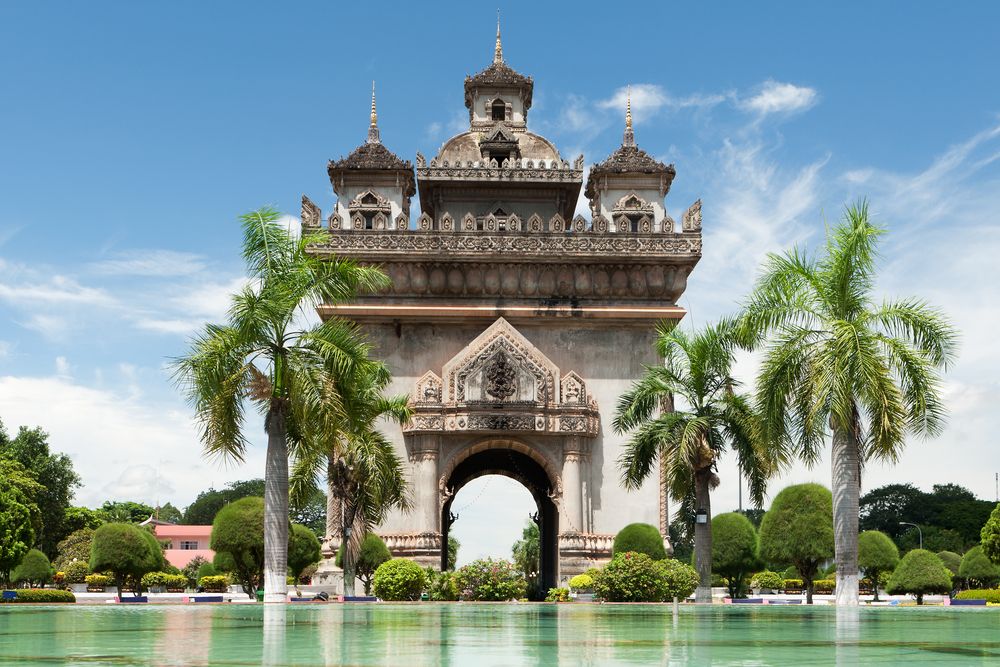
Patuxai is immediately familiar and completely strange. Its central arch recalls the Arc de Triomphe, yet the upper towers, decorative reliefs and mythological motifs are unmistakably Lao. The monument was begun in the late 1950s and developed during the following decade as a memorial to those who fought for independence.
Look upward beneath the arches and the European silhouette begins to dissolve. Decorative elements include kinnari, the graceful half-woman, half-bird creatures found in Southeast Asian mythology, alongside lotus motifs and Buddhist imagery.
The best reason to enter is the view. Stairs lead through internal levels to an elevated terrace overlooking Lane Xang Avenue, with Pha That Luang visible in the distance and the low-rise city stretching towards the Mekong. In a capital without many high buildings, the perspective is surprisingly useful.
Patuxai is currently open daily from approximately 08:00 to 17:00, with admission around 30,000 kip.
Why Patuxai Is More Interesting Than Its Nickname
Calling Patuxai “the Arc de Triomphe of Vientiane” is convenient and slightly lazy. The French influence is obvious, but the monument is more interesting as a hybrid created in a newly independent state trying to build a national architectural vocabulary from colonial urbanism and Lao symbolism.
That mixture explains why it can look both familiar and eccentric. European monumental planning survives in the broad avenue and triumphal arch format, while the decoration pushes insistently back towards local mythology and religious forms.
Visit once from ground level, then climb. Patuxai makes considerably more sense when seen as part of the urban axis rather than as an isolated monument.
Wat Si Saket
Wat Si Saket is arguably the most important historical temple in central Vientiane because it survived the destruction that erased much of the old city. Built in 1818 under King Anouvong, it remained largely intact when Siamese forces devastated Vientiane a decade later.
The survival may have been helped by the temple’s architecture, which shows strong Siamese influence and may therefore have appeared more familiar to invading troops. Whatever the reason, Wat Si Saket now provides one of the clearest surviving links with pre-destruction Vientiane.
The cloister is its defining feature. Thousands of Buddha images occupy niches and shelves along the surrounding walls, ranging from tiny figures to larger bronze and wooden sculptures. Current counts generally exceed 6,000 images, creating a dense visual rhythm that becomes more impressive the longer you stay.
Opening hours are normally 08:00–12:00 and 13:00–17:00, with admission around 30,000 kip. Allow at least forty-five minutes rather than rushing through the courtyard.
The Buddha Images of Wat Si Saket
Do not treat the thousands of Buddha figures as a single decorative wall. Their differences matter. Materials, gestures, proportions and facial styles reflect changing artistic traditions across Laos and neighbouring regions, while the sheer quantity turns the cloister into something between monastery, devotional archive and sculpture collection.
Many smaller niches were designed to hold paired images, creating a repetitive pattern that makes the walls appear almost perforated. Larger sculptures sit below them, producing a hierarchy of scale rather than a chaotic accumulation.
Early morning is the best time to look closely, before heat and visitor numbers rise.
Haw Phra Kaew
Directly opposite Wat Si Saket stands Haw Phra Kaew, one of the most historically loaded buildings in Vientiane. King Setthathirath commissioned the royal temple in 1565 to house the Emerald Buddha, the revered image he had brought with him after ruling in Chiang Mai and returning to Laos.
The statue remained here until Siamese forces captured Vientiane in the late eighteenth century and took it south. Today the Emerald Buddha is enshrined in Bangkok’s Wat Phra Kaew, while the Vientiane sanctuary—destroyed and reconstructed more than once—functions primarily as a museum of Buddhist art.
The current building largely reflects the twentieth-century reconstruction completed during the French colonial period. Inside and around the terrace are Buddha sculptures, carved doors, religious objects, Khmer stone pieces and examples of Lao sacred art. Admission is generally around 30,000 kip, with opening hours from 08:00–12:00 and 13:00–16:00.
The Missing Emerald Buddha
The absence of the Emerald Buddha is part of what makes Haw Phra Kaew interesting. The temple was built for an object that is no longer there, and the missing image embodies centuries of rivalry, shifting borders and political power between Laos and Siam.
The statue’s journey passed through Chiang Rai, Lampang, Chiang Mai, Luang Prabang and Vientiane before eventually reaching Bangkok. Following that route is almost a compressed history of mainland Southeast Asian kingdoms.
Haw Phra Kaew is therefore worth visiting even if religious museums are not normally your priority. Its empty original purpose tells as much history as the objects now displayed inside.
Wat Si Muang
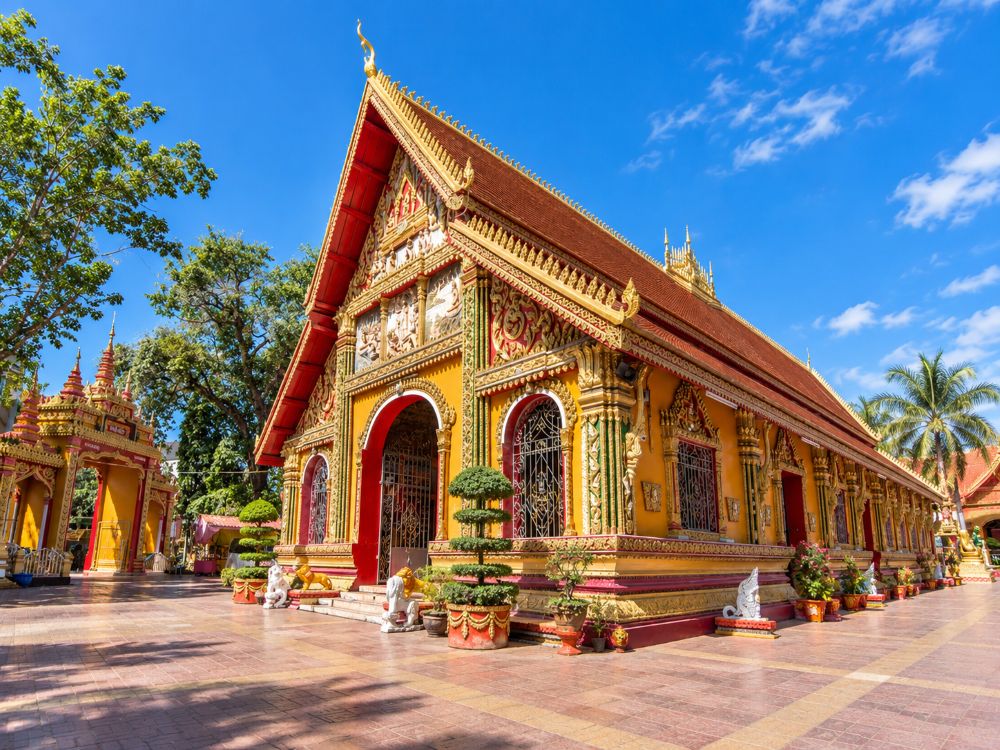
Wat Si Muang is less visually monumental than That Luang but more revealing about everyday religious practice. The temple houses Vientiane’s sacred city pillar and is closely associated with protective spirits, good fortune and promises made by worshippers.
Local tradition centres on a woman known as Nang Si, whose spirit is believed to protect the site. The story describes her sacrificing herself during the installation of the city pillar, creating a striking example of how older animist beliefs became intertwined with Theravada Buddhism rather than simply disappearing beneath it.
The temple is busy throughout the day with people bringing flowers, candles and offerings, asking for help with work, relationships, travel or family matters. It is normally open from roughly 07:00 to 20:00 and does not require the same museum-style visit as Wat Si Saket.
Come quietly and watch how the temple is actually used.
That Dam: The Black Stupa
In the middle of a traffic circle stands one of Vientiane’s strangest monuments: That Dam, the Black Stupa. Unlike the meticulously restored gold of Pha That Luang, this structure remains dark, weathered and partially consumed by vegetation.
Local legend once connected the stupa with a seven-headed naga believed to protect the city. During the Siamese destruction of Vientiane, the mythical serpent was said to have attempted to defend the population. Another tradition links the monument with treasures supposedly removed during nineteenth-century conflict.
The appeal lies largely in its condition. That Dam looks forgotten in a city increasingly filled with new construction, and that neglect gives it more atmosphere than a polished restoration probably would.
It takes only a few minutes to see, but those few minutes are worthwhile.
Presidential Palace
The Presidential Palace stands near Haw Phra Kaew and Wat Si Saket, closing one of the most architecturally interesting intersections in central Vientiane. The building reflects French colonial planning and later political use, with a formal façade, manicured grounds and a position of obvious symbolic importance.
It is not generally open for casual sightseeing, so treat it as an exterior landmark rather than planning an interior visit. The best view comes while walking between Haw Phra Kaew and the river.
The surrounding district is also useful for reading Vientiane’s urban history: temples, colonial planning and modern state architecture sit within a few hundred metres of one another.
COPE Visitor Centre
COPE provides the sharpest break from Vientiane’s temples and monuments. Its exhibitions focus on the continuing impact of unexploded ordnance, or UXO, left across Laos after the conflicts of the twentieth century.
Laos became one of the most heavily bombed countries per capita in history during the Indochina wars. Large quantities of ordnance failed to explode on impact and remain dangerous decades later, particularly in rural areas. COPE explains both the historical context and the contemporary medical consequences, including rehabilitation and prosthetic support.
The centre is not large, but the material is powerful precisely because it avoids turning war into abstract statistics. Allow around an hour and do not rush directly from display to display.
For understanding modern Laos, this is one of Vientiane’s most important stops.
Mekong Riverside
By late afternoon, move towards the Mekong.
The riverfront is where Vientiane relaxes. Joggers, families, cyclists and groups of teenagers gather as temperatures fall, while stalls begin opening and the western sky changes colour over Thailand on the opposite bank.
The Mekong here functions as both landscape and international border. Thailand is close enough to see clearly, giving the sunset an unusual geographical immediacy: another country begins across the water.
Walk through Chao Anouvong Park, continue along the promenade and stay through sunset. Vientiane is not a city of spectacular skylines, so the broad river horizon provides the visual drama.
Vientiane Night Market
As evening develops, the riverfront becomes a shopping strip dominated by the Vientiane Night Market. Red-roofed stalls sell clothing, accessories, souvenirs, electronics and inexpensive goods, while food vendors occupy surrounding streets and sections of the promenade.
Do not expect an artisanal market curated for travellers. Much of the merchandise is generic, and that is part of the experience. The market is used by locals as well as visitors and functions more as an evening social space than a heritage attraction.
Come for the atmosphere, river walk and food rather than expecting rare handicrafts.
Talat Sao
Talat Sao, the Morning Market, occupies an important central position near the bus hub and Lane Xang Avenue. Despite the name, the modern complex operates well beyond the morning and mixes jewellery, textiles, electronics, household goods and imported products.
The surrounding streets are often more interesting than the modern shopping sections. Look for textile shops, gold sellers and smaller stalls rather than expecting the atmosphere of a traditional covered food market.
Talat Sao is also becoming increasingly important as a transport point because Vientiane’s expanding BRT network uses the area as a central station.
Buddha Park – Xieng Khuan
About 25 kilometres southeast of Vientiane, beside the Mekong, lies one of Laos’s most eccentric attractions. Xieng Khuan, better known as Buddha Park, contains more than 200 concrete sculptures combining Buddhist and Hindu imagery.
The park was created in 1958 by Luang Pu Bunleua Sulilat, a mystic and spiritual teacher fascinated by both traditions. The sculptures are deliberately theatrical: multi-armed deities, demons, animals, ascetics and monumental Buddhas fill the riverside garden.
The most striking figure is a reclining Buddha approximately 40 metres long, but the park’s defining object is the enormous pumpkin-like structure near the entrance. Enter through a demon’s mouth and climb through symbolic levels representing Hell, Earth and Heaven before emerging on the roof.
The stairs are narrow and steep. Skip the climb if enclosed spaces or heights are uncomfortable.
Why Buddha Park Looks Ancient but Is Not
One of the pleasures of Xieng Khuan is the visual deception. Weathered concrete, exaggerated forms and tropical vegetation make many sculptures look far older than their actual mid-twentieth-century date.
The park is not a ruined archaeological site and should not be interpreted as one. It is closer to visionary folk architecture, created by a modern religious eccentric working with concrete rather than an ancient royal patron working with stone.
Sulilat later created another extraordinary sculpture park across the Mekong in Nong Khai, Thailand, after leaving Laos. Seeing both gives an even clearer picture of his highly personal religious imagination.
Allow 60–90 minutes at Xieng Khuan, plus travel time from central Vientiane.
Wat Ong Teu, Wat Mixai and Wat Inpeng
Central Vientiane rewards travellers who stop entering only the famous temples. Wat Ong Teu, Wat Mixai and Wat Inpeng sit within walking distance of the riverfront and provide a quieter view of everyday monastic life.
Wat Ong Teu is particularly notable for its large bronze Buddha and its historical connection with Buddhist education. Wat Mixai has a lively neighbourhood atmosphere, while Wat Inpeng offers another example of traditional Lao religious architecture tucked among guesthouses, restaurants and city streets.
None requires a long visit. Fifteen or twenty minutes at each is enough, but together they prevent Vientiane from becoming a checklist of national monuments.
French Colonial Vientiane
French colonial architecture survives in scattered fragments rather than one perfectly preserved district. Government offices, old villas and administrative buildings appear between newer structures, particularly around the central grid between the Mekong and Lane Xang Avenue.
The French rebuilt Vientiane as an administrative centre after the city had spent decades in decline. Their urban plan introduced broader streets and more formal geometry, but Vientiane never received the monumental colonial investment seen in Hanoi or Saigon.
That relative modesty is important. The colonial city always remained small, and modern Vientiane still feels closer to a provincial river capital than a metropolis.
What to Eat in Vientiane
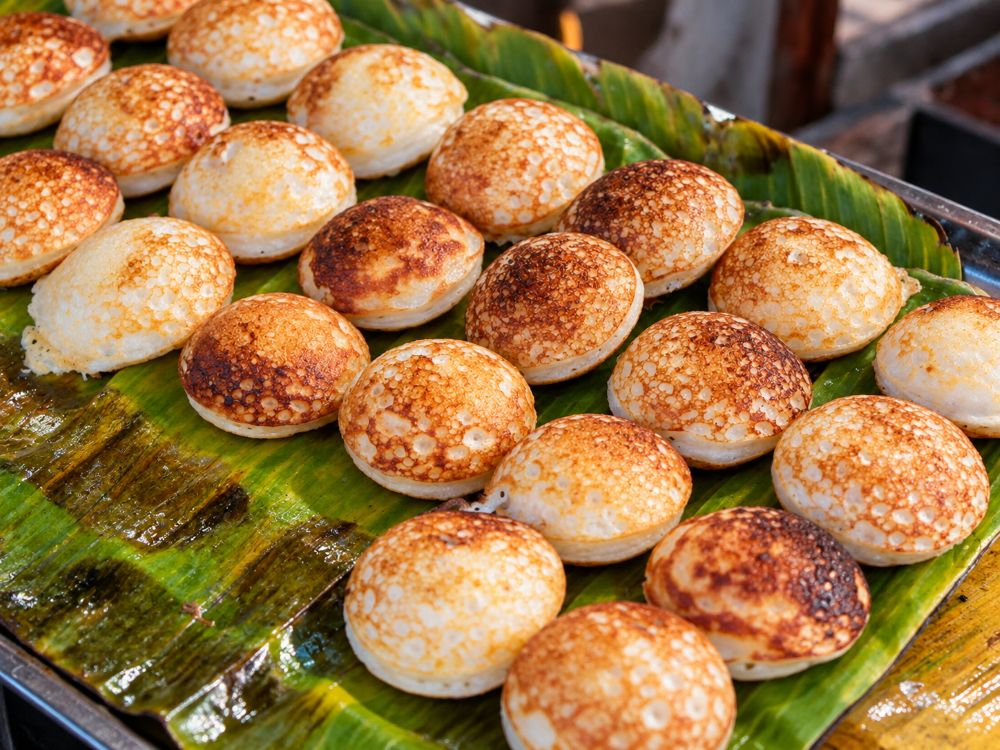
Lao cuisine deserves considerably more attention than it receives. The foundation is sticky rice, eaten with the fingers and paired with grilled meat, salads, soups and intensely flavoured dips known as jaew. Meals often combine smoke, herbs, fermented fish, lime, chilli and bitterness rather than relying on sweetness.
Start with laap, the famous minced-meat or fish salad mixed with toasted rice powder, herbs and lime. Then try tam mak hoong, the Lao version of green papaya salad, which can be considerably more pungent than Thai som tam thanks to fermented fish sauce. Mok pa wraps seasoned fish with herbs inside banana leaves before steaming it, while ping kai brings smoky grilled chicken to the table with sticky rice and dipping sauce.
For something comforting, order khao piak sen, a thick rice-noodle soup with a slightly chewy texture. Another excellent choice is or lam, a rich stew associated more strongly with northern Laos but commonly found on serious Lao menus in the capital.
And learn one word quickly: padaek. This deeply fermented fish condiment is central to Lao cooking and contributes the savoury intensity that distinguishes many local dishes.
What to Drink
The obvious starting point is Beerlao, one of the most recognisable Lao brands and a perfectly logical match for spicy food, grilled meats and humid evenings beside the Mekong. Beerlao Lager is the classic easy-drinking bottle; Beerlao Dark offers more malt depth when you want something richer with grilled pork or beef.
Coffee is equally important. Much of Laos’s best arabica and robusta comes from the Bolaven Plateau in the south, and Vientiane has developed a strong café culture around it. Order it black if you want to understand the beans; order Lao iced coffee with condensed milk when the temperature makes intellectual purity less appealing.
For something stronger, lao-lao is the traditional rice spirit. Quality varies enormously, from rustic village distillates to cleaner bottled examples, so treat the first unidentified shot offered from a plastic container with appropriate curiosity rather than blind confidence.
Where to Eat in Vientiane
Tamnak Lao Restaurant Vientiane
Tamnak Lao has been serving Lao cuisine since 1993 and is one of the easiest places for first-time visitors to explore traditional flavours in a comfortable setting. The menu has strong Luang Prabang influences, with dishes such as Lao sausage, papaya salad, fish with lemongrass, Mekong fish soup and different styles of laap. Traditional music and dance are part of the evening experience, making it more formal than a neighbourhood restaurant but useful for a broad introduction.
Address: No. 100, 23 Singha Road, Phonxay Village, Vientiane
Telephone: +856 21 413562
Opening: Monday–Saturday, 11:00–14:00 and 18:00–21:00
Price: $$–$$$
Best for: Traditional Lao cuisine and first-time visitors
Kualao Restaurant
Kualao is another long-established Vientiane reference for Lao cooking, with a more polished dining-room atmosphere and a broad selection designed to introduce regional dishes rather than concentrate on one narrow style. It works especially well when you want a full dinner built around several shared plates rather than a quick bowl of noodles.
Address: 134 Rue Samsenthai, Vientiane
Telephone: +856 21 214813 / +856 21 215777
Opening: daily, 11:00–14:00 and 18:00–22:00
Price: $$–$$$
Best for: A broad Lao tasting dinner and groups
Le Padaek
Le Padaek takes its name from the fermented fish condiment at the heart of Lao cooking, immediately signalling a stronger local identity than the average international restaurant. The cooking is useful for travellers ready to move beyond cautious introductory flavours and explore the herbal, sour, spicy and fermented edge of the cuisine.
Telephone: +856 30 5557766
Opening: daily, 11:00–22:00
Price: $$
Best for: Contemporary Lao flavours and a more confident introduction to padaek-driven cooking
Where to Stay in Vientiane
DoubleTree by Hilton Vientiane
The DoubleTree is one of the most convenient modern choices for exploring the centre on foot. It sits close to the river, Night Market and Wat Mixai, while the rooftop pool is particularly welcome after a day of temples in tropical heat.
Address: Manthatourath Road, Ban Xieng Ngeun, Chanthabouly District, Vientiane 01000
Telephone: +856 21 457878
Check-in: 15:00
Check-out: 12:00
Best for: Central location, modern comfort and riverfront evenings
Crowne Plaza Vientiane by IHG
Crowne Plaza is a larger international-style hotel with pool, spa, fitness centre and two restaurants. It is slightly removed from the tightest historic cluster but remains close enough for quick taxi or tuk-tuk transfers and works particularly well for longer stays where hotel facilities matter.
Address: 20 Rue Samsenthai, Nongduang Nua Village, Vientiane 01000
Telephone: +856 21 908888
Check-in: 15:00
Check-out: 12:00
Best for: Full-service comfort, spa facilities and business travellers
Lao Plaza Hotel
Opened in 1997, Lao Plaza became the country’s first official five-star hotel and remains one of the best-known addresses in central Vientiane. The style is more traditional and business-oriented than the newest international properties, but the location on Samsenthai Road is extremely practical.
Address: 63 Samsenthai Road, Xieng Ngeun Village, Chanthabouly District, Vientiane 01000
Telephone: +856 21 218800
Check-in: from 14:00
Check-out: by 14:00
Best for: Central access, traditional five-star service and business travel
A Perfect One-Day Vientiane Itinerary
Start early at Wat Si Saket while the courtyard is still quiet, then cross the road to Haw Phra Kaew. Continue to Wat Si Muang before taking a tuk-tuk or taxi to Pha That Luang, where late morning light gives the golden stupa its strongest colour.
After lunch, visit Patuxai and climb to the upper terrace. Continue to the COPE Visitor Centre in the afternoon, then return towards the Mekong before sunset. Finish with a river walk, Night Market and Lao dinner.
The itinerary is compact enough to avoid rushing while still covering the essential religious, historical and modern sides of the city.
Two Days in Vientiane
Use the first day for the central temples, Pha That Luang, Patuxai and Mekong. On the second morning head to Buddha Park, ideally before midday heat becomes aggressive, then return to central Vientiane for Talat Sao, That Dam and smaller temples around the old quarter.
Use the final afternoon slowly. A café, massage or extended lunch is not wasted time here; it is closer to the rhythm of the city than squeezing in another four temples.
Two days also give enough margin for unpredictable tropical weather and temple opening breaks around midday.
How Long Do You Need in Vientiane?
One full day is enough for the essential monuments, but two days is the ideal minimum. Three days makes sense if you enjoy café culture, museums, food or want to visit Buddha Park without compressing the rest of the city.
Vientiane suffers when treated as a transit stop between Thailand, Vang Vieng and Luang Prabang. Its attractions are less spectacular than Luang Prabang’s, but the city offers a clearer picture of contemporary Lao urban life.
Do not judge it by the number of monuments per hour.
Getting Around Vientiane
The central area is reasonably compact and many major sights can be reached on foot, particularly around Wat Si Saket, Haw Phra Kaew and the Mekong. Heat changes the calculation. A twenty-minute walk at 08:00 and the same walk at 14:00 can feel like two completely different journeys.
Tuk-tuks and ride-hailing services are useful for Pha That Luang, COPE and longer cross-city trips. Agree on the fare before entering a conventional tuk-tuk.
Vientiane also relaunched its BRT system in 2026, with services operating roughly from 06:00 to 22:00. The expanding network includes Talat Sao and Patuxai and is becoming more useful for visitors as routes increase.
Getting to Buddha Park
Buddha Park lies roughly 25 km southeast of central Vientiane, near the First Lao–Thai Friendship Bridge. A taxi, private driver or tuk-tuk is the easiest option if several people are travelling together.
Public buses are cheaper but slower, and schedules can change. Whatever method you choose, allow roughly half a day including transport and the visit.
Go early. The park is exposed and midday heat can turn the symbolic journey from Hell to Heaven inside the pumpkin into a surprisingly literal physical experience.
Arriving by Air
Wattay International Airport is remarkably close to the city, only a few kilometres west of central Vientiane. Transfers are therefore much shorter than in many Asian capitals, generally taking around 10–20 minutes depending on traffic and hotel location.
International connections link Vientiane with major regional hubs, while domestic flights connect the capital with other parts of Laos.
If your hotel offers a reasonably priced airport transfer, it can be worth arranging simply to avoid negotiating immediately after arrival.
Arriving by Train
The Laos–China Railway has transformed travel through northern Laos since opening in 2021. Fast trains connect Vientiane with Vang Vieng, Luang Prabang and northern Laos, while international services continue through to China.
In 2026, international passenger services between Vientiane and Kunming have expanded, making rail increasingly important for regional travel. The principal Vientiane railway station is outside the historic centre, so allow additional road-transfer time rather than assuming the train arrives downtown.
For most visitors heading north, train is now substantially faster and more comfortable than the old road journeys.
Crossing to Thailand
Thailand lies directly across the Mekong, but the main land crossing is outside central Vientiane at the First Lao–Thai Friendship Bridge near Nong Khai. Buses and taxis connect the capital with the border, while onward rail and road connections provide access to northeastern Thailand and Bangkok.
Do not confuse seeing Thailand across the riverfront with being able to cross directly from central Vientiane. There is no casual city-centre ferry border crossing for international travellers.
Best Time to Visit Vientiane
The most comfortable period runs roughly from November to February, when temperatures are cooler and rainfall is limited. November has the additional attraction of the That Luang Festival.
March to May can be brutally hot, especially in the afternoon, while the rainy season generally intensifies from May through October. Rain rarely makes the city impossible to visit, but sudden heavy downpours can flood streets and complicate walking.
Late November and December provide the easiest combination of dry weather, pleasant evenings and clear Mekong sunsets.
Temple Etiquette
Vientiane’s temples remain religious spaces, even when an entrance ticket is involved. Cover shoulders and knees, remove shoes where indicated and avoid touching Buddha images or climbing onto religious structures for photographs.
Do not position your feet directly towards Buddha statues when sitting, and keep your voice low during ceremonies. Monks may be happy to speak with visitors, but treat the interaction as conversation rather than a photo opportunity.
Women should also be aware of traditional restrictions surrounding physical contact with monks.
Coffee in Vientiane
Coffee culture is one of Vientiane’s underrated pleasures. French influence left a strong café habit, while Lao beans from the Bolaven Plateau have given modern coffee shops a genuinely local raw material to work with.
You will find everything from sweet condensed-milk coffee to carefully prepared espresso and pour-over. A strong iced coffee in the early afternoon is not merely enjoyable; during the hot season it can become an operational necessity.
Vientiane is one of those cities where adding forty-five minutes for coffee often improves the itinerary rather than wasting it.
Small Curiosities Worth Knowing
Vientiane’s name is often translated as “City of Sandalwood,” although linguistic interpretations vary. The city became the Lan Xang capital only in the sixteenth century, meaning Luang Prabang retained the older royal prestige even after political power moved south.
Wat Si Saket survived the nineteenth-century destruction that erased much of Vientiane, making its thousands of Buddha images far more than decorative curiosities. Haw Phra Kaew, meanwhile, was constructed for the Emerald Buddha now kept in Bangkok, leaving the Lao capital with a temple whose most famous object is conspicuously absent.
Patuxai borrows the basic language of a European triumphal arch but covers it in Lao mythological imagery, while Buddha Park looks ancient despite dating only from 1958. The Mekong also performs an unusually visible geopolitical role: at sunset, the land directly opposite the promenade is Thailand.
Is Vientiane Worth Visiting?
Yes, but Vientiane requires the right expectations.
Come looking for Bangkok and it feels sleepy. Come looking for Luang Prabang and it feels comparatively ordinary. Approach it as a low-rise Mekong capital where Buddhist ritual, colonial history, modern Lao politics and everyday life overlap without much theatrical packaging, and the city becomes considerably more interesting.
The essential sights are strong enough: Pha That Luang is one of Southeast Asia’s great national stupas, Wat Si Saket preserves extraordinary religious art and Buddha Park is wonderfully strange. Yet Vientiane’s real character emerges between them—in temple courtyards, bowls of khao piak sen, coffee breaks, late-afternoon tuk-tuk rides and the slow migration of half the city towards the Mekong at sunset.
Do not over-schedule it.
Vientiane is one capital where moving more slowly is not a compromise. It is the correct way to visit.
Useful Information
- Country: Laos
- Status: National capital
- River: Mekong
- Ideal stay: 2 days
- Best season: November–February
- Essential monument: Pha That Luang
- Best historical temple: Wat Si Saket
- Best city view: Patuxai
- Most unusual excursion: Buddha Park – Xieng Khuan
- Best evening area: Mekong Riverside
- Essential food: laap, sticky rice, tam mak hoong, mok pa and khao piak sen
- Essential drink: Beerlao and Lao coffee
- Airport: Wattay International Airport
- Rail: Laos–China Railway to Vang Vieng, Luang Prabang and northern Laos
- Urban transport: walking, tuk-tuk, taxis, ride-hailing and expanding BRT
- Temple clothing: shoulders and knees covered
- Currency: Lao kip
- Buddha Park distance: approximately 25 km from central Vientiane
- Pha That Luang admission: around 30,000 kip
- Wat Si Saket admission: around 30,000 kip
- Haw Phra Kaew admission: around 30,000 kip
- Patuxai admission: around 30,000 kip

