
Canterbury Through Two Thousand Years, from Roman Durovernum and Saint Augustine to Chaucer and the Reformation

Few English cities compress so much history into such a small area as Canterbury.
Roman streets survive beneath modern buildings. A medieval gate still controls the western entrance to the old city. The River Stour slips beneath bridges, gardens and timber-framed houses. Beyond the walls stand the ruins of the monastery founded for Augustine’s mission to Anglo-Saxon England, while a small church nearby preserves a Christian tradition older than the cathedral itself.
And then there is Canterbury Cathedral.
For more than fourteen centuries, the city has been one of the principal centres of English Christianity. Augustine arrived from Rome in 597, established his episcopal seat here and began a religious transformation that would alter Anglo-Saxon England. Nearly six centuries later, Archbishop Thomas Becket was murdered inside the Cathedral on 29 December 1170, turning Canterbury into one of medieval Europe’s great pilgrimage destinations.
Those pilgrims changed the city.
They needed roads, inns, food, hospitals and religious houses. They carried stories. They bought badges. They approached Becket’s shrine from England and continental Europe. Around 200 years later, Geoffrey Chaucer transformed that culture of pilgrimage into literature with The Canterbury Tales.
Canterbury is therefore not simply an attractive cathedral city in Kent. It is a place where Roman Britain, Anglo-Saxon Christianity, Norman power, Plantagenet politics, medieval pilgrimage, Tudor destruction and modern England overlap within a centre that can still be crossed on foot in twenty minutes.
A long day covers the principal monuments, but two days are much better. The second allows St Augustine’s Abbey, St Martin’s Church, the Roman Museum, Westgate, the riverside and smaller medieval buildings to be explored without reducing the city to the Cathedral alone.
Things to See in Canterbury
- Canterbury Cathedral
- site of Thomas Becket’s murder
- Trinity Chapel
- Corona
- Cathedral crypt
- medieval stained glass
- Cathedral cloisters
- Christ Church Gate
- St Augustine’s Abbey
- St Martin’s Church
- UNESCO World Heritage Site
- Westgate Towers
- Westgate Gardens
- River Stour
- Eastbridge Hospital
- Greyfriars Chapel
- Canterbury Roman Museum
- The Beaney House of Art & Knowledge
- Mercery Lane
- Buttermarket
- High Street
- St George’s Clock Tower
- Dane John Gardens
- surviving city walls
- Canterbury Castle ruins
- King’s School precincts
- Marlowe Theatre
- medieval timber-framed houses
Roman Canterbury
Canterbury began long before the arrival of Augustine.
The Roman city, known as Durovernum Cantiacorum, developed after the Roman conquest of Britain in the first century AD. It became the principal urban centre of the Cantiaci, the local population of eastern Kent.
Its position was excellent.
Roads connected Canterbury with the ports of the Kent coast, London and other Roman settlements. The city eventually acquired streets laid out on a regular plan, public buildings, baths, temples, houses with mosaic floors and a defensive wall.
Parts of that Roman street pattern still influence Canterbury today.
More importantly, archaeological remains survive beneath the medieval and modern city.
The best place to understand them is the Canterbury Roman Museum, where excavated structures allow visitors to descend physically below contemporary street level into the Roman past.
Canterbury Roman Museum
The museum grew around the remains of a Roman townhouse discovered after bombing during the Second World War exposed archaeological layers beneath the city.
A surviving mosaic pavement forms the centre of the visit.
Reconstructions, objects and excavated remains explain domestic life, trade, food, religion and urban organisation in Roman Canterbury.
This is worth doing before immersing yourself completely in medieval Christianity.
Without the Roman layer, Canterbury can seem to begin magically with Augustine in 597.
It did not.
Augustine established his mission in a city whose strategic importance was already several centuries old.
Canterbury Roman Museum in 2026
Address: Butchery Lane, Canterbury CT1 2JR
Telephone: +44 1227 785575
Opening: daily 10:00–17:00
Last admission: 16:30
Recommended visit: 60–75 minutes
Advance booking is useful during busy periods, although same-day admission is normally available.
Augustine Arrives in Kent
The decisive transformation began in 597.
Pope Gregory the Great sent a mission from Rome under the leadership of Augustine, prior of a monastery in Rome, with the objective of converting the Anglo-Saxons.
Kent was a logical place to begin.
King Æthelberht of Kent was one of the most powerful Anglo-Saxon rulers of his age. His wife Bertha was already Christian and had been allowed to practise her faith.
Augustine and his companions landed in Kent and eventually met the king.
Æthelberht did not convert immediately, but he permitted the missionaries to settle in Canterbury.
The consequences were enormous.
Augustine became the first Archbishop of Canterbury, and the city became the centre of what would develop into the English Church.
St Martin’s Church: Before the Cathedral
To understand Canterbury chronologically, begin not with the Cathedral but with St Martin’s Church.
Bertha was already using a church dedicated to Saint Martin before Augustine’s mission arrived. The building incorporates extremely early masonry, including material associated with the Roman and early Christian periods.
Augustine initially worshipped here.
That makes St Martin’s one of the most important small churches in England.
Its significance is almost inversely proportional to its size.
There are no enormous Gothic vaults, no monumental pilgrimage shrine and no towers dominating the skyline.
Instead, the church preserves the physical environment of Christianity in Kent before the great medieval institutions were built.
The churchyard also contains historical burials and offers a quieter atmosphere than the Cathedral precinct.
St Martin’s Church in 2026
During the high season from 5 May 2026, the church is normally open daily from 11:00 to 15:00.
Sunday worship takes place at 09:00.
Because St Martin’s remains an active church, private events and services can alter access.
Telephone: +44 1227 768072
Recommended visit: 30–45 minutes
St Augustine’s Abbey
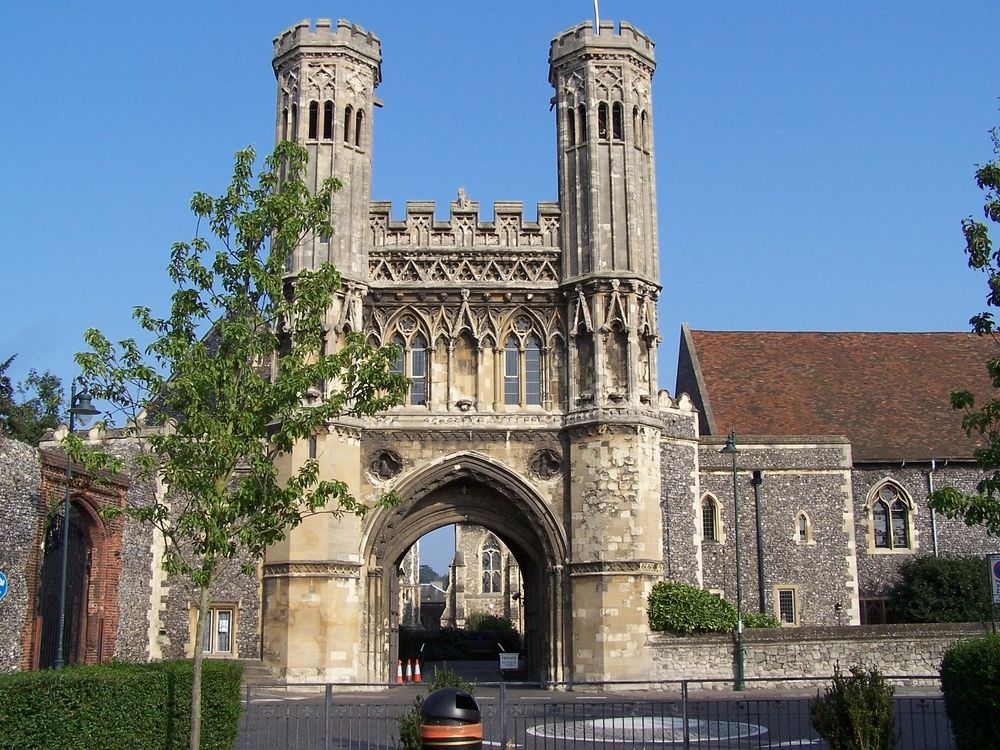
Shortly after Augustine’s arrival, Æthelberht provided land outside the Roman city walls for a monastery.
The monastery was founded around 598 and eventually became known as St Augustine’s Abbey.
This was not a minor religious house.
It became one of the great monasteries of medieval England and the burial place of early archbishops and kings of Kent.
The original Anglo-Saxon complex changed dramatically after the Norman Conquest. New churches and monastic buildings transformed the site into a major Romanesque abbey.
Today most of the monastery survives as ruins.
That does not make the visit secondary.
The foundations reveal the extraordinary scale of the complex, while the museum helps reconstruct successive Anglo-Saxon, Norman and later phases.
The UNESCO World Heritage Site
In 1988, Canterbury Cathedral, St Augustine’s Abbey and St Martin’s Church were inscribed together as a UNESCO World Heritage Site.
The grouping is important.
These are not three unrelated attractions bundled together for convenience.
Together they explain the Christianisation of Anglo-Saxon England and the subsequent development of Canterbury into the ecclesiastical centre of the country.
St Martin’s represents the earliest Christian context.
St Augustine’s represents monastic mission and institutional expansion.
The Cathedral represents the archiepiscopal church that eventually became internationally famous through Becket and pilgrimage.
See all three and the history becomes chronological rather than fragmented.
St Augustine’s Abbey in 2026
From 28 March to 24 October, the abbey is open daily from 10:00 to 17:00, with last admission normally at 16:30.
From late October, hours shorten and winter access becomes more limited, with weekend-only opening during part of the low season.
Ticket prices vary according to date and demand. In the 2026–27 schedule, standard adult admission ranges roughly from £9.26 to £12.32, while booking in advance gives a discount.
Address: Longport, Canterbury CT1 1PF
Telephone: +44 1227 767345
Recommended visit: about 90 minutes
The World Heritage Pass
For visitors who intend to see the complete Christian sequence, a Canterbury World Heritage Pass combines the Cathedral, St Augustine’s Abbey and St Martin’s Church.
The 2026 adult price is around £29.50, with children admitted free under the current scheme.
This is the ticket that makes the most sense for a serious first visit.
The value is not simply financial.
It encourages you to see the three sites as parts of one story.
Canterbury Cathedral
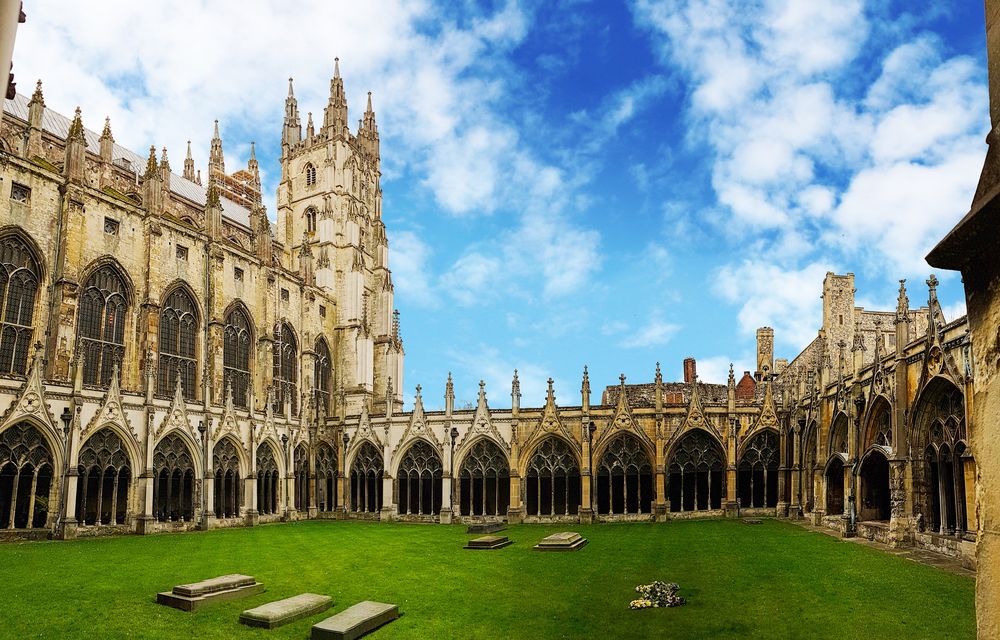
The Cathedral occupies the physical and historical centre of the city.
Its foundations go back to Augustine’s mission, but the building visible today developed principally after the Norman Conquest of 1066 and through repeated medieval rebuilding.
The first Norman archbishop, Lanfranc, began reconstructing the church after a fire in 1067.
His successor Anselm continued the transformation, particularly in the eastern sections.
Then came Thomas Becket.
His murder changed both the Cathedral and Canterbury permanently.
Thomas Becket and Henry II
Thomas Becket was born around 1120 and rose rapidly through royal administration.
King Henry II appointed him Lord Chancellor and later supported his election as Archbishop of Canterbury in 1162.
Henry expected a useful ally at the head of the English Church.
Instead, Becket’s priorities changed.
Once archbishop, he increasingly defended ecclesiastical privileges against royal authority.
Disputes over the jurisdiction of royal courts, the rights of clergy and the broader balance between Crown and Church became bitter.
Becket spent years in exile.
Although reconciliation was eventually attempted, the relationship between king and archbishop remained explosive.
The Murder in the Cathedral
On 29 December 1170, four knights associated with Henry II arrived in Canterbury.
The confrontation moved into the Cathedral.
Becket refused to submit.
He was killed near the north-west transept.
The murder of an archbishop inside his own cathedral sent shockwaves through Christian Europe.
Becket was canonised by Pope Alexander III in 1173, only a little more than two years after his death.
Pilgrims began arriving in enormous numbers.
Canterbury had acquired the religious cult that would define the next three and a half centuries of its history.
Where Becket Was Murdered
The place of the murder is still clearly marked inside the Cathedral.
A modern memorial uses a suspended sword and its shadows to evoke the four weapons of Becket’s attackers.
Do not confuse this location with Becket’s later shrine.
The murder occurred in the transept.
His principal medieval shrine eventually stood much farther east in Trinity Chapel.
The distinction matters because the entire eastern expansion of the Cathedral became shaped by pilgrimage to Becket.
The Fire of 1174
Only four years after the murder, a major fire damaged the eastern part of the Cathedral.
Reconstruction created one of the most important architectural transitions in medieval England.
The French master mason William of Sens began the new choir using an architectural vocabulary associated with early Gothic developments in France.
After he was injured in a fall, work continued under another architect traditionally known as William the Englishman.
The resulting eastern church introduced forms that would profoundly influence English Gothic architecture.
Canterbury therefore became important not only because pilgrims travelled there.
The need to accommodate Becket’s cult helped produce architectural innovation.
Trinity Chapel
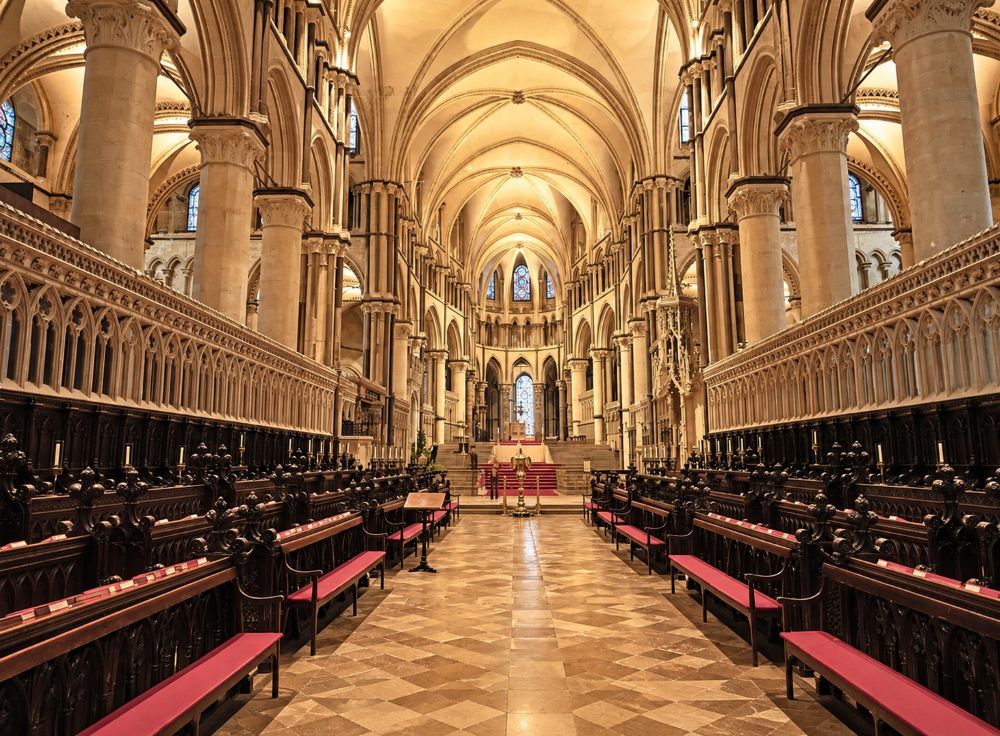
The most sacred destination for medieval pilgrims was Trinity Chapel.
Becket’s remains were transferred there in 1220 during a magnificent ceremony attended by King Henry III and leading church figures.
The shrine became one of the richest in Europe.
Precious metals, jewels and offerings accumulated around it as kings, nobles and ordinary pilgrims came to seek Becket’s intercession.
The chapel’s stained glass also developed around this devotional culture.
Windows illustrated stories of miracles attributed to the saint.
Pilgrims could therefore see visual testimony to Becket’s power while approaching his tomb.
The Shrine That No Longer Exists
Visitors today encounter an empty space.
That absence is historically important.
In 1538, during the reign of Henry VIII, Becket’s shrine was destroyed as part of the Crown’s campaign against saintly cults and monastic wealth.
Its treasures disappeared.
The saint who had resisted a king’s authority was particularly uncomfortable within Henry VIII’s newly reconfigured English Church.
Today a candle marks the former shrine site.
The emptiness is more powerful than a reconstruction would be.
It represents not only medieval pilgrimage but its deliberate destruction.
The Corona
Beyond Trinity Chapel lies the Corona, traditionally associated with relics connected with Becket’s head.
The easternmost part of the Cathedral gave pilgrims another focal point within the elaborate Becket cult.
Its stained glass and architecture belong to the same extraordinary rebuilding programme that transformed Canterbury after 1170.
Medieval Stained Glass
Canterbury contains some of the most important medieval stained glass in England.
The surviving windows span several periods and themes, including biblical genealogy and the cult of Thomas Becket.
The famous Miracle Windows originally surrounded the saint’s shrine area and narrated cures and supernatural interventions attributed to him.
These images are invaluable social documents.
They do not portray only kings and bishops.
Sick people, injured bodies, ordinary families and moments of everyday crisis appear within the glass.
The saint’s cult is shown from the perspective of those who believed they had experienced his intervention.
The Ancestors of Christ
Another major stained-glass programme depicts the ancestors of Christ.
Created across the twelfth and early thirteenth centuries, these monumental figures originally formed a much larger genealogical sequence.
Their survival is particularly remarkable given fires, religious upheaval, iconoclasm, weather and later restoration.
Look at the windows from different distances.
From the floor they initially read as luminous architecture.
Closer visual study reveals individual figures, gestures, inscriptions and extraordinary colour.
The Crypt
The Cathedral crypt is one of its oldest major surviving areas.
Much of it belongs to the Norman rebuilding begun under Anselm.
Massive columns, carved capitals and low vaults create an atmosphere completely different from the soaring Gothic choir above.
Fragments of medieval wall painting survive.
This is also one of the best places to understand that the Cathedral is not one architectural object.
It is a vertical and chronological accumulation.
Norman Romanesque supports Gothic reconstruction.
Later chapels and monuments occupy both.
The Black Prince
Canterbury Cathedral also became a royal and aristocratic burial place.
One of the most famous tombs belongs to Edward of Woodstock, better known as the Black Prince, eldest son of Edward III.
He died in 1376 before he could become king.
His tomb in Trinity Chapel includes a gilded effigy showing him in armour.
Associated funerary objects traditionally displayed nearby include representations of his military equipment.
The placement close to Becket’s shrine was deliberate.
Burial near a powerful saint carried immense prestige.
Henry IV
Henry IV, who seized the English throne from Richard II in 1399, is also buried in Canterbury Cathedral.
His tomb stands with that of his second wife, Joan of Navarre.
Henry is unusual among medieval English kings because he was buried at Canterbury rather than Westminster or another royal foundation.
Again, proximity to Becket mattered.
Royal authority and saintly prestige occupied the same sacred geography.
The Cloisters
Do not leave the Cathedral after the nave and choir.
The cloisters provide a quieter architectural transition towards the monastic precinct.
Stone vaulting, carved bosses and views into the central garth reveal the daily institutional world that surrounded the church.
The Cathedral was never simply a giant room for pilgrims.
It formed part of a religious community with dormitories, chapter spaces, kitchens, administrative buildings and gardens.
The precinct still preserves some of this enclosure.
Christ Church Gate
The ornate gateway facing the Buttermarket provides the ceremonial entrance to the Cathedral precinct.
Its appearance is late medieval and early Tudor rather than Norman.
Statues, heraldry, pinnacles and dense sculptural decoration announce the transition from commercial city to ecclesiastical enclosure.
Walk through it slowly.
The Cathedral is deliberately hidden until you pass the gate.
This makes the first full view more dramatic.
Canterbury Cathedral in 2026
Sightseeing entry is currently available:
Monday–Saturday: 10:00–17:00
Last admission: 16:00
Sunday: precinct and shop from 11:30; Cathedral church from 12:30; closing 17:00
Last admission: 16:00
The Cathedral remains a functioning church, so services, ceremonies and conservation can restrict visitor access.
Admission tickets include the Cathedral, precincts and gardens and currently operate as an annual pass valid for one year.
It is always free to attend worship.
Address: Cathedral House, 11 The Precincts, Canterbury CT1 2EH
Telephone: +44 1227 762862
Allow at least two hours.
Three are easy to justify for anyone seriously interested in medieval art or architecture.
Chaucer and The Canterbury Tales
By the late fourteenth century, pilgrimage to Becket’s shrine had become so familiar that Geoffrey Chaucer could use it as the narrative framework for one of the foundational works of English literature.
In The Canterbury Tales, a group of pilgrims meet at the Tabard Inn in Southwark and travel towards Canterbury.
They agree to tell stories along the road.
The result is a remarkably diverse portrait of late medieval society: knight, miller, merchant, prioress, clerk, wife, pardoner and others all acquire distinct voices.
Canterbury itself appears less extensively than modern readers sometimes expect.
The destination is important because it creates the journey.
That distinction is essential.
Chaucer did not write a medieval tourist guide to Canterbury.
He used pilgrimage as a reason to put different social classes on the same road.
Mercery Lane
Few streets capture the medieval pilgrimage city better than Mercery Lane.
Narrow timber-framed and later façades create a direct approach towards Christ Church Gate.
Pilgrims would have needed food, lodgings, devotional objects and souvenirs.
The streets around the Cathedral consequently developed a dense commercial economy around sacred travel.
Modern shops occupy the route today, but the scale remains remarkably intimate.
At the end, the Cathedral towers appear above the gate.
Walk it early.
At midday, the experience becomes considerably more commercial.
Eastbridge Hospital
Pilgrimage required infrastructure.
The Eastbridge Hospital of St Thomas the Martyr was established during the late twelfth century to provide accommodation and assistance for poor pilgrims visiting Becket’s shrine.
The building stands beside the River Stour near the High Street.
Its surviving spaces help reconstruct the practical side of medieval pilgrimage.
Not everyone arriving in Canterbury was a wealthy aristocrat able to pay for comfortable lodging.
Hospitals, religious houses and charitable institutions made large-scale pilgrimage possible.
The Eastbridge remains one of the strongest places in the city for understanding that social world.
Greyfriars Chapel
A short walk from the centre leads to Greyfriars Chapel, associated with the first Franciscan settlement in England.
The Franciscans arrived in England in 1224, only a few years after the order received formal papal recognition.
At Canterbury, their buildings developed beside the River Stour.
Much of the medieval friary disappeared, but the surviving chapel dramatically straddles the river on stone arches.
Its location is more memorable than its scale.
The building demonstrates how completely medieval Canterbury incorporated the Stour into its urban fabric.
The River Stour
Canterbury is not a canal city, but water provides one of the most pleasant ways to read its medieval structure.
Branches of the River Stour pass beneath buildings, beside gardens and along sections of the old wall.
Historically the river supported mills, industry, transport and everyday urban life.
Today it provides a softer counterpoint to the Cathedral and stone fortifications.
The best section for an easy walk runs through Westgate Gardens.
Westgate Towers
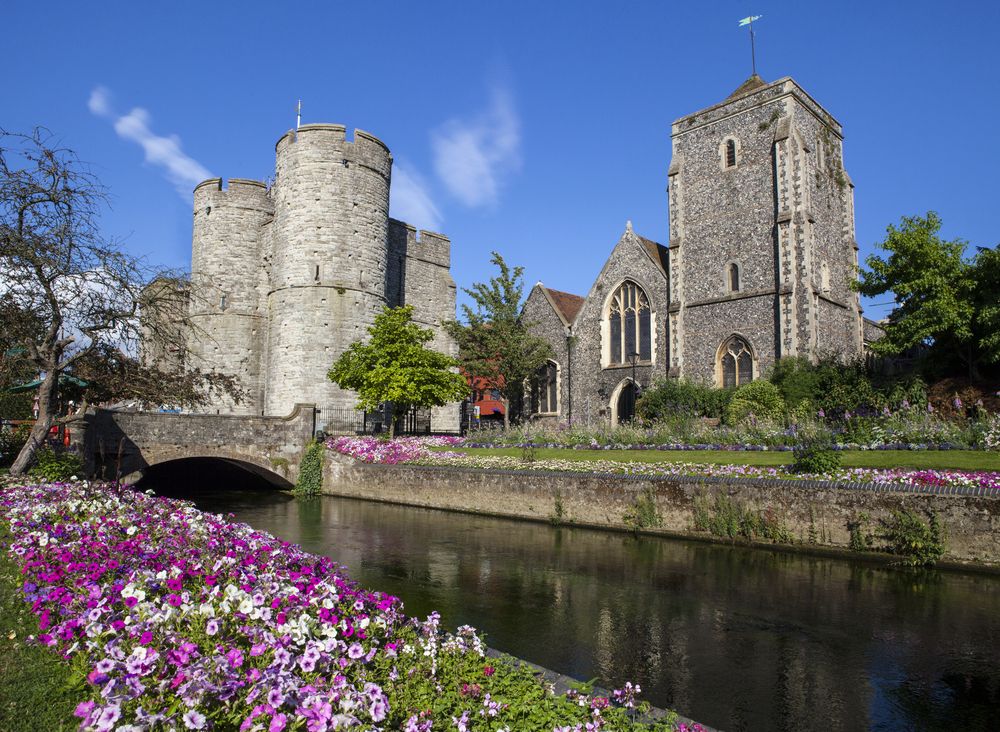
At the western end of the old city stands Westgate, the most impressive surviving medieval gateway in Canterbury.
The present structure dates principally to the late fourteenth century and was built in connection with Archbishop Simon Sudbury.
Two powerful drum towers flank the central entrance.
The gate controlled one of the principal approaches into the city, including the road used by pilgrims travelling from London.
Later it served judicial and prison functions.
Its continued survival is remarkable.
Cars still pass through the medieval arch, producing one of Canterbury’s strangest juxtapositions between historic fabric and modern traffic.
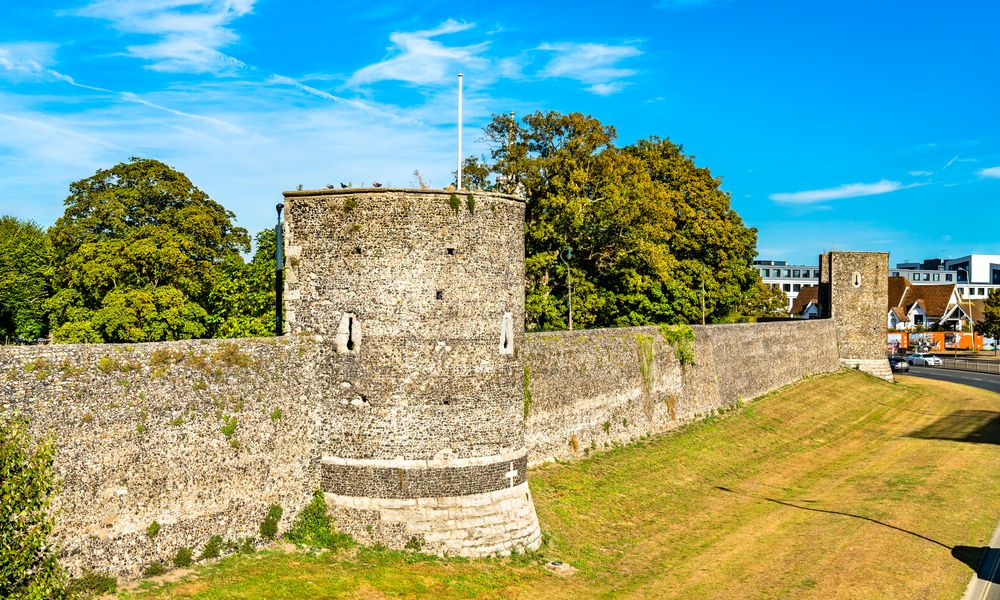
The City Walls
Canterbury’s defensive circuit originated in the Roman period and was heavily rebuilt during the Middle Ages.
Substantial sections remain.
The easiest stretch to explore runs from Westgate towards the southern centre, connecting gardens and surviving fortifications.
Unlike cities where walls survive as an isolated monument, Canterbury’s remains are still integrated into ordinary movement.
Roads curve around them.
Gardens occupy former defensive areas.
Medieval gates establish street alignments that remain active.
Westgate Gardens
Immediately beyond Westgate, Westgate Gardens follow the Stour through one of the most attractive green spaces in central Canterbury.
Old trees, lawns and riverside paths make this the correct place to slow down after the Cathedral.
The gardens also preserve historic buildings and views across the water.
Continue west if you have time.
The urban landscape gradually becomes quieter while the river remains the organising feature.
Dane John Gardens
South of the centre, Dane John Gardens occupy another section of the old defensive landscape.
The unusual name probably developed from the Norman term donjon, connected with the castle and defensive earthworks.
A mound provides elevated views over parts of the city.
The gardens work particularly well as part of a route between the railway station, surviving wall sections and Canterbury Castle.
Canterbury Castle
The remains of Canterbury Castle are considerably less complete than the Cathedral or Westgate, but they preserve another crucial phase of the city’s history.
A Norman motte-and-bailey fortress was created after the Conquest.
The surviving stone keep belongs to a later phase.
Its military importance declined relatively quickly as royal and administrative priorities changed.
Today only substantial ruins survive.
Do not expect a furnished castle.
The value lies in understanding how Norman military control was imposed alongside the simultaneous reconstruction of the Cathedral.
Church and Crown were remaking Canterbury at almost the same moment.
The Beaney House of Art & Knowledge
On the High Street, The Beaney combines museum, gallery and library functions within an elaborate late-Victorian building.
Collections range across local history, archaeology, decorative arts, painting and ethnographic material.
It is not essential on a first six-hour visit.
It becomes useful with two days or in bad weather.
The building also provides a reminder that Canterbury’s identity did not end when medieval pilgrimage declined.
The city continued evolving through Georgian, Victorian and modern Britain.
The Reformation and the End of Medieval Pilgrimage
The greatest rupture came under Henry VIII.
The English Reformation dissolved monasteries, transformed religious practice and attacked saintly cults.
St Augustine’s Abbey was dissolved in 1538.
Becket’s shrine was destroyed the same year.
The economic consequences for Canterbury were substantial.
For centuries, thousands of travellers had arrived because of the saint.
Suddenly the religious system supporting that movement disappeared.
Buildings changed use.
Monastic property passed into private or royal hands.
Relics and shrines vanished.
Yet the city did not lose its ecclesiastical status.
The Archbishop of Canterbury remained the senior bishop of the Church of England.
Canterbury therefore survived one of the most dramatic religious reversals in European history without ceasing to be a major Christian centre.
Huguenot Canterbury
Another population later transformed the city.
From the sixteenth century onwards, French-speaking Protestant refugees, particularly Huguenots fleeing persecution, settled in Canterbury.
Many were skilled textile workers.
Their presence introduced new economic and cultural elements, especially weaving.
The Huguenot community was allowed to worship in part of the Cathedral, and a French Protestant congregation remains associated with the building.
This gives Canterbury another unexpected layer.
The Cathedral famous for medieval Catholic pilgrimage also became a home for Protestant refugees from continental Europe.
Christopher Marlowe
Playwright Christopher Marlowe was born in Canterbury in 1564.
Before Shakespeare became the dominant figure of English drama, Marlowe transformed the Elizabethan stage through works such as Doctor Faustus, Tamburlaine and Edward II.
His life ended violently in Deptford in 1593 at only twenty-nine.
Canterbury’s major modern theatre bears his name.
The Marlowe Theatre sits close to the river and has become the principal performing-arts venue in the city.
Canterbury and the University
Modern Canterbury is also a university city.
The University of Kent, Canterbury Christ Church University and other educational institutions bring a large student population into what might otherwise risk becoming primarily a heritage destination.
That changes restaurants, pubs, cultural programming and evening life.
The city feels significantly younger after the Cathedral closes.
This is one reason staying overnight produces a more complete impression than joining a daytime coach excursion.
What to Eat in Canterbury
Canterbury does not have a single iconic dish comparable with Bath buns or Cornish pasties.
Its food identity belongs to Kent.
That is more interesting.
Kent has historically been associated with orchards, hops, market gardening, coastal fish and shellfish, apples, cherries and beer.
Modern English wine has added another important dimension, with vineyards across Kent producing particularly strong traditional-method sparkling wines.
Look for Kentish apples, local cheeses, seasonal vegetables, beer from regional breweries and meat from surrounding farms.
If the trip includes the coast, oysters become central.
Whitstable is only a short distance away and has one of England’s most famous oyster traditions.
Kentish Beer and Hops
Kent’s relationship with hops became fundamental to English brewing.
The county’s climate and soils supported commercial hop production on a large scale, creating the distinctive landscapes of hop gardens and oast houses.
Production has declined dramatically from its historical peak, but local brewing remains part of Kent’s identity.
A Canterbury pub is therefore a perfectly legitimate cultural stop.
Ask for a Kent-brewed cask ale rather than defaulting automatically to an international lager.
Kent Wine
The chalk geology extending through southern England shares important characteristics with the geological formations beneath Champagne.
Combined with a warming climate and increasingly sophisticated viticulture, this has helped southern England develop a serious sparkling-wine industry.
Kent is one of the key regions.
Traditional-method wines based on Chardonnay, Pinot Noir and Pinot Meunier are particularly important.
A Canterbury dinner is an excellent place to try one without building an entire winery excursion into a short city break.
Where to Eat in Canterbury
The Goods Shed
The Goods Shed
Located beside Canterbury West station, The Goods Shed combines a food market with a restaurant built around ingredients from local farmers, fishermen and producers. It is particularly appropriate for this guide because the menu connects Canterbury with the agricultural landscape of Kent rather than presenting a generic British menu.
Address: Station Road West, Canterbury CT2 8AN
Telephone: +44 1227 459153
Cuisine: seasonal British, local Kent produce
Price level: ££–£££
Best for: local sourcing, lunch and a food-focused introduction to Kent.
Cafe du Soleil
Cafe du Soleil
Set beside the Stour near Westgate, Cafe du Soleil combines Mediterranean influences with British produce in a converted mill building. Its riverside position also works naturally at the end of a walk through Westgate Gardens.
Address: 4–5 Pound Lane, Canterbury CT1 2BZ
Telephone: +44 1227 479999
Cuisine: Mediterranean-influenced contemporary cooking
Price level: ££–£££
Best for: dinner near Westgate and the river.
The Cook’s Tale
The Cook’s Tale Restaurant
The Cook’s Tale gives Canterbury a very different gastronomic direction, with a modern Indian menu built around spices, regional influences and contemporary presentation.
Address: 14–15 Beer Cart Lane, Canterbury CT1 2NY
Telephone: +44 1227 200777
Cuisine: modern Indian
Price level: ££–£££
Best for: a more distinctive dinner after a day of traditional English history.
Where to Stay in Canterbury
For a first visit, stay inside or immediately beside the old city.
The centre is compact, and the ability to walk to the Cathedral before breakfast or through the medieval streets after dinner is worth more than extensive resort facilities outside town.
Budget – Hampton by Hilton Canterbury
Hampton by Hilton Canterbury
A modern, practical option directly in the centre. The location makes the Cathedral, High Street and Roman Museum easily walkable while keeping the accommodation more functional than historic.
Address: 7 St Margaret’s Street, Canterbury CT1 2TP
Telephone: +44 1227 936505
Category: modern city hotel
Price level: ££
Best for: convenience, central position and predictable comfort.
Mid-range – The Falstaff Hotel
The Falstaff Hotel
The Falstaff occupies historic buildings close to Westgate, only a short walk from the Cathedral. Its location is particularly good for combining the medieval centre with Westgate Gardens and Canterbury West station.
Address: 8–10 St Dunstan’s Street, Canterbury CT2 8AF
Telephone: +44 1227 462138
Category: historic city hotel
Price level: ££–£££
Best for: character and a strong position beside the medieval gateway.
Splurge – Canterbury Cathedral Lodge
Canterbury Cathedral Lodge Hotel
This is the accommodation that changes the experience of Canterbury most substantially.
The lodge stands inside the Cathedral precinct, giving guests direct access to one of England’s most extraordinary historic settings after most daytime visitors have left.
Address: The Precincts, Canterbury Cathedral, Canterbury CT1 2EH
Telephone: +44 1227 865350
Email: [email protected]
Category: Cathedral precinct hotel
Price level: £££
Best for: waking beside the Cathedral and experiencing the precinct outside peak sightseeing hours.
How Many Days Do You Need?
A half day allows the Cathedral and a walk through the centre.
That is not enough for Canterbury’s history.
A full day can cover the Cathedral, Roman Museum, Westgate and either St Augustine’s Abbey or St Martin’s Church.
Two days are ideal.
The additional time allows the entire UNESCO sequence — Cathedral, St Augustine’s Abbey and St Martin’s — together with the Roman Museum, Eastbridge Hospital, riverside and smaller medieval buildings.
Three days make sense when Canterbury becomes a base for Whitstable, Dover, Sandwich or the Kent countryside.
The Best One-Day Canterbury Itinerary
Begin at St Martin’s Church if its opening hours fit the day.
Continue downhill to St Augustine’s Abbey and spend around 90 minutes among the ruins and museum.
Walk towards the city centre and enter the Cathedral precinct before lunch.
Give the Cathedral at least two hours.
Follow the route through the nave, site of Becket’s murder, crypt, choir, Trinity Chapel, Corona and cloisters.
Have lunch in the centre.
During the afternoon, walk Mercery Lane and the High Street to Eastbridge Hospital, then continue towards Westgate Towers and Westgate Gardens.
Finish along the Stour.
This route follows Canterbury roughly from the origins of English Christianity towards the medieval pilgrimage city.
The Best Two-Day Canterbury Itinerary
Day 1 – Christianity, Becket and Pilgrimage
11:00: St Martin’s Church
12:00: St Augustine’s Abbey
14:00: lunch
15:00: Canterbury Cathedral
17:30: Evensong if operating that evening
Evening: Mercery Lane, Buttermarket and dinner
The timing can be reversed according to Cathedral services and ticket availability.
Day 2 – Roman and Medieval Canterbury
10:00: Canterbury Roman Museum
11:30: High Street and Eastbridge Hospital
12:30: lunch
14:00: Greyfriars and River Stour
15:00: Westgate Towers and Westgate Gardens
16:30: city walls and Dane John Gardens
Evening: pub or dinner in the centre
The second day deliberately moves away from the Cathedral.
Canterbury becomes more convincing once you understand that pilgrimage grew inside a much older Roman city and eventually produced an entire medieval urban economy.
Evensong at Canterbury Cathedral
One of the best ways to experience the Cathedral is not as a visitor attraction at all.
Choral Evensong is normally celebrated at 17:30 on most days.
Entry for worship is free.
The service changes the building completely.
Tourist movement stops.
The architecture becomes acoustic rather than visual.
Music moves through the choir and stone vaults in the setting for which they were designed.
Even visitors without a religious commitment can understand the Cathedral differently after hearing it used liturgically.
Arrive early and behave as a worshipper rather than treating the service as a free concert.
Canterbury with Children
The city works well for families because distances are short.
The Roman Museum provides the strongest interactive historical component.
Westgate adds towers and medieval defensive architecture.
The river gives the day a break from churches.
St Augustine’s Abbey has enough open space to prevent younger visitors from spending the entire trip indoors.
The Cathedral is enormous, so focus on a few stories rather than attempting to explain every chapel.
Thomas Becket is usually enough.
Murdered archbishops tend to hold attention better than ecclesiastical architectural chronology.
Canterbury and Whitstable
Whitstable is the natural coastal excursion.
The town lies only around seven miles north of Canterbury and is famous for its oyster tradition, harbour and beach.
The historical relationship between the two became particularly interesting in the nineteenth century when the Canterbury and Whitstable Railway, opened in 1830, connected the cathedral city with the coast.
It was one of the earliest passenger railways in the world.
Today the combination remains excellent:
Canterbury for medieval history.
Whitstable for sea, oysters and sunset.
A dedicated half day is enough for Whitstable if Canterbury remains the main base.
Canterbury and Dover
Dover lies to the southeast and creates a completely different historical pairing.
Canterbury tells the story of Christianity, pilgrimage and ecclesiastical authority.
Dover is defined by the Channel, military defence, the castle and the White Cliffs.
By train or car, the two can be combined within a short Kent itinerary, although each deserves a full day if history is the priority.
Canterbury and Sandwich
For a quieter medieval extension, Sandwich is an excellent alternative to the better-known coastal destinations.
It was one of the Cinque Ports and preserves an unusually coherent small historic centre.
Timber-framed houses, medieval churches and narrow streets create a useful contrast with Canterbury’s monumental religious architecture.
Getting to Canterbury from London
Canterbury is exceptionally easy from London.
High-speed Southeastern trains from London St Pancras International to Canterbury West can complete the journey in roughly one hour, depending on the service.
Other trains operate from London Victoria and alternative stations, generally taking longer.
For a day trip, the St Pancras route is the most efficient.
For a two-day visit, either Canterbury West or Canterbury East works because the city centre is compact.
Canterbury West Station
Canterbury West is particularly convenient for:
- Westgate
- The Goods Shed
- St Dunstan’s
- the northern side of the centre
From the station, Westgate is only a few minutes away.
Piazza-like monumental arrival does not exist here.
Instead, you pass through one of the medieval city gates and enter Canterbury in almost the same direction as historic travellers arriving from London.
Canterbury East Station
Canterbury East lies south of the centre near Dane John Gardens and the surviving walls.
It is useful for trains operating on the Victoria route and places the southern historic sites within easy walking distance.
Neither station requires a taxi for most central hotels.
Do You Need a Car?
For Canterbury itself: absolutely not.
The city is best explored on foot.
A car becomes useful only when the itinerary extends into rural Kent, small villages or sites with weaker public transport.
For Whitstable, Dover and many surrounding towns, trains and buses remain entirely practical.
Parking in Canterbury
If arriving by car for the day, the most efficient choice is usually Park and Ride rather than attempting to park inside the historic centre.
Three principal sites operate:
New Dover Road Park and Ride
Canterbury CT1 3EL
Sturry Road Park and Ride
Canterbury CT1 1AD
Wincheap Park and Ride
Canterbury CT1 3TQ
The 2026 charge is £4 per car for the entire day, covering up to six passengers.
New Dover Road and Wincheap generally have buses every eight minutes during the main Monday–Saturday daytime schedule; Sturry Road operates approximately every fifteen minutes.
Central car parks are considerably more expensive, with the highest tariff band reaching £3.70 per hour.
Walking Canterbury
The centre is compact enough that transport between attractions is largely unnecessary.
From Westgate to the Cathedral takes around ten minutes.
The Cathedral to St Augustine’s Abbey is another ten to fifteen.
St Martin’s sits slightly farther east.
The principal challenge is not distance.
It is stopping constantly because another medieval building appears.
Wear comfortable shoes.
Historic paving and long Cathedral visits become noticeable by the end of the second day.
Best Time to Visit Canterbury
April, May, June, September and October provide the best balance.
Spring brings gardens and longer daylight without the greatest summer pressure.
September works particularly well because the city remains lively while major visitor numbers begin easing.
July and August are busy, particularly around the Cathedral and central streets.
Book Cathedral access and accommodation ahead.
Winter can be extremely atmospheric.
Short daylight works surprisingly well with medieval architecture, while Cathedral interiors become quieter outside Christmas and major events.
Rain should not be treated as a disaster.
This is England.
Canterbury has had practice.
Canterbury in 2026
The Cathedral is open for normal sightseeing Monday through Saturday from 10:00 to 17:00, with last admission at 16:00. On Sundays, the precinct opens from 11:30 and the Cathedral church itself from 12:30.
St Augustine’s Abbey operates daily from 10:00 to 17:00 through 24 October, before moving onto shorter autumn and winter schedules.
St Martin’s Church is normally open 11:00–15:00 daily during the high season from 5 May.
The Canterbury Roman Museum remains open daily from 10:00 to 17:00.
For drivers, the city’s three Park and Ride sites remain the sensible option at £4 per car per day for up to six passengers.
Useful Information
Country: England, United Kingdom
County: Kent
Roman name: Durovernum Cantiacorum
Main monument: Canterbury Cathedral
Augustine’s mission arrived: 597
St Augustine’s Abbey founded: c. 598
Thomas Becket murdered: 29 December 1170
Becket canonised: 1173
Cathedral fire and Gothic rebuilding: from 1174
Translation of Becket’s relics to Trinity Chapel: 1220
Becket shrine destroyed: 1538
St Augustine’s Abbey dissolved: 1538
UNESCO World Heritage inscription: 1988
UNESCO components: Canterbury Cathedral, St Augustine’s Abbey, St Martin’s Church
Main medieval gate: Westgate
Westgate construction: late 14th century
Major literary connection: Geoffrey Chaucer, The Canterbury Tales
Major Elizabethan writer born here: Christopher Marlowe, 1564
Cathedral sightseeing hours: Mon–Sat 10:00–17:00; Sun church from 12:30
Cathedral last admission: 16:00
Cathedral telephone: +44 1227 762862
St Augustine’s Abbey: Longport, CT1 1PF
St Augustine’s Abbey main-season hours: 10:00–17:00
St Martin’s Church high-season hours: 11:00–15:00
Roman Museum: daily 10:00–17:00
Roman Museum telephone: +44 1227 785575
World Heritage Pass 2026: approximately £29.50 adult; children free under current scheme
Main railway stations: Canterbury West and Canterbury East
Fastest London route: St Pancras International to Canterbury West
Typical fastest journey: around 1 hour
Car required: no
Park and Ride 2026: £4 per car/day, up to six passengers
Park and Ride sites: New Dover Road, Sturry Road, Wincheap
Minimum stay: 1 full day
Ideal stay: 2 days
Best months: April–June and September–October

