
Metz Travel Guide: What to See, Gothic Stained Glass, Imperial Architecture and the Best Things to Do

Metz is one of those French cities whose architecture becomes much easier to understand once you stop expecting it to look completely French.
The historic centre rises above the Moselle and Seille rivers in northeastern France, close enough to Luxembourg, Germany and Belgium for borders to feel less like edges than part of everyday geography. Golden limestone façades surround medieval streets; Saint-Étienne Cathedral contains stained glass spanning almost eight centuries; an enormous neo-Romanesque railway station belongs unmistakably to the age of Kaiser Wilhelm II; and a few minutes away, the white canopy of the Centre Pompidou-Metz looks as if somebody has lowered an enormous woven hat onto the city.
That mixture is not accidental.
Metz has spent roughly 3,000 years at a European crossroads. The Celtic Mediomatrici settled here before Rome transformed the town into Divodurum Mediomatricorum. It became capital of the Merovingian kingdom of Austrasia, later developed into a powerful medieval republic within the Holy Roman Empire, passed into the orbit of the French monarchy in 1552, was formally recognised as French in 1648, became German following the Franco-Prussian War, returned to France in 1918, was annexed again during the Second World War and liberated in November 1944.
Few medium-sized European cities display those political shifts so clearly in stone.
The medieval centre is dense, irregular and built largely from warm Jaumont limestone. The eighteenth-century royal city is disciplined and classical. The German Imperial Quarter is monumental, eclectic and deliberately different. Contemporary Metz then adds Shigeru Ban, Jean de Gastines and Philippe Starck rather than attempting to imitate any of them.
Metz is consequently much more interesting than the conventional image of a pretty cathedral city.
Give it two days rather than two hours.
Things to See in Metz
- Saint-Étienne Cathedral
- Place d’Armes
- Place de Chambre and the Covered Market
- Musée de La Cour d’Or
- Sainte-Croix hill
- Place Saint-Louis
- Porte des Allemands
- Outre-Seille district
- Saint-Maximin and Jean Cocteau’s stained glass
- Temple Neuf and the Moselle islands
- Place de la Comédie
- Saint-Pierre-aux-Nonnains
- Templars’ Chapel
- Esplanade and Citadel district
- Imperial Quarter
- Metz railway station
- Avenue Foch
- Centre Pompidou-Metz
- Amphitheatre Quarter
- Moselle riverbanks and Plan d’Eau
- Constellations de Metz
A City Built in Layers
Metz works best when explored chronologically without becoming obsessive about dates.
The highest part of the old centre, around Sainte-Croix hill, contains the earliest urban nucleus. Archaeology beneath the city reveals the Roman settlement. Medieval streets descend towards Place Saint-Louis and Outre-Seille. Saint-Étienne Cathedral expresses the city’s late-medieval wealth. Eighteenth-century French urban planning appears around Place d’Armes and Place de la Comédie.
Then walk south.
Around the railway station, the scale changes completely.
After Metz was incorporated into the German Empire in 1871, enormous sections of fortification were eventually removed and a Neustadt, or new city, developed around a strategic new station. Neo-Romanesque, neo-Gothic, neo-Renaissance and Jugendstil architecture appeared beside broad avenues and large residential blocks.
Continue another few minutes and Shigeru Ban’s Centre Pompidou-Metz appears.
That walk from cathedral to Pompidou is barely two kilometres.
Architecturally, it crosses centuries.
Saint-Étienne Cathedral

If Metz had nothing except Cathédrale Saint-Étienne, it would still justify a serious stop.
Construction of the Gothic cathedral began around 1220 and continued into the early sixteenth century. The building resulted partly from the integration of two earlier churches and eventually produced one of the most vertically ambitious Gothic interiors in France. Its nave rises approximately 42 metres beneath the vaults.
Height, however, is not what makes Saint-Étienne extraordinary.
Light does.
Approximately 6,500 square metres of stained glass fill the building, one of the greatest ensembles of architectural glass in Europe and the reason the cathedral acquired the nickname “La Lanterne du Bon Dieu” — God’s Lantern.
This is not a homogeneous medieval collection.
The windows form a visual history extending from the fourteenth century into contemporary art.
That makes Metz completely different from a cathedral where later restoration attempted to reconstruct one supposedly pure Gothic moment.
Here, centuries remain visible beside each other.
Hermann de Münster
At the western end, the monumental glazing associated with Hermann de Münster dates from the late fourteenth century.
The scale is immediately impressive, but the more useful observation is how little wall appears to remain around the glass.
Late Gothic architecture pushed the structural skeleton towards increasingly narrow supports so that coloured light could occupy larger sections of the building.
Metz took that idea remarkably far.
Stand near the centre of the nave and look backwards before moving towards the later windows.
You are about to travel through several completely different ideas of what stained glass can do.
Valentin Bousch
The Renaissance brought Valentin Bousch, whose work forms one of the strongest historic ensembles in the cathedral.
Bousch worked during the first half of the sixteenth century and developed stained glass with an almost painterly complexity. Figures acquire volume, architectural settings become more elaborate and Renaissance ideas begin entering an essentially Gothic building.
This is one reason Metz is particularly valuable for anyone interested in stained glass.
The cathedral is not simply large.
It functions almost like an encyclopedia of the medium.
Official tourism material describes its windows as spanning three major golden periods of stained-glass production in Lorraine.
Marc Chagall
Then the colour changes completely.
Between 1959 and 1969, Marc Chagall produced several groups of windows for Saint-Étienne, drawing primarily on stories from the Old Testament.
Deep blue dominates much of the glass, pierced by red, green and yellow figures that seem to float rather than obey conventional perspective.
The emotional effect is remarkably different from the Renaissance glazing only metres away.
Do not look at Chagall in isolation.
Turn around.
The power comes from seeing twentieth-century modernism inhabiting the same Gothic structure as Hermann de Münster and Valentin Bousch without either cancelling the other.
Jacques Villon, Roger Bissière and Kimsooja
Chagall is the famous name, but stopping there would miss much of the cathedral’s modern programme.
Jacques Villon, the brother of Marcel Duchamp, created intensely coloured windows installed in 1957. Roger Bissière followed with abstract glazing around 1959–60.
In 2022, South Korean artist Kimsooja added sixteen windows to the south transept, introducing another contemporary interpretation of coloured light into the medieval structure.
That willingness to continue commissioning serious contemporary art is one of the cathedral’s strengths.
The building is historic.
It is not finished.
Visiting the Cathedral in 2026
For 2026, Saint-Étienne is officially listed as open daily from 08:00 to 18:00. Admission to the church itself is free, while specialist guided visits of the cathedral, crypt, treasury and stained glass are offered separately.
Come once during daylight and, if possible, again towards evening.
The stained glass needs sun.
The exterior needs dusk.
During the 2026 Constellations festival, the cathedral becomes one of the principal nighttime projection surfaces in the city.
Place d’Armes
Immediately outside Saint-Étienne, Place d’Armes Jacques-François Blondel belongs to a completely different architectural language.
The medieval fabric was reorganised during the eighteenth century as Metz became increasingly shaped by French royal planning.
The square forms part of the classical urban ensemble commissioned under the influence of Marshal Belle-Isle and developed around the cathedral by architect Jacques-François Blondel.
The contrast with the Gothic church is deliberate.
Regular façades, disciplined proportions and pale golden stone attempt to impose order around an enormous medieval object that refuses to become symmetrical.
It is one of Metz’s recurring themes.
Every political period inherited the previous city rather than starting again.
The results are architectural negotiations.
Place de Chambre and the Covered Market
Walk around the cathedral towards Place de Chambre.
The square has a more informal character than Place d’Armes and leads directly towards Metz’s Marché Couvert, the covered market.
The building began life in the eighteenth century as a planned episcopal palace but was never completed for that purpose. It later became a market.
That change of function turned out to be far more useful for visitors.
Come in the morning.
Cheese, charcuterie, vegetables, pastries and prepared food provide a much better introduction to Lorraine than a souvenir shop full of mirabelle-flavoured products.
This is also a sensible place for a quick lunch.
Sainte-Croix Hill
The highest part of the historic centre lies around Colline Sainte-Croix, the hill associated with the earliest development of Metz.
The streets here become narrower and less ceremonially French.
Old houses, small squares, fragments of medieval architecture and quiet passages create an urban fabric completely different from the broad eighteenth-century spaces around the cathedral.
Do not approach this area with an overplanned route.
Walk.
Rue Taison, the Récollets, Hôtel Saint-Livier and the surrounding streets are close enough that getting mildly lost improves the experience rather than creating a logistical problem.
Musée de La Cour d’Or
The Musée de La Cour d’Or is much better than its relatively low international profile suggests.
The museum occupies a complicated collection of buildings on Sainte-Croix hill and incorporates genuine archaeological remains into the visitor route.
The galleries cover roughly 2,000 years of Metz history, moving through Gallo-Roman archaeology, medieval art, architecture and fine arts. Admission to the permanent museum is currently free.
Do not allocate forty minutes.
You will regret it.
Roman Metz: Divodurum
Roman Metz was known as Divodurum Mediomatricorum, developing from the settlement associated with the Celtic Mediomatrici.
Its location placed it at an important road junction, and the Roman city acquired baths, an amphitheatre, aqueduct infrastructure and substantial public architecture.
The Cour d’Or’s Gallo-Roman section is particularly effective because parts of the collection are displayed within the remains of a second-century bathing complex.
Among the objects are funerary stelae, sculpture, glass, jewellery, a Mithraic relief and a gladiator mosaic.
The funerary monuments are worth slowing down for.
Many show trades and ordinary occupations.
Roman urban life becomes much more specific when stonecutters, merchants and craftspeople replace anonymous emperors.
Austrasia
After the collapse of Roman authority, Metz acquired another major role.
Following the death of Clovis in 511, the city became a capital of the Merovingian kingdom of Austrasia, remaining an important political centre through the early medieval period. The name Cour d’Or itself refers to the legendary or remembered royal palace associated with that era.
Later, Metz became closely associated with the rise of the Carolingians.
The museum’s medieval galleries contain Merovingian material alongside architectural fragments, sculpture and decorated interiors that demonstrate the city’s continuing wealth.
The Medieval Painted Ceilings
One of the museum’s unexpected highlights is above your head.
Several painted medieval wooden ceilings preserve imagery that once decorated private houses in Metz.
Animals, heraldry, grotesques and figures occupy beams and panels that originally belonged to domestic interiors.
They are extraordinarily useful.
Medieval cities are normally experienced through surviving churches and defensive architecture because wood, furniture and residential decoration disappear more easily.
These ceilings bring private urban life back into the story.
The Chèvremont Granary
The museum route also incorporates the imposing Grenier de Chèvremont, a medieval municipal grain store.
Its massive internal structure now houses sculpture from Lorraine dating between the twelfth and sixteenth centuries.
Again, the building is part of the collection.
This is why La Cour d’Or takes longer than expected.
You repeatedly move from viewing objects to walking inside the historical architecture that produced them.
Practical Information
The museum is at 2 rue du Haut Poirier and is open every day except Tuesday, currently 10:00–12:45 and 14:00–18:00.
Its permanent collections are free.
In August 2025 the museum also opened a new 360-square-metre Biodiversity Pavilion, expanding the institution beyond its archaeological and art collections.
Place Saint-Louis
Place Saint-Louis is among Metz’s most distinctive medieval spaces.
Tall narrow façades form a long irregular square, several with arcades at ground level.
The architecture has sometimes been described as showing Italian influence, reflecting the commercial networks that connected medieval Metz with merchants and bankers from farther south.
Do not expect the visual uniformity of a planned Renaissance piazza.
That is precisely what makes it attractive.
The buildings lean towards different periods and modifications, yet the long arcaded frontage keeps the space together.
Come around lunchtime or early evening when terraces occupy the lower level.
Outre-Seille
Continue southeast into Outre-Seille.
The name refers to the quarter beyond the Seille, historically lying outside the earliest urban nucleus before later fortifications enclosed it.
This was a district of artisans, merchants and religious communities rather than monumental royal planning.
The streets retain more of that scale.
Two places matter especially: Saint-Maximin and the Porte des Allemands.
Saint-Maximin and Jean Cocteau
The medieval church of Saint-Maximin contains one of the strangest modern artistic interventions in Metz.
Beginning in 1962, Jean Cocteau designed stained-glass windows for the church.
Cocteau died in 1963 before the entire project was installed, and the work was completed by the Brière workshop according to his designs.
The windows use a very different language from Chagall’s cathedral glass.
Linear figures, abstract signs, faces and intensely coloured shapes bring Cocteau’s unmistakable drawing style into an old religious interior.
If Saint-Étienne demonstrates eight centuries of monumental glass art, Saint-Maximin provides the more intimate counterpoint.
Porte des Allemands
The Porte des Allemands — German Gate is one of the best surviving pieces of medieval military architecture in Metz.
The name comes from the nearby medieval hospital of the Teutonic or German brothers rather than from the city’s later annexation to Germany.
What survives is more than a gateway.
Built and expanded between the thirteenth and sixteenth centuries, the structure combines a fortified city gate with a bridge crossing the Seille. It is the last survivor of the eighteen gates that once punctuated Metz’s medieval walls.
Round and polygonal towers, walls and bridge structures make the building resemble a compact castle stretched across the river.
Walk through it and then continue along the ramparts.
The exterior view is better than the first impression from the street.
The Moselle Islands
Metz changes character again around the Moselle.
Branches of the river divide around small islands, gardens and embankments immediately beside the centre.
This is one reason the city feels greener than its history as a fortress suggests.
Walk towards Place de la Comédie, cross the bridges and look back towards the cathedral.
The combination of water, pale stone and Gothic mass produces one of Metz’s best urban views.
Place de la Comédie

The eighteenth-century Place de la Comédie sits on an island in the Moselle and forms part of the major French classical transformation of Metz.
Its principal monument is the Opéra-Théâtre, one of the oldest theatres in France still operating in its original building.
The square is formal but not excessively grand.
That works in its favour.
The cathedral appears unexpectedly behind the classical façades, reminding you again that Metz never belongs visually to one century.
Temple Neuf
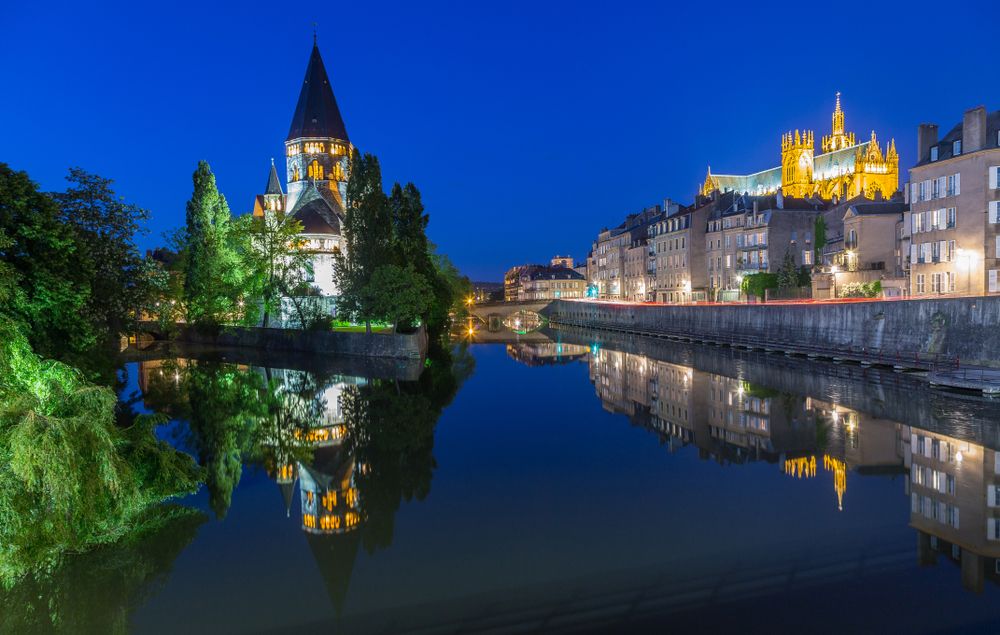
At the edge of the island stands the Temple Neuf, whose dark stone and neo-Romanesque architecture look almost deliberately confrontational beside the French classical city.
They were.
The Protestant church was erected during the German Imperial period in the early twentieth century under Kaiser Wilhelm II.
Its architecture belongs to the historicist language promoted in the German city, dramatically different from the golden Jaumont stone used throughout older Metz.
The location makes the political symbolism impossible to miss.
A German Imperial Protestant church rises on an island only a short distance from one of France’s great Gothic cathedrals.
Today the conflict has become scenery.
Historically, it was much more deliberate.
Saint-Pierre-aux-Nonnains
Near the Esplanade stands one of Metz’s least immediately spectacular but most historically important buildings.
Saint-Pierre-aux-Nonnains began as part of a Roman complex, probably associated with a palestra, before being transformed into a church during the early Middle Ages.
Official tourism material dates its conversion to religious use to around the seventh century.
The thick plain walls can initially seem underwhelming after the cathedral.
That reaction disappears once you understand the chronology.
Very few buildings allow Roman fabric and early medieval Christian reuse to remain so physically legible.
Today the former church forms part of Metz’s cultural infrastructure and is used for events rather than functioning as a conventional parish church.
The Templars’ Chapel
Nearby, the Chapelle des Templiers belongs to another architectural world.
Built during the transition from Romanesque to Gothic architecture, the small centralised chapel once formed part of a Templar commandery.
Its scale is compact, almost jewel-like.
The interior preserves painted decoration that makes the visit much richer than the exterior suggests.
Combine it with Saint-Pierre-aux-Nonnains and the Arsenal rather than treating each monument as a separate expedition.
The Arsenal
The old military arsenal was transformed in the late twentieth century by Catalan architect Ricardo Bofill into a major concert venue.
The project is a good example of Metz’s ability to reuse military architecture rather than erasing it.
Where enormous defensive and barracks complexes once reflected the city’s strategic position, music and cultural programming now occupy the structures.
The surrounding Esplanade is also one of the best places in central Metz to stop without having to “see” anything.
The Imperial Quarter
Now comes the part of Metz that surprises visitors who expect France to remain architecturally consistent.
After the Franco-Prussian War, Metz became part of the German Empire from 1871 until 1918.
The transformation was enormous.
Old military restrictions limited urban expansion, so once sections of fortifications were removed, the authorities developed a new district south of the historic centre.
The Quartier Impérial, or German Neustadt, was conceived as a modern city and as a visual statement of imperial power.
Do not rush through it simply because your train arrived here.
German Metz

The Imperial Quarter is not built in one German style.
That is what makes it interesting.
Neo-Romanesque buildings stand beside neo-Gothic, neo-Renaissance and Jugendstil architecture. Different stones and rooflines create a deliberate catalogue of architectural references.
The German administration wanted modern infrastructure and strategic efficiency, but also symbolic architecture capable of expressing Metz’s place within the empire.
The result is often monumental.
It can also be eccentric.
Avenue Foch
Walk along Avenue Foch.
Villas and apartment buildings display the stylistic diversity of the district particularly well.
One façade looks medievalising, another borrows from Renaissance architecture, another begins leaning towards Art Nouveau.
The avenue should be read slowly.
The interest lies less in a single masterpiece than in seeing how freely architects manipulated historical styles during the decades around 1900.
Metz Railway Station
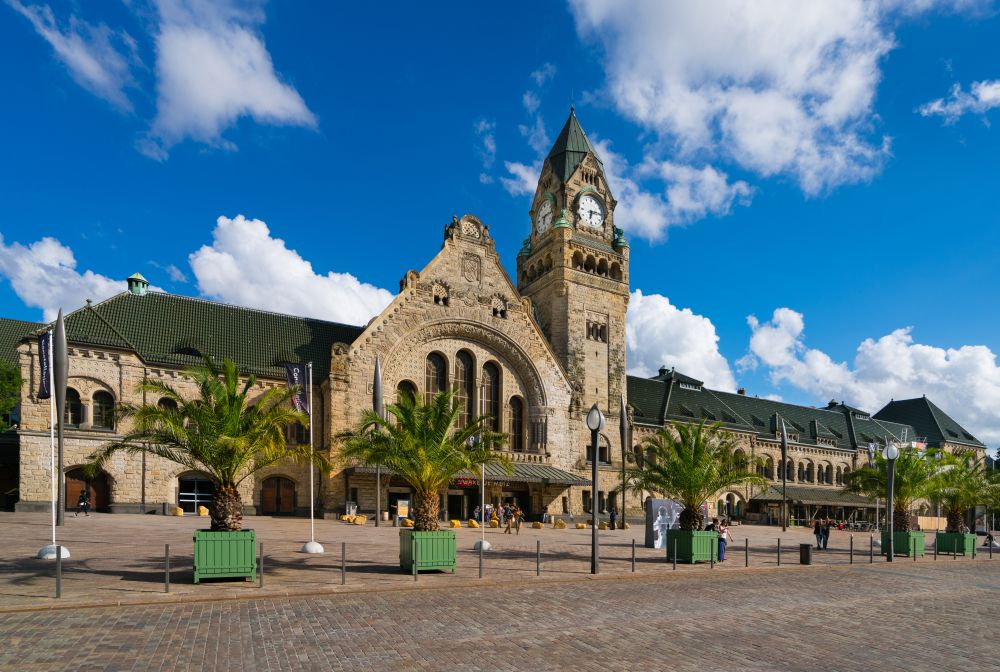
The centrepiece is Gare de Metz-Ville.
Constructed between 1905 and 1908, the station is approximately 300 metres long and uses an imposing neo-Romanesque architectural language.
Its scale was driven partly by military requirements.
Metz remained one of the German Empire’s crucial western garrison cities, and the station had to move troops and equipment efficiently as well as serve civilian passengers.
This explains why the building seems almost absurdly large for the urban centre beside it.
Look closely at the sculptural decoration.
Railway stations are normally treated as infrastructure.
This one is political architecture.
The Grande Poste
Opposite the station, the Grande Poste continues the same Imperial vocabulary.
Architect Ludwig Bettcher designed it in a Rhenish neo-Romanesque style using pink Vosges sandstone. Construction began in 1908 and the post office opened in 1911.
The darker stone separates the German city visually from older Metz.
Walking from the cathedral to the station therefore involves more than changing neighbourhoods.
The colour palette changes with sovereignty.
From Germany Back to France
Metz returned to France in 1918.
Then history repeated itself brutally.
The city was annexed again to Germany during the Second World War from 1940 to 1944 and was liberated in November 1944 by American forces belonging to Patton’s Third Army.
That history explains why identity here is more complicated than simply deciding whether a building looks French or German.
The region has lived both.
Modern Metz is more interesting when the two inheritances are treated as history rather than architectural rivalry.
Centre Pompidou-Metz

Then Metz makes another jump.
The Centre Pompidou-Metz opened in 2010 as the first major decentralised branch associated with Paris’s Centre Pompidou.
It became one of the most significant contemporary cultural projects outside the French capital.
Architects Shigeru Ban and Jean de Gastines, working with Philip Gumuchdjian on the competition design, created a building organised around a hexagonal plan and three long exhibition galleries beneath an enormous curving roof.
The central spire rises 77 metres, a deliberate reference to 1977, the year the original Centre Pompidou opened in Paris.
The Roof
The roof is what everyone remembers.
Ban’s timber lattice develops a repeating hexagonal geometry beneath a translucent membrane, producing something variously compared with woven bamboo, a Chinese hat and an enormous textile structure.
The building is most successful when viewed from several distances.
Close up, the timber engineering dominates.
From farther away, the roof appears unexpectedly soft.
This is architecture built around contradiction: massive yet light, technically complicated yet visually simple.
Inside the Pompidou
Do not assume the museum contains a permanent miniature version of Paris’s collection.
The Centre Pompidou-Metz operates primarily through temporary exhibitions, using loans and partnerships with the national collection alongside other works.
That means the quality and subject of a visit depend heavily on the current programme.
Check before going.
The galleries themselves are unusually long and flexible, and their ends frame carefully selected views across Metz.
The city becomes another object in the exhibition.
Centre Pompidou-Metz in 2026
The 2026 programme is particularly strong.
François Morellet: 100 pour cent runs from 3 April to 28 September 2026, while Dimanche sans fin continues through 31 October. A participatory Marina Abramović project, Mutual Gaze, runs from 8 May to 23 November.
Later in the year, Séraphine Louis: De Senlis et sans rivale opens on 31 October 2026 and continues until 12 April 2027.
Most interesting architecturally, from 5 December 2026 to 30 August 2027 the museum hosts Shigeru Ban: Bâtir un monde meilleur, a major exhibition curated by Ban himself and devoted to his architecture, influences and humanitarian work.
The museum is closed on Tuesdays.
Maison Heler and the New Amphitheatre Quarter
The area around Pompidou has continued developing.
The Quartier de l’Amphithéâtre combines offices, housing, shopping, conference facilities and major contemporary architecture rather than functioning simply as a museum district.
Its strangest new landmark is Maison Heler.
Philippe Starck conceived the building as a dark modern tower with what appears to be a traditional Lorraine house improbably placed on the roof.
It is ridiculous.
That is the idea.
Rather than competing with Pompidou through another smooth piece of heroic architecture, Starck built something almost surreal.
Walking along the Moselle
Metz is best understood partly through water.
The Moselle divides around islands beside the historic centre, while the Seille traces the eastern side of old Metz.
Paths along the water produce softer views of a city historically associated with fortification.
Walk around the Plan d’Eau, continue towards the islands and return past Temple Neuf.
This is particularly effective near sunset.
The cathedral remains visible above the trees and water while the city traffic becomes almost irrelevant.
Metz as a Garden City
Metz has long promoted itself as a Ville Jardin, and unlike many municipal slogans, the claim is reasonably convincing.
Parks, riverbanks and planted promenades penetrate surprisingly close to the centre.
The Esplanade provides the formal urban version.
The Plan d’Eau and Moselle banks are looser.
Farther away, the Botanical Garden extends across several hectares.
You do not need to dedicate a separate day to parks.
Use them to connect monuments.
Metz becomes much less exhausting when every hour does not involve another church or museum.
The Graoully
Every respectable old European city seems eventually to acquire a dragon.
Metz has the Graoully.
According to local legend, a monstrous dragon terrorised the population until Saint Clement, traditionally considered the first bishop of Metz, defeated or expelled it.
The story developed over centuries and became part of civic identity.
Representations of the Graoully appear around the city, including near the cathedral.
Do not mistake the legend for early Christian history.
Its value lies in how Metz repeatedly reused it as a symbol.
A dragon is much easier to remember than another bishop.
Paul Verlaine
Poet Paul Verlaine was born in Metz in 1844.
His birthplace survives in the historic centre and can be visited in connection with literary programming.
Verlaine’s adult life was tied much more strongly to Paris, Brussels and other cities, so building an entire Metz itinerary around him would be excessive.
Still, the connection adds another layer to a city already dense with political and artistic history.
What to Eat in Metz
Lorraine cooking is not subtle in the Mediterranean sense.
It does not need to be.
Butter, cream, smoked pork, pastry and fruit are used with confidence, which becomes increasingly understandable as temperatures fall.
Start with quiche Lorraine.
The traditional structure is straightforward: pastry, eggs, cream and bacon or lardons. Cheese is not the defining ingredient despite what countless international versions suggest.
Then comes pâté lorrain, generally made from marinated pork and veal enclosed in puff pastry.
There is also potée lorraine, smoked meats, potatoes and vegetables.
This is cold-weather cooking designed by people with no interest in pretending winter is a salad season.
Mirabelle Plums
The ingredient most closely associated with Lorraine is the mirabelle plum.
Small, golden and intensely aromatic when ripe, mirabelles appear in tarts, preserves, eau-de-vie, liqueurs and savoury dishes.
Their season is relatively short in late summer.
This matters.
Eating a fresh mirabelle tart in August is a completely different proposition from buying an industrial mirabelle sweet in December and declaring the regional investigation complete.
Metz also celebrates the fruit through the Fêtes de la Mirabelle.
Paris-Metz
One modern local pastry deserves attention simply because it refuses to look traditionally Lorrain.
The Paris-Metz combines brightly coloured macarons with raspberry and a mousseline flavoured with Arlequin sweets.
The result looks slightly radioactive.
It also makes a useful counterpoint to the city’s heavier historic pastry repertoire.
Try one once.
You can return to mirabelle tart afterwards.
Moselle Wine
Wine is often forgotten when discussing Lorraine.
The Moselle AOC produces wine in vineyards around Metz and farther north, working with grapes including Auxerrois, Pinot Gris, Pinot Noir and others.
Production is small compared with neighbouring Alsace or Champagne.
That is precisely why it is worth looking for on restaurant lists.
Order a local bottle rather than automatically defaulting to Burgundy simply because the name is more familiar.
Beer also belongs naturally here, particularly given Lorraine’s position between French, Luxembourgish and German brewing cultures.
Where to Eat
Restaurant Le Paris
Restaurant Le Paris is a useful choice for traditional French cooking without the theatricality sometimes attached to regional restaurants.
The kitchen works around market ingredients, fish, meat and dishes such as sweetbreads and veal. It has been operating for more than twenty years.
Address: 2 Rue de la Gendarmerie, 57000 Metz
Telephone: +33 3 87 37 02 04
Email: [email protected]
Cuisine: traditional French
Price level: approximately €30–70
Best for: classic French cooking away from the most tourist-heavy cathedral streets
La Fleure de Ly
La Fleure de Ly sits between the cathedral and Moselle and takes a slightly more polished approach to French cooking.
Fresh products and regional ingredients remain central, but the presentation moves beyond basic brasserie territory.
Address: 5 Rue des Piques, 57000 Metz
Telephone: +33 3 87 74 01 23
Email: [email protected]
Cuisine: contemporary French, fish and regional cooking
Price level: approximately €30–80
Best for: dinner near the cathedral when you want something more refined
Les Pas Sages
Les Pas Sages is smaller and more relaxed, with a blackboard menu built around French flavours.
Its position on Rue Taison makes it particularly convenient while exploring Sainte-Croix hill and the medieval centre. Official 2026 tourism information lists it as open year-round, generally from Tuesday to Saturday.
Address: 21 Rue Taison, 57000 Metz
Telephone: +33 3 87 50 20 95
Email: [email protected]
Cuisine: French, seasonal
Price level: approximately €20–40
Best for: an informal dinner in the old town
L’Épicurien
L’Épicurien offers a more intimate restaurant experience east of the core cathedral area.
The scale and relatively focused price range make it a sensible option when dinner itself matters more than having the most famous view.
Address: 33 Rue Vigne Saint-Avold, 57000 Metz
Telephone: +33 3 87 36 69 11
Cuisine: modern French
Price level: approximately €40–50
Best for: a quieter, more food-focused evening
Reservations are sensible on Friday and Saturday evenings and during major events such as Constellations and the Christmas markets.
Where to Stay
The best area depends on what you are doing.
Stay around the cathedral for immediate access to medieval Metz.
Stay near Avenue Ney for a quieter position between old centre and Imperial Quarter.
Stay around the station and Amphitheatre Quarter if Pompidou, contemporary architecture or railway convenience matters most.
La Citadelle Hotel Metz – MGallery
La Citadelle Hotel Metz – MGallery Collection occupies a former military building beside the old Citadel district.
The property has 78 rooms and sits within walking distance of both the cathedral and station, making the location unusually balanced.
Address: 5 Avenue Ney, 57000 Metz
Telephone: +33 3 87 17 17 17
Email: [email protected]
Category: four-star hotel
Best for: history, quiet surroundings and walking access to both old and new Metz
Hôtel de la Cathédrale
Hôtel de la Cathédrale is the obvious location-first choice.
It stands directly on Place de Chambre, beside Saint-Étienne and the Covered Market.
Address: 25 Place de Chambre, 57000 Metz
Telephone: +33 3 87 75 00 02
Best for: cathedral views and immediate access to the medieval centre
You sacrifice some of the contemporary polish of newer hotels.
You gain the ability to step outside before breakfast and have Saint-Étienne almost to yourself.
Maison Heler Metz
Maison Heler Metz, Curio Collection by Hilton is the architectural wildcard.
Designed by Philippe Starck, the hotel occupies a nine-storey monolith surmounted by an apparently conventional Lorraine house. It contains 104 rooms and two restaurants and stands in the Amphitheatre district near Centre Pompidou-Metz.
Address: 31 Rue Jacques Chirac, 57000 Metz
Telephone: +33 3 56 63 16 31
Email: [email protected]
Category: four-star Curio Collection by Hilton
Check-out: 12:00
Best for: design, Pompidou and contemporary Metz
Mercure Grand Hôtel Metz Centre Cathédrale
Mercure Grand Hotel Metz Centre Cathédrale sits directly inside the pedestrian core.
Its appeal is practical rather than conceptual: you can reach the cathedral, Place Saint-Louis, shops and restaurants almost immediately.
Address: 3 Rue des Clercs, 57000 Metz
Telephone: +33 3 87 36 16 33
Category: hotel in the historic centre
Best for: a compact city break without relying on transport
How Many Days Do You Need?
A day trip is possible.
Metz is compact and the train from Paris is fast.
But one day forces an awkward decision between La Cour d’Or and Centre Pompidou-Metz.
Two nights are much better.
Use the first day for the cathedral, old town, La Cour d’Or, Outre-Seille and Moselle.
Use the second for the Citadel and Imperial Quarter before spending several hours at Pompidou.
Three nights make sense during Constellations, the Christmas markets or if you want to visit the wider Moselle region.
A One-Day Metz Itinerary
Begin at Saint-Étienne Cathedral early enough to see the stained glass without the busiest midday traffic.
Cross Place d’Armes, walk around Place de Chambre and enter the Covered Market.
Then climb Sainte-Croix hill and spend at least ninety minutes inside the Musée de La Cour d’Or.
After lunch, walk through Place Saint-Louis towards Outre-Seille.
Visit Saint-Maximin and continue to the Porte des Allemands.
Return towards the river and cross to Place de la Comédie and Temple Neuf.
From there, walk through the Citadel district towards the Imperial Quarter and station.
If you still have time and energy, finish at the Centre Pompidou-Metz.
That is a long day.
Two days are better.
A Two-Day Metz Itinerary
On day one, stay almost entirely north of the Imperial Quarter.
Visit the cathedral, La Cour d’Or and Sainte-Croix in the morning.
Have lunch around the Covered Market or old centre.
Use the afternoon for Place Saint-Louis, Saint-Maximin, Porte des Allemands and the ramparts.
Finish beside Temple Neuf and the Moselle.
On day two, begin with Saint-Pierre-aux-Nonnains, the Templars’ Chapel and Esplanade.
Then walk through Avenue Foch and the Imperial Quarter, allowing enough time to inspect the railway station rather than merely passing through it.
Spend the afternoon at Centre Pompidou-Metz.
During Constellations, return to the old centre after dinner for the nighttime route.
Getting to Metz from Paris
Metz is unusually convenient for a city this far from Paris.
Direct TGV services leave Paris Est and reach Metz in as little as approximately 1 hour 24 minutes. Current SNCF schedules show multiple direct departures each day.
That makes Metz entirely realistic as a day trip.
The problem is not transport.
The problem is having enough time once you arrive.
The station is already an attraction, so do not march straight out of it without looking around.
Getting to Metz from Strasbourg
Regional and high-speed trains connect Metz with Strasbourg.
The journey naturally makes sense for travellers exploring Grand Est, particularly because the two cities provide very different architectural experiences.
Strasbourg is larger and more obviously Alsatian.
Metz is smaller, less expected and historically harder to categorise.
Getting to Metz from Luxembourg
Luxembourg lies close enough for substantial cross-border commuting.
Train connections make Metz a practical addition to a Luxembourg trip, and the cultural contrast is considerable despite the short distance.
This is also where Metz’s location inside the wider Grande Région becomes tangible rather than theoretical.
Do You Need a Car?
No.
For Metz itself, a car is more liability than advantage.
The old centre is compact, much of it is pedestrianised and the railway station sits within comfortable walking distance of the major sights.
Use public transport if needed.
A car becomes useful only for excursions into the Moselle countryside, vineyards, military heritage sites or villages outside the metropolitan core.
When to Visit Metz
April and May are excellent for walking.
The parks are green, temperatures are comfortable and the centre has not yet entered peak summer programming.
June becomes more interesting towards the end of the month when Constellations begins.
July and August are the strongest months for evening culture.
The city can be warm during the day, but the riverbanks and parks provide relief, and Constellations gives a genuine reason to remain outside after dark.
September remains very good, particularly during the first week when the festival is still operating.
October is quieter and suits museums particularly well.
Then comes winter.
Metz at Christmas
Metz takes Christmas seriously.
The Christmas market spreads across several central squares rather than remaining confined to one enclosure.
Place d’Armes hosts the large wheel beside the cathedral, while Place de la République traditionally contains skating and larger seasonal attractions.
The 2026 tourism calendar lists the Christmas market and Advent festivities from 26 November to 30 December 2026, with Saint Nicholas celebrations in early December.
The architecture suits the season.
Golden stone, Gothic windows and the Imperial Quarter become considerably more convincing under winter lighting.
Wear proper shoes and accept the possibility of cold rain.
Lorraine is not Provence with fairy lights.
Constellations de Metz 2026
If you can choose one special time to visit, summer 2026 is particularly strong.
The 10th edition of Constellations de Metz runs from 25 June to 5 September 2026 and is completely free.
The festival combines digital art, installations and visual art across the city.
Thursday, Friday and Saturday evenings bring the principal nighttime programme.
For the tenth anniversary, six different video-mapping works from previous editions are being projected on Saint-Étienne Cathedral. The first projection begins at 22:30 early in the season, 22:00 from late July and 21:30 from mid-August as sunset moves earlier.
This is exactly the sort of event Metz handles well.
Contemporary art does not sit in an isolated festival field.
It uses the city’s historic architecture as material.
Metz in 2026
Beyond Constellations, 2026 is a particularly dense cultural year.
At the Centre Pompidou-Metz, exhibitions include François Morellet, Marina Abramović, Séraphine Louis and, from December, a major exhibition devoted to the museum’s architect Shigeru Ban.
The Musée de La Cour d’Or continues to operate with free permanent admission and its Biodiversity Pavilion, opened in 2025.
The Christmas season begins in late November, while the city continues to offer cathedral and Imperial Quarter tours throughout the year.
For architecture and contemporary art, Metz is unusually strong in 2026.
What I Would Not Do
Do not visit only the cathedral and leave.
Saint-Étienne is extraordinary, but Metz makes much more sense once you have seen the Imperial Quarter.
Do not skip La Cour d’Or because it sounds like a local civic museum.
It contains some of the best historical context in the city and costs nothing.
Do not treat the German architecture as an awkward historical interruption.
It is fundamental to modern Metz.
And do not visit Centre Pompidou-Metz merely because the building looks good from outside.
Check the exhibition programme first and give it enough time.
Useful Information
Region: Grand Est
Department: Moselle
Historic region: Lorraine
Rivers: Moselle and Seille
Ancient Roman name: Divodurum Mediomatricorum
Early medieval role: capital of Austrasia
Medieval status: free republic within the Holy Roman Empire
French occupation: 1552
Formal incorporation into France: 1648
German annexation: 1871–1918
Second German annexation: 1940–1944
Liberation: November 1944
Principal monument: Saint-Étienne Cathedral
Cathedral nave: approximately 42 m
Stained glass: approximately 6,500 m²
Main history museum: Musée de La Cour d’Or
Permanent admission to La Cour d’Or: free
Main contemporary museum: Centre Pompidou-Metz
Pompidou opening: 2010
Main modern district: Quartier de l’Amphithéâtre
Main Imperial monument: Metz railway station
Best medieval fortification: Porte des Allemands
Fastest Paris train: approximately 1 h 24 min
Car needed: no
Recommended stay: 2 nights
Best months: May, July, August, September and December
Constellations 2026: 25 June–5 September
Christmas festivities 2026: late November–30 December

