
Castiglion Fiorentino Travel Guide: What to See, Etruscan Sites and the Best Things to Do in Tuscany

Castiglion Fiorentino occupies exactly the sort of hill that medieval Tuscany considered too useful to leave undefended. The historic centre rises between the Val di Chiana to the west and the smaller Val di Chio to the east, roughly halfway between Arezzo and Cortona. From the Cassero tower, fields, olive groves and farmhouses spread across the plain in one direction while wooded hills close around the town in the other.
It would be easy to treat Castiglion Fiorentino as a quieter alternative to its famous neighbours. That description is convenient but reductive. Beneath the medieval streets lies an Etruscan settlement dating back at least to the 7th–5th centuries BC, archaeological excavations survive directly below the Cassero, Renaissance loggias overlook the valley and local museums contain paintings by Bartolomeo della Gatta, Taddeo Gaddi and Luca Signorelli.
The town is compact enough for a day trip, but its greatest advantage is precisely that it does not demand hurried tourism. Corso Italia leads gradually uphill towards Piazza del Municipio; the Cassero sits immediately behind it; churches, gates and old palazzi remain within a few minutes’ walk. Outside the walls, Montecchio Vesponi preserves one of the most complete medieval fortified complexes in this part of Tuscany.
Castiglion Fiorentino is also one of the easier Tuscan hill towns to reach without a car because its railway station sits directly below the historic centre on the Florence–Arezzo–Chiusi corridor.
Come for the archaeology and architecture. Stay for the evening, when the streets empty and the town stops looking like somewhere between Cortona and Arezzo and starts making sense entirely on its own.
Things to See in Castiglion Fiorentino
- Piazza del Municipio
- Logge Vasariane
- Cassero and its tower
- Civic Archaeological Museum
- Underground archaeological excavations
- Pinacoteca Comunale
- Porta Fiorentina
- Corso Italia
- Collegiata dei Santi Michele e Giuliano
- Museo della Pieve di San Giuliano
- Church of the Gesù
- Church of San Francesco
- Teatro Comunale Mario Spina
- Montecchio Vesponi Castle
- Val di Chio
- Palio dei Rioni
The Historic Centre
Castiglion Fiorentino developed around a strategic height controlling routes between Arezzo, Cortona, the Val di Chiana and the upper Tiber valley.
The importance of the position predates the Middle Ages. Archaeological evidence documents an Etruscan settlement here from at least the 7th century BC, while finds from the Cassero area demonstrate that the upper part of the hill already contained significant religious and defensive structures.
The medieval town later grew over this ancient framework rather than replacing it completely.
That layered structure is still visible.
Walls and gates define the old centre. Streets climb towards the Cassero. Renaissance palazzi and religious buildings occupy spaces established centuries earlier. Beneath them, archaeological excavations reveal levels belonging to an entirely different city.
Castiglion Fiorentino therefore rewards a slightly unusual order of exploration: start in the medieval streets, climb to the Cassero and then go underground.
The deeper you move into the town, the older it becomes.
Porta Fiorentina
The principal approach from the northwest enters through Porta Fiorentina, historically known as Porta Aretina and earlier as Porta Santa Maria.
The gate marks the beginning of the old town far more clearly than a modern sign ever could.
Pass through it and the road becomes the historic central axis leading uphill towards Piazza del Municipio.
The distance is short — roughly 260 metres — but the urban transition is immediate. Traffic falls away, façades move closer together and Castiglion Fiorentino begins to reveal its original scale.
This is the best way to enter the town for the first time.
Driving to the highest available parking space and beginning beside the Cassero saves effort but eliminates the gradual architectural sequence that makes the centre comprehensible.
Corso Italia
Corso Italia is the principal street through the historic centre.
Shops, bars, small restaurants and residential buildings occupy a sequence of narrow medieval plots while side streets climb or descend towards the walls.
Unlike Siena or Arezzo, Castiglion Fiorentino does not build its identity around one enormous ceremonial piazza.
The town unfolds linearly.
Follow Corso Italia and the architecture gradually becomes more civic and monumental until the route opens into Piazza del Municipio.
Spend some time looking sideways.
Stone stairways, arches and narrow passages disappearing between buildings often provide better glimpses of the town than the main street itself.
Piazza del Municipio
Piazza del Municipio is the architectural heart of Castiglion Fiorentino.
The Palazzo Comunale occupies one side, while the celebrated Renaissance loggia opens dramatically towards the Val di Chio.
Behind the piazza, the ground rises again towards the Cassero.
This creates an unusually effective sequence of spaces: commercial Corso Italia leads into the civic square, the square opens towards the landscape and the ancient fortified centre rises immediately behind it.
The piazza is small enough to understand in a few minutes.
Do not leave after a few minutes.
The view through the loggia changes substantially with the light, and the relationship between the arches and the valley is one of the strongest architectural compositions in town.
The Logge Vasariane
The Logge Vasariane are one of the buildings most frequently associated with Castiglion Fiorentino, but the name is slightly misleading.
The loggia was originally constructed in 1513 by Bernardo di Ghirba and Filippo da Bellinzona. Giorgio Vasari probably intervened later, during subsequent modifications, including work associated with the Medici presence.
That distinction makes the building more interesting rather than less important.
Three broad Renaissance arches frame the Val di Chio like an enormous triptych.
Inside, coats of arms commemorate former podestà and commissioners, including examples in coloured glazed terracotta.
The arches were closed in the eighteenth century because of structural concerns and finally reopened in 1930.
Stand beneath them rather than photographing the façade only from the piazza.
The whole architectural idea depends on the landscape beyond.
The Cassero
From Piazza del Municipio, a short climb reaches the Cassero, the fortified upper nucleus of Castiglion Fiorentino.
This is the most important part of the town.
Medieval structures occupy an area already inhabited and fortified during Etruscan times, creating a dense archaeological sequence beneath the present piazzale.
The tall Cassero tower dominates the skyline and remains Castiglion Fiorentino’s visual symbol.
Its military logic is immediately understandable.
From the summit, the entire surrounding territory opens beneath you: the Val di Chiana towards Arezzo and Cortona, the Val di Chio on the opposite side and the network of roads that once made control of this hill politically valuable.
Do not visit the Cassero solely for the panorama.
The archaeological material beneath it is what separates this from dozens of other Tuscan viewpoints.
The Cassero Tower
The tower rises above the fortified complex and provides the best overview of the town.
From here, Castiglion Fiorentino becomes geographically obvious.
The red roofs collect tightly around the upper hill. The railway and modern settlement spread across flatter terrain below. Olive groves climb the slopes while the broad agricultural geometry of the Val di Chiana extends into the distance.
The view also explains the proximity of Cortona, visible within the same landscape rather than functioning as an entirely separate destination.
Climbing the tower is worthwhile even if you have already stopped at the Logge Vasariane.
The two viewpoints do different things.
The loggia frames the countryside.
The Cassero explains it.
Civic Archaeological Museum
The Museo Civico Archeologico occupies Palazzo Pretorio within the Cassero complex and should be considered essential rather than optional.
Opened in 2001, the museum presents archaeological discoveries made in Castiglion Fiorentino and the surrounding territory from the Iron Age through the Etruscan and Roman periods and into Late Antiquity.
Among the most important material are finds from Brolio, Montecchio and Brolio Melmone, a settlement connected with production and trade along the ancient Clanis, the river system corresponding to the Chiana.
One of the museum’s strongest exhibits reconstructs part of the architectural decoration from an Etruscan sanctuary dating between the late 5th and early 4th centuries BC.
This matters because Etruscan archaeology is too often reduced to tombs.
Here you are looking at evidence for an inhabited urban centre with religious architecture, craft activity and commercial connections.
The museum’s medieval section continues the chronology through the period when Castiglion Fiorentino became the fortified town visible above ground today.
The Underground Archaeological Route
Beneath the Cassero is an archaeological route that makes Castiglion Fiorentino’s stratification unusually tangible.
Excavations begun in the late twentieth century revealed successive occupation levels within the fortified summit.
Fragments of Etruscan defensive masonry, structures associated with the sanctuary and later medieval remains coexist within a relatively small area.
This is the section I would prioritise if time is limited.
Museum cases explain the objects.
The underground excavations explain where the city came from.
The municipal museum system currently includes the Archaeological Museum, underground route, Pinacoteca and Cassero area, and official regional tourism information indicates that these civic museum spaces are accessible free of charge.
Opening periods vary during the year, so check locally before organising the entire day around a specific time slot.
Pinacoteca Comunale
The Municipal Art Gallery occupies the former Church of Sant’Angelo close to Piazza del Municipio.
The setting is compact, but the collection is unexpectedly strong.
Medieval goldsmithing sits beside paintings by artists including Margarito d’Arezzo, Taddeo Gaddi and Bartolomeo della Gatta.
This is another reason not to approach Castiglion Fiorentino as architecture alone.
The town occupied a cultural corridor between Florence, Arezzo, Siena and Cortona, and its churches accumulated art reflecting all of those connections.
Bartolomeo della Gatta is particularly significant in this territory. His work appears repeatedly around the Arezzo area, and seeing it here provides useful context before visiting Cortona or Arezzo itself.
Allow around forty-five minutes rather than expecting a large regional museum.
The quality-to-size ratio is excellent.
Collegiata dei Santi Michele e Giuliano
The Collegiata dei Santi Michele e Giuliano looks surprisingly recent beside the medieval town because much of the present building is nineteenth century.
That does not mean the site is new.
A medieval parish church dedicated to San Giuliano already existed here, was rebuilt in the fifteenth century and survived in altered form even after the creation of the larger collegiate church beside it.
After a lightning strike caused serious damage in 1836, construction of the present church reshaped the complex.
The interior follows a neoclassical vocabulary with a Latin-cross plan, columns, barrel vaults and a large dome.
Its art collection is more diverse than the architecture suggests.
Among the works are a polychrome terracotta from the Della Robbia workshop, a 1486 altarpiece by Bartolomeo della Gatta, an Adoration by Lorenzo di Credi and a medieval painted cross.
This is not a church to enter simply because it happens to be open.
There is serious painting inside.
Museo della Pieve di San Giuliano
The surviving part of the older Pieve di San Giuliano has housed a museum of sacred art since 2006.
More than one hundred works originating from churches around Castiglion Fiorentino have been brought together here.
The collection ranges from medieval wooden sculpture to Renaissance and later devotional art.
The major name for most visitors is Luca Signorelli.
A Lamentation over the Dead Christ associated with Signorelli provides one of the strongest connections between Castiglion Fiorentino and the artistic world of nearby Cortona.
There is also work related to the Della Robbia tradition and a significant collection of processional sculpture.
Anyone continuing to Cortona should visit this first.
Signorelli becomes considerably more interesting when encountered across the territory rather than as a single museum masterpiece.
Church of the Gesù
Beside the old parish church stands the Church of the Gesù, built between 1527 and 1545 for the Congregation of the Blessed Sacrament.
Its structure is more complicated than the façade suggests.
The building develops over three levels and incorporates the ancient San Giuliano city gate into its lower section.
At piazza level, a five-arched portico introduces the main oratory.
Inside, an elaborate wooden coffered ceiling dating from 1615 incorporates motifs related to the Passion of Christ.
Paintings include a Resurrection by Francesco Vanni and an Last Supper by Francesco Morandini, while a wooden crucifix belongs to the artistic circle of Baccio da Montelupo.
It is precisely the kind of church that disappears from rushed Tuscany itineraries.
That is a mistake.
Its architectural layering tells the story of Castiglion Fiorentino exceptionally well: medieval gate below, Renaissance confraternity church above, seventeenth-century decoration inside.
Church of San Francesco
The Gothic Church of San Francesco introduces another major religious tradition into the town.
Its comparatively sober architecture reflects the mendicant character of Franciscan building rather than the civic display of Piazza del Municipio or the later theatricality of the collegiate church.
The church and adjacent convent developed during the medieval expansion of Franciscan institutions across Tuscany.
It is worth including not because every Tuscan town requires a checklist of churches, but because San Francesco completes the religious geography of Castiglion Fiorentino.
Here the centre moves away from grand civic architecture and returns to quieter medieval streets.
Teatro Comunale Mario Spina
The Mario Spina Municipal Theatre adds a completely different period to the town.
Its interior preserves a nineteenth-century theatrical layout with three tiers of boxes, gilded stucco and marbled decoration.
The theatre is comparatively small, which makes its survival particularly interesting.
Provincial theatres such as this were essential parts of nineteenth-century Italian civic culture. Opera, drama and public events were not confined to Florence or major regional capitals.
Check whether the theatre is open or hosting an event during your stay.
Seeing the auditorium in use is far better than treating it as another historic interior.
The Medieval Walls
Castiglion Fiorentino still preserves substantial sections of its defensive circuit.
Walking beside the walls is useful because the centre otherwise feels more open than its history suggests.
During the Middle Ages this was a contested fortified settlement whose political allegiance repeatedly shifted between major Tuscan powers, particularly Arezzo, Perugia and Florence.
The walls were therefore infrastructure, not decoration.
Look beyond them and the reason becomes obvious.
The town controlled routes across one of the principal agricultural and communication corridors of eastern Tuscany.
That strategic geography explains both its prosperity and the frequency with which other powers wanted it.
Montecchio Vesponi Castle
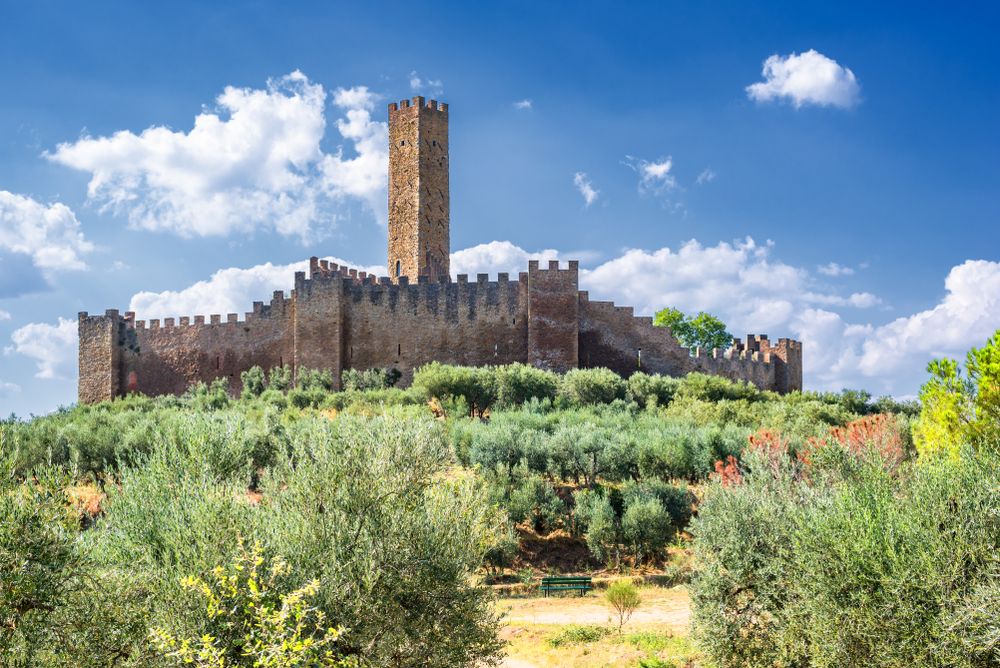
About five kilometres south of the town stands Castello di Montecchio Vesponi, one of the strongest reasons to have access to a car.
The castle occupies another strategic hill between the Val di Chio and Val di Chiana, controlling the historic route connecting Arezzo with Cortona.
Its preservation is exceptional.
Approximately 263 metres of defensive wall survive, punctuated by nine towers, while a square keep rises around thirty metres above the complex.
Montecchio appears in documents as early as 1014, although much of the architecture visible today reflects the transformations of the thirteenth century.
The castle was repeatedly involved in conflicts between Arezzo and Florence and developed its characteristic fortified appearance during this politically unstable period.
What makes Montecchio particularly valuable is integrity.
Many Tuscan castles survive as romantic fragments.
Montecchio still reads as a fortified settlement.
The Val di Chio
East of Castiglion Fiorentino, the Val di Chio forms the quieter half of the surrounding landscape.
The Val di Chiana is broad, agricultural and historically connected with major transport routes.
The Val di Chio is narrower, hillier and more enclosed.
Farmhouses, olive groves, woodland and small settlements occupy a landscape that remains surprisingly rural only a short distance from the town.
If you are staying for two or three days, drive or cycle through the valley rather than using every free hour to add another famous Tuscan town.
This is where Castiglion Fiorentino begins to make sense as a base rather than merely an attraction.
The Val di Chiana
To the west stretches the Val di Chiana, one of central Italy’s great agricultural plains.
The landscape seen today is not entirely natural.
For centuries the valley struggled with water management, marshy land and drainage problems before major reclamation projects transformed it into exceptionally productive farmland.
That agricultural history remains visible in the geometry of fields and drainage channels.
It also explains the region’s culinary identity.
Chianina cattle, cereals, legumes, wine and olive oil belong to an economy shaped by the valley rather than by picturesque marketing created for visitors.
Palio dei Rioni
Castiglion Fiorentino’s most important annual event is the Palio dei Rioni, held on the third Sunday of June.
The modern competition was resumed regularly in 1977, although its symbolism draws on much older civic and religious traditions.
Three districts compete: Rione Cassero, Porta Fiorentina and Porta Romana.
The central horse race takes place in Piazzale Garibaldi, but reducing the Palio to a few minutes of racing misses most of the event.
The preceding days include flag throwers, musicians, veterinary inspections, blessings, rehearsals, district dinners and ceremonies linked to the Madonna delle Grazie del Rivaio.
In 2026 the Palio was held on Sunday 21 June, with the race scheduled for 19:00.
If you want to experience Castiglion Fiorentino at maximum intensity, Palio week is the obvious moment.
If you want museums, empty streets and an easy dinner reservation, choose another week.
What to Eat in Castiglion Fiorentino
This is Val di Chiana food, so beef matters.
Chianina is the obvious reference, particularly in grilled preparations and bistecca alla Fiorentina. But the local table becomes monotonous if every meal is reduced to an enormous steak.
Look for pici, pappardelle with wild boar or hare, crostini with chicken-liver pâté, ribollita, roast meats, legumes and pecorino.
Seasonality remains important.
Autumn brings mushrooms, game and new olive oil. Winter favours soups, beans and braised meats. Spring introduces fresh vegetables and lighter preparations.
Local extra-virgin olive oil deserves more attention than it normally receives in restaurant descriptions.
Olive groves surround Castiglion Fiorentino on almost every slope unsuitable for broad-field agriculture.
When the new oil appears after harvest, taste it simply on toasted bread before burying it beneath an elaborate dish.
Wine Around Castiglion Fiorentino
Castiglion Fiorentino sits in an unusually complicated wine position.
There is no single famous appellation dominating the town in the way Brunello defines Montalcino.
Instead, several Tuscan wine territories overlap around it.
Chianti Colli Aretini DOCG reaches through the Arezzo area, while Valdichiana Toscana DOC, Cortona DOC and Valdarno di Sopra DOC broaden the regional picture.
This is an advantage for curious drinkers.
Sangiovese remains fundamental, but the Cortona area immediately south has become particularly interesting for Syrah, while the wider province provides whites, Vin Santo and increasingly ambitious interpretations of indigenous grapes.
If you have a car, treat wine as part of the landscape rather than ordering whatever bottle has “Toscana” written most visibly on the label.
Where to Eat
Da Muzzicone
Da Muzzicone is the classic meat address in the historic centre.
The restaurant is particularly associated with grilled meat and bistecca, making it the obvious choice if Chianina is one of the reasons for coming to the Val di Chiana.
This is not delicate contemporary cooking and should not pretend to be.
Come hungry.
Address: Via San Francesco 7, 52043 Castiglion Fiorentino
Telephone: +39 0575 658403
Cuisine: Tuscan, grilled meat, Chianina
Price level: approximately €30–40
Best for: bistecca and traditional Tuscan meat
Ristorante La Piana
Ristorante La Piana takes a more polished approach while remaining recognisably Tuscan.
The location close to the centre makes it convenient for dinner after spending the afternoon around the Cassero.
Address: Via Dante 23, 52043 Castiglion Fiorentino
Telephone: +39 0575 048045
Cuisine: Tuscan and contemporary regional cooking
Price level: approximately €30–40
Best for: a more composed dinner in town
Silla’s Bistrò
Silla’s Bistrò is a modern alternative on Corso Italia.
The menu moves beyond the strict trattoria formula, making it useful when you have already spent several meals working methodically through steak, pici and wild boar.
Address: Corso Italia 64/A, 52043 Castiglion Fiorentino
Telephone: +39 333 2965065
Cuisine: contemporary Italian
Price level: approximately €30–40
Best for: modern dinner inside the historic centre
Il Buongustaio
Il Buongustaio sits directly on Corso Italia and is useful for a less formal meal in the centre.
Its position makes it particularly practical for lunch between the lower town and Piazza del Municipio.
Address: Corso Italia 17/19, 52043 Castiglion Fiorentino
Telephone: +39 0575 958659
Cuisine: Italian and Tuscan
Price level: approximately €30–40
Best for: an informal central meal
Where to Stay
If you are spending only one night, stay in or immediately below the historic centre.
For longer stays with a car, the countryside around Montecchio and the Val di Chio becomes more attractive.
Suite San Michele
Suite San Michele places you directly inside the historic centre.
This is the best strategy if the objective is to walk out after breakfast and reach Corso Italia, the Cassero and Piazza del Municipio within minutes.
Address: Via Dante Alighieri 32, 52043 Castiglion Fiorentino
Telephone: +39 340 8413884
Category: B&B / suites
Best for: staying inside the historic centre
Tuttomio Home & Breakfast
Tuttomio-Home&Breakfast is another small-scale option in the upper town.
The format suits travellers who prefer an individual property rather than a conventional hotel.
Address: Via della Tinaia 15, 52043 Castiglion Fiorentino
Telephone: +39 339 1604074
Category: boutique B&B
Best for: a characterful stay inside the old town
Hotel Park
Hotel Park lies outside the tight medieval core and is more convenient for travellers arriving by car or using Castiglion Fiorentino as a touring base.
Address: Via Umbro Casentinese 88, 52043 Castiglion Fiorentino
Telephone: +39 0575 658173
Category: hotel
Best for: practical road-trip accommodation and parking convenience
Villa Schiatti
Villa Schiatti lies in the countryside near Montecchio Vesponi.
This is a completely different experience from sleeping inside Castiglion Fiorentino.
Choose it for landscape, pool and rural atmosphere rather than immediate pedestrian access to the centre.
Address: Montecchio Vesponi 131, 52043 Castiglion Fiorentino
Telephone: +39 0575 651440
Category: countryside hotel
Best for: longer stays, countryside and exploring by car
How Many Days Do You Need?
A half day is enough to walk through the centre and see the Cassero.
It is not enough to understand the place.
A full day allows you to visit the archaeological museum, underground excavations, Pinacoteca, churches and viewpoints without rushing.
One night is better, particularly if you are travelling between Arezzo and Cortona.
With two days, add Montecchio Vesponi and part of the Val di Chio.
Three nights make sense if Castiglion Fiorentino becomes a base for wine, cycling and slower exploration of the Val di Chiana.
There is little benefit in filling a week with daily car journeys to famous towns simply because Castiglion Fiorentino has a convenient railway and road position.
If every morning begins with leaving, you have chosen accommodation rather than a destination.
A One-Day Castiglion Fiorentino Itinerary
Enter through Porta Fiorentina and follow Corso Italia towards Piazza del Municipio.
Spend the morning around the Logge Vasariane, Pinacoteca and Cassero.
Visit the archaeological museum and underground excavations before lunch.
Afterwards, continue towards the Collegiata, Pieve museum and Church of the Gesù.
Use the late afternoon for San Francesco and the walls, then return to the Cassero area or Logge Vasariane when the light softens over the valley.
Stay for dinner.
The historic centre is considerably more attractive once the daytime movement between Arezzo and Cortona has disappeared.
A Two-Day Itinerary
Use the first day entirely for the historic centre and museums.
On the second morning, drive to Montecchio Vesponi Castle and then continue through the Val di Chio.
Have lunch in the countryside or return to town.
The afternoon can be used for olive-oil or wine visits, a longer drive through the valley or simply another walk around Castiglion Fiorentino.
This is a better rhythm than attempting to combine Castiglion Fiorentino, Cortona and Arezzo in one day.
They are geographically close.
That does not make them one attraction.
Getting to Castiglion Fiorentino by Train
Castiglion Fiorentino has one major practical advantage over many Tuscan hill towns: its own railway station.
Regional trains connect the town with Arezzo, Florence, Cortona-Camucia, Chiusi and other stations along the main north-south corridor.
The station lies below the historic centre.
From there, the old town can be reached on foot, although the route naturally climbs.
Travelling without a car therefore makes sense if your itinerary centres on towns served by the railway.
Arezzo and Cortona are particularly easy combinations.
Montecchio Vesponi, wineries and rural sections of the Val di Chio are much easier with independent transport.
Getting to Castiglion Fiorentino from Florence
Take a regional train from Firenze Santa Maria Novella towards Arezzo and the Val di Chiana.
Depending on the service, travel usually involves either a direct regional train or a connection in Arezzo.
Once in Castiglion Fiorentino, the historic centre is accessible on foot from the station.
For a day trip focused entirely on the town, the train is preferable to driving.
For a two- or three-day exploration of the countryside, a car becomes more useful.
Getting to Castiglion Fiorentino from Rome
Travelling north from Rome, use the main railway corridor towards Chiusi, Terontola and Arezzo, changing according to the selected regional service.
Castiglion Fiorentino therefore works surprisingly well as a car-free stop between Rome and Florence.
This is an underused advantage.
Many better-known Tuscan hill towns require bus connections after leaving the railway.
Here the train puts you directly beneath the town.
Driving and Parking
The historic centre is compact, steep and partly restricted to traffic.
There is no reason to force a car deeper into the old streets than necessary.
Use public parking outside the principal gates and continue on foot.
If your hotel lies inside the historic centre, ask for access instructions before arriving rather than improvising around the ZTL.
The town is not large enough for distant parking to become a serious inconvenience.
A ten-minute uphill walk is usually easier than negotiating medieval streets while watching simultaneously for traffic restrictions and stone corners.
When to Visit
April and May are excellent.
The surrounding valleys are green, temperatures remain comfortable for walking and the old centre is far quieter than Tuscany’s famous destinations.
June is particularly interesting because of the Palio dei Rioni.
Come during Palio week if the event itself is the purpose of the trip.
Otherwise, choose early June and enjoy warm weather before the largest summer crowds arrive elsewhere in Tuscany.
July is hot but manageable.
August can be intensely warm during the middle of the day, especially when climbing towards the Cassero.
September and October are probably the best all-round months.
The landscape begins changing, wine and olive harvest activity increases and the heat becomes less aggressive.
November has a quieter appeal, particularly around new olive oil and autumn cooking.
Winter is subdued rather than dead.
Castiglion Fiorentino remains a functioning town, but museum opening times and smaller attractions should be checked before travelling specifically for them.
Castiglion Fiorentino in 2026
The principal confirmed civic event of 2026 was the Palio dei Rioni on Sunday 21 June, preceded by more than a week of ceremonies and competitions.
The programme included the presentation of the painted Palio banner, musicians and flag throwers, veterinary inspections, stable blessings, trial races, district dinners and the final horse race in Piazzale Garibaldi.
For museums, the municipal system continues to encompass the Civic Archaeological Museum, underground archaeological route, Pinacoteca and Cassero monumental area. Official tourism information currently indicates free admission to the municipal museums, although opening schedules remain seasonal.
The town continues to work particularly well as a railway stop between Arezzo and Cortona, while visitors intending to explore Montecchio Vesponi or the Val di Chio benefit substantially from having a car.
Useful Information
Region: Tuscany
Province: Arezzo
Area: Val di Chiana Aretina
Eastern valley: Val di Chio
Historic origins: Etruscan, from at least the 7th–5th centuries BC
Main street: Corso Italia
Main civic square: Piazza del Municipio
Principal monument: Cassero
Main viewpoint: Cassero Tower
Renaissance landmark: Logge Vasariane
Main archaeological museum: Museo Civico Archeologico
Main art museum: Pinacoteca Comunale
Important nearby castle: Montecchio Vesponi
Main annual event: Palio dei Rioni
Palio 2026: 21 June
Railway station: Castiglion Fiorentino
Car needed in town: no
Car useful for surroundings: yes
Recommended stay: 1–2 nights
Best months: May, June, September and October

