
Guimarães Through Its Streets, Where Medieval Granite Houses Lead from Portugal’s Castle Hill to the Industrial Couros District

Guimarães occupies a special place in Portuguese history, but the familiar phrase “Aqui nasceu Portugal” — “Portugal was born here” — needs a little explanation.
The city was closely connected with the political events that produced the independent Portuguese kingdom during the 12th century. Afonso Henriques, who became Portugal’s first king, was associated with Guimarães; the surrounding region became one of the principal centres of the emerging county of Portugal; and the Battle of São Mamede was fought nearby in 1128, strengthening Afonso Henriques’s political control.
But Guimarães is more than a patriotic origin story.
Its historic centre preserves one of the most coherent medieval and early-modern urban landscapes in Portugal: granite houses with timber-framed upper floors, narrow streets, arcaded squares, convents, churches and aristocratic residences that developed continuously between the Middle Ages and the 19th century.
UNESCO inscribed the historic centre in 2001 and significantly extended the World Heritage property in 2023 to include the Couros Zone, the former leather-working district south of the medieval core. The official name is now Historic Centre of Guimarães and Couros Zone.
There is another reason 2026 is particularly interesting: Guimarães is European Green Capital 2026, with a year-long programme focused on sustainable urban development, public space, biodiversity, mobility and climate policy.
One full day is enough for the castle, palace and old centre. Two days are better if you want Penha, the Couros district and the Museu de Alberto Sampaio without compressing everything into a Porto day trip.
Things to See in Guimarães
- Guimarães Castle
- Paço dos Duques de Bragança
- Igreja de São Miguel do Castelo
- Rua de Santa Maria
- Praça de Santiago
- Largo da Oliveira
- Igreja de Nossa Senhora da Oliveira
- Padrão do Salado
- Museu de Alberto Sampaio
- Medieval walls and Torre da Alfândega
- Couros Zone
- Casa da Memória
- Plataforma das Artes e da Criatividade
- Penha Mountain
- Santuário da Penha
- Citânia de Briteiros
Guimarães Castle
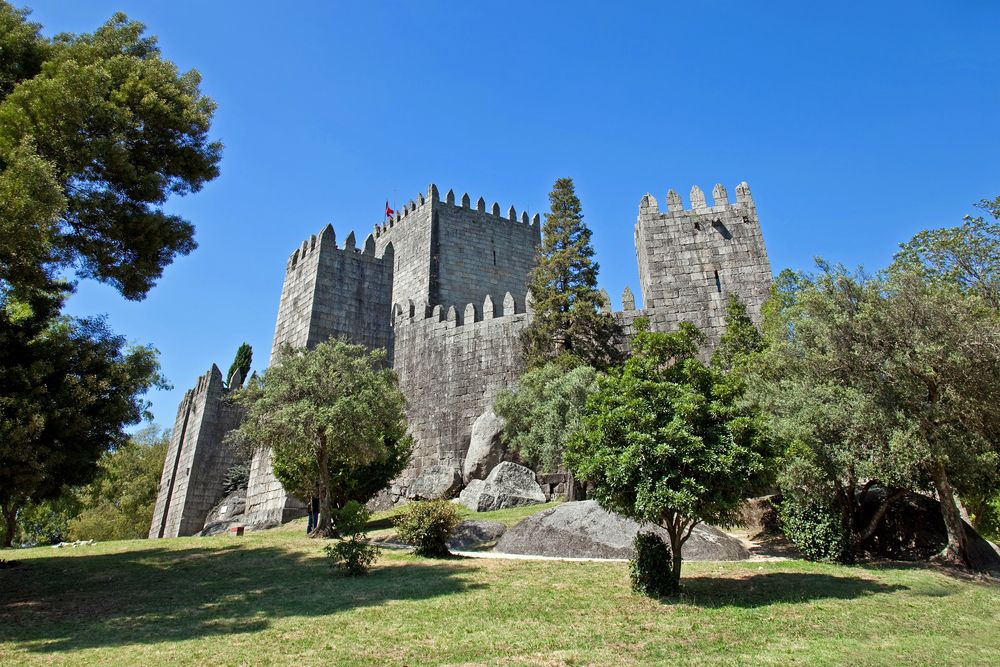
The castle dominates the northern end of the historic centre and has become the most powerful visual symbol of the city.
Its origins reach back to the 10th century, when Countess Mumadona Dias established a monastery in Guimarães and ordered defensive works to protect the settlement against attacks.
The fortress was subsequently enlarged and transformed during the medieval period.
Its irregular walls enclose a central keep surrounded by crenellated towers and battlements.
The building seen today is not an untouched survival from one precise medieval moment. Like many Portuguese castles, it underwent periods of alteration, neglect and substantial restoration, particularly during the 20th century, when the Estado Novo regime placed enormous symbolic value on medieval monuments associated with Portuguese national origins.
The connection with Afonso Henriques is central to the castle’s identity.
Tradition frequently states that he was born inside the castle, but the exact birthplace of Portugal’s first king is not securely documented. It is better to say that Guimarães and its castle are strongly associated with his early life and with the political environment from which the Portuguese monarchy emerged.
The castle still delivers an excellent architectural experience even without the legend.
Visitors can walk through the enclosure and along sections of the defensive structures.
There is, however, an important 2026 restriction: the central keep — Torre de Menagem — is temporarily closed to the public. The castle itself remains open.
Current opening:
10:00–18:00 daily
Last admission: 17:30
Closed on:
1 January
Easter Sunday
1 May
24 June
25 December.
Tickets are issued through the Paço dos Duques ticket office.
Allow around 30–45 minutes.
Paço dos Duques de Bragança

The Palace of the Dukes of Braganza lies only a few metres below the castle but belongs to a completely different phase of Portuguese history.
The palace was constructed during the 15th century for Afonso, 1st Duke of Braganza, an illegitimate son of King João I.
Its architectural appearance is unusual in Portugal.
Tall brick chimneys, steep roof forms and an enclosed courtyard have often been associated with northern European or Burgundian influences, reflecting the international political and cultural networks of the Portuguese court.
The Braganza dynasty would later become extraordinarily important: in 1640, João IV of Braganza became king, beginning the dynasty that ruled Portugal until the monarchy ended in 1910.
The palace itself declined after the ducal family shifted its principal residences elsewhere.
By the modern period substantial parts were ruinous.
A major reconstruction during the 20th century restored the palace to a monumental form and adapted it for official and museum use.
Inside are tapestries, furniture, weapons, paintings and decorative arts intended to evoke aristocratic court life.
Do not assume that every room is preserved exactly as it looked in the 15th century. The palace is partly a historic building and partly a 20th-century reconstruction of an idealised ducal residence.
That distinction makes it more interesting, not less.
Important 2026 Restoration Works at the Ducal Palace
The palace is undergoing substantial rehabilitation and accessibility works in 2026.
Some museum spaces are currently unavailable, and the elevator may temporarily be out of operation. The official monument service explicitly warns visitors that the normal museum route has been reduced during the works.
During the second phase of works, several rooms were progressively closed from March 2026.
The reduced museum route has also led to temporary pricing arrangements.
The current official adult rate for the Paço dos Duques is €5 during the partial closure.
There is one useful summer change.
From 1 July through 31 August 2026, the palace itself opens:
09:00–20:00
with last admission at 19:30.
The castle and São Miguel church continue to close earlier at 18:00.
Address: Rua Conde Dom Henrique, 4800-412 Guimarães
Telephone: +351 253 412 273
Additional phones: +351 253 423 912 / +351 253 423 918
Email: [email protected]
Allow approximately one hour, slightly less while the museum route remains reduced.
Igreja de São Miguel do Castelo
Between the castle and ducal palace stands the tiny Igreja de São Miguel do Castelo.
Its size is easy to underestimate.
The small Romanesque church is traditionally linked to the baptism of Afonso Henriques, and a baptismal font inside is associated with that story.
Again, tradition is stronger than documentary certainty.
The current church appears to date mainly from the 13th century, later than the birth of Afonso Henriques, which complicates the conventional narrative.
Its real value lies in the architecture.
Granite walls, narrow openings and an extremely simple interior provide a strong contrast with the ceremonial scale of the palace nearby.
The church is currently open with the same standard schedule as the castle:
10:00–18:00, last admission 17:30.
Do not skip it simply because the visit takes only ten minutes.
Rua de Santa Maria
Rua de Santa Maria is one of the most important streets in medieval Guimarães.
It historically connected the upper settlement around the castle with the lower religious and commercial centre around Nossa Senhora da Oliveira.
This physical connection helps explain how medieval Guimarães developed as two initially distinct nuclei that gradually merged.
The street remains lined with granite houses, aristocratic residences, projecting upper floors and small courtyards.
Unlike some heavily reconstructed medieval streets, Rua de Santa Maria still feels like a functioning route rather than a museum corridor.
Pay attention to the building structure.
UNESCO specifically highlights the local construction system combining granite ground floors with timber-framed upper levels, a building tradition that later influenced Portuguese architecture overseas.
Walking downhill from the castle towards Praça de Santiago is the most natural direction.
Praça de Santiago
Praça de Santiago is one of the two principal medieval squares at the heart of Guimarães.
It is smaller and more irregular than Largo da Oliveira and surrounded by tall houses with timber balconies, arcades and narrow façades.
According to local tradition, the square takes its name from an early chapel dedicated to Saint James.
That chapel disappeared, but the name remained.
Today restaurants and cafés occupy much of the ground level.
The architecture above them is more important than the terraces themselves.
Come back after dark.
The square becomes one of the best places to appreciate how compact the medieval core is once daytime groups disappear.
The Guimarães Tourist Office operates at Praça de São Tiago.
Telephone: +351 253 421 221
Email: [email protected].
Largo da Oliveira
A narrow medieval passage connects Praça de Santiago with Largo da Oliveira.
The transition is one of the defining urban experiences of Guimarães.
Largo da Oliveira is dominated by the Church of Nossa Senhora da Oliveira and the Gothic monument known as the Padrão do Salado.
Arcaded houses enclose the square.
The layout feels irregular because it evolved over centuries rather than from a single planning scheme.
This was one of the religious and civic centres of the medieval town.
It remains the strongest place to understand why Guimarães received UNESCO recognition: architecture, paving, building scale and public space still work as one coherent urban system rather than as isolated monuments.
Igreja de Nossa Senhora da Oliveira
The church occupies one of the oldest religious sites in Guimarães.
Its origins are connected with the monastery founded by Mumadona Dias in the 10th century, around which the lower settlement developed.
The monastery later became a collegiate church.
The present architecture contains multiple phases, particularly Gothic and later interventions.
The name “Oliveira” refers to the olive tree associated with a local medieval legend.
According to tradition, an olive tree in front of the church had withered but miraculously returned to life after a cross was placed nearby.
The story became part of the identity of the church and square.
Inside, the church preserves a complex combination of medieval and later religious architecture.
It is best visited together with the Museu de Alberto Sampaio next door, because many important objects originally associated with the collegiate church are now preserved in the museum.
Padrão do Salado
The curious Gothic structure standing in Largo da Oliveira is the Padrão do Salado.
It resembles a small open stone chapel or monumental canopy.
The structure commemorates the Battle of Río Salado in 1340, in which Portuguese and Castilian forces defeated a Marinid-led army in southern Iberia.
King Afonso IV of Portugal participated in the campaign.
The monument shelters a cross beneath a pointed Gothic canopy.
Its importance is easy to miss because the surrounding square is so lively.
Look at the tracery and proportions rather than treating it as street furniture.
The monument represents the way medieval military victory, kingship and religious gratitude were connected publicly within the city.
Museu de Alberto Sampaio
This museum is one of the strongest reasons to give Guimarães more than half a day.
It occupies parts of the former collegiate complex beside Nossa Senhora da Oliveira: the cloister, chapter house and priory buildings.
The museum was created in 1928 to preserve works from the former collegiate church and religious institutions around Guimarães.
Its collection is particularly strong in:
religious metalwork
medieval sculpture
textiles
painting
carved wood.
One of the highlights is the Romanesque chalice associated with Sancho I.
Another is a late-14th-century gilt-silver Gothic Nativity altarpiece.
The museum also preserves the famous loudel, the padded military garment traditionally associated with King João I at the Battle of Aljubarrota in 1385.
The cloister alone justifies the visit.
Museu de Alberto Sampaio Practical Information
Current admission:
€5 general ticket
Current combined prices during the Ducal Palace renovation:
Museu de Alberto Sampaio + Paço dos Duques: €8
Museu + Paço dos Duques + Castle: €13.
Opening:
Tuesday–Sunday 10:00–18:00
Last admission 17:30.
Closed Monday and on 1 January, Easter Sunday, 1 May, 24 June and 25 December.
Address: Rua Alfredo Guimarães
Telephone: +351 253 423 910
Email: [email protected]
Allow 60–90 minutes.
The Medieval Walls and Adarve
Only fragments of the original defensive circuit survive, but an especially useful section can be walked along Avenida Alberto Sampaio.
The pedestrian walkway on top of the wall — the adarve — reopened as a visitor route in 2019.
It gives elevated views towards the cathedral-like mass of Nossa Senhora da Oliveira, the castle hill and Penha in the distance.
Current access is free.
Summer schedule, 20 March–22 September:
10:00–21:00
Winter schedule, 23 September–19 March:
10:00–17:00.
This is one of the best free viewpoints in the centre and requires only fifteen to twenty minutes.
Torre da Alfândega and “Aqui Nasceu Portugal”
The famous inscription “Aqui nasceu Portugal” appears on a surviving section of wall close to the Torre da Alfândega.
The phrase is modern rather than medieval.
It summarises the city’s symbolic connection with the formation of the Portuguese kingdom rather than marking a literal birthplace.
The Torre da Alfândega can currently be visited daily between 10:00 and 18:00.
The inscription is worth photographing, but do not let it replace the more complicated historical story.
Portugal did not suddenly appear at one exact point in Guimarães.
State formation developed through decades of political, military and diplomatic events during the 12th century.
The Battle of São Mamede
The event most directly connected with Guimarães and the emergence of independent Portuguese political authority is the Battle of São Mamede on 24 June 1128.
Afonso Henriques confronted forces loyal to his mother Teresa of León and her Galician allies.
His victory strengthened his control over the County of Portugal.
This did not instantly create the modern Portuguese state, but it was a decisive political step.
Afonso later defeated Muslim forces at Ourique in 1139 and increasingly adopted royal authority.
The Treaty of Zamora in 1143 became another major milestone in Portugal’s recognition.
The papacy formally recognised Afonso as king through Manifestis Probatum in 1179.
Guimarães is therefore best understood as the political cradle of the process rather than the site of one clean constitutional birth.
The Couros Zone
The Zona de Couros is the most important addition to the usual Guimarães itinerary.
For decades, many visitors saw only the castle and medieval squares.
UNESCO’s 2023 extension formally incorporated the Couros district into the World Heritage property, recognising the importance of the city’s industrial and working history alongside the elite medieval monuments.
“Couros” means leather.
The district developed around tanning and leatherworking, using local watercourses for industrial processes.
The craft survived into the 20th century.
Tanneries, drying areas, workers’ houses and industrial buildings remain embedded within the neighbourhood.
UNESCO describes Couros as evidence of Guimarães’s proto-industrial and industrial development from the 19th and early 20th centuries, complementing the medieval historic centre.
This matters because the district changes the story of the city.
Guimarães was not preserved in amber after the Middle Ages.
It became an industrial northern Portuguese city.
Walk south from the historic centre towards Couros rather than leaving immediately after Largo da Oliveira.
Why UNESCO Extended the Site
The original World Heritage property focused primarily on the medieval and early-modern centre.
The 2023 extension expanded the protected property to 38.2 hectares, with a buffer zone of 129.4 hectares.
UNESCO recognised that Couros helps demonstrate roughly one thousand years of continuous urban, architectural and social development.
The World Heritage Committee also noted conservation challenges in the district and the need to protect historic tannery structures from redevelopment and tourism pressure.
In 2025, UNESCO welcomed Portugal’s subsequent designation of the expanded Historic Centre and Couros Zone as a National Monument.
For a serious visitor, Couros is therefore no longer optional background.
It is part of the official definition of Guimarães’s heritage.
Casa da Memória
Casa da Memória provides the broader social history that the castle cannot.
Rather than concentrating only on kings, battles and medieval architecture, the museum explores Guimarães through objects, photographs, documents, oral histories and everyday culture.
Themes include local industry, community identity, festivals, rural connections and the transformation of the city.
This is particularly useful after visiting Couros because it places the industrial landscape within human history rather than treating old factories purely as architecture.
If you have only one day, prioritise Alberto Sampaio.
If you have two, Casa da Memória becomes one of the strongest additions.
Plataforma das Artes e da Criatividade
The Plataforma das Artes e da Criatividade represents the modern cultural Guimarães that emerged particularly strongly around the city’s role as European Capital of Culture in 2012.
The complex occupies the former municipal market area and incorporates contemporary architecture into the urban centre.
It includes the Centro Internacional das Artes José de Guimarães, dedicated partly to work by artist José de Guimarães and to dialogues between contemporary art and collections from Africa, Asia and pre-Columbian cultures.
Its significance is urban as well as artistic.
The project demonstrates how Guimarães has deliberately used contemporary architecture and cultural institutions rather than preserving the historic centre as a sealed medieval stage set.
Penha Mountain
The Montanha da Penha rises southeast of the centre and provides Guimarães with something many historic Portuguese cities lack: a wooded granite landscape immediately above the urban area.
Huge boulders, grottos, paths, chapels and viewpoints are scattered through the mountain.
It is not alpine terrain.
Penha is closer to a granite park landscape crossed by paths and roads.
The best reason to go is perspective.
From the upper viewpoints, the dense city spreads below while the surrounding Minho landscape extends towards distant hills.
On very clear days, the official tourism office notes that views can extend towards the coastal zone around 50 kilometres away.
Allow two to three hours if combining the sanctuary, paths and cable car.
Teleférico da Penha
The easiest way to reach the mountain is the Guimarães–Penha cable car.
The system opened in 1995 and climbs from the city towards Penha.
The ride is short but worthwhile because the landscape changes rapidly from urban roofs to wooded granite slopes.
The lower station is near the historic centre.
The service is generally around the daytime period, but operating hours can vary seasonally and according to maintenance.
Current visitor information in 2026 commonly shows operation around 10:00–18:15, but the operator’s own same-day notice should be checked before planning a rigid return time.
Older official tariff material lists €7.50 return and €4 one way, but because ticket pricing has changed periodically, treat these as a reference rather than a guaranteed 2026 fare unless confirmed at the station.
The cable car also permits dogs under specific rules: they must travel on a leash and with a muzzle, accompanied by the owner.
Santuário da Penha
The sanctuary is much newer than many visitors expect.
Architect José Marques da Silva designed the present building.
Construction began in the 20th century and the structure was essentially completed in 1945.
The sanctuary was formally inaugurated and blessed on 14 September 1947.
Its architecture is restrained and monumental rather than Baroque.
The setting is more important than the interior.
Granite boulders surround the sanctuary, and paths lead towards grottos, small chapels and viewpoints.
A major annual Pilgrimage to Penha takes place on the second Sunday of September.
The procession traditionally leaves Nossa Senhora da Oliveira in the city around 08:30 and climbs towards the sanctuary for an outdoor Mass.
Information telephone: +351 253 414 114
Email: [email protected]
The Granite Landscape of Penha
The huge boulders around Penha are not decorative landscaping.
They belong to the natural granite geology of the mountain.
Paths weave between narrow cracks and enormous blocks, producing spaces that feel almost cave-like.
Some of these natural cavities later acquired religious significance.
One of the best known is associated with Nossa Senhora do Carmo and Santo Elias, where an 18th-century hermit tradition developed.
The official Penha map records Guilherme Marino, who lived in spiritual retreat among the rocks in the early 18th century and left the site to the Carmelite Order in 1731.
This is why Penha should not be reduced to one cable-car viewpoint.
Walk.
Citânia de Briteiros
The most important archaeological excursion from Guimarães is Citânia de Briteiros, north of the city.
The fortified hill settlement preserves one of the major Iron Age sites of northern Portugal.
Its stone foundations reveal streets, circular and rectangular houses, defensive walls and communal structures associated with the Castro culture of northwestern Iberia.
Occupation began before Roman conquest and continued into the Roman period.
The site became closely associated with archaeologist Francisco Martins Sarmento, a major figure in 19th-century Portuguese archaeology.
Briteiros provides historical depth far beyond the medieval “birth of Portugal” narrative.
People were constructing large organised settlements in this region more than a millennium before Afonso Henriques.
A car or taxi is the most practical way to reach it.
Allow roughly two hours at the archaeological site.
A Short History of Guimarães
The history of the city begins most clearly in the 10th century.
Countess Mumadona Dias, one of the most powerful aristocratic figures in the region, founded a monastery around which a settlement developed.
Defensive works followed.
The town gradually expanded through two nuclei: one around the monastery and another around the castle.
By the 12th century Guimarães had become closely tied to Afonso Henriques and the political struggle that produced Portuguese independence.
The Battle of São Mamede in 1128 strengthened Afonso’s control.
During subsequent decades Portugal expanded southward while establishing political independence from León.
Guimarães did not remain the permanent capital of the new kingdom.
The political centre shifted, first towards Coimbra and later Lisbon.
That change helped preserve Guimarães as an important regional rather than dominant royal city.
During the late Middle Ages and early modern period, aristocratic residences, religious institutions and commercial buildings expanded.
The 15th-century Paço dos Duques demonstrates the continuing importance of elite families.
Industrialisation later changed the surrounding region profoundly.
Textiles, leatherworking and manufacturing became major economic forces in Guimarães and the wider Vale do Ave.
That industrial layer explains why the UNESCO property now includes Couros.
The modern city then developed a particularly strong cultural strategy.
Guimarães was European Capital of Culture in 2012, European City of Sport in 2013 and is now European Green Capital 2026.
Why Guimarães Is Called the Birthplace of Portugal
The slogan is historically useful as long as it is not taken too literally.
Three elements explain it.
First, Guimarães was a major political centre of the County of Portugal.
Second, Afonso Henriques was closely connected with the city and surrounding region.
Third, the Battle of São Mamede was fought nearby in 1128 and helped establish his authority.
But Portugal’s formation did not happen in one afternoon.
Independence required military success, diplomatic recognition and papal acceptance over several decades.
The slogan therefore captures symbolic historical concentration, not one precise constitutional event.
Guimarães and Traditional Architecture
UNESCO’s recognition goes far beyond the castle.
The organisation specifically values a local architectural tradition in which granite construction at lower levels combines with timber-framed structures above.
This system allowed upper floors to project over streets and produced the characteristic proportions visible throughout the historic centre.
UNESCO also notes that aspects of this construction tradition were subsequently transmitted through Portuguese expansion to settlements overseas.
Look for architecture rather than only monuments:
granite portals
timber balconies
arcaded ground floors
projecting upper storeys
internal courtyards
wrought-iron balconies.
That fabric is the real World Heritage monument.
Guimarães European Green Capital 2026
Guimarães officially began its year as European Green Capital on 9 January 2026.
The award recognises environmental policy rather than simply attractive parks.
The European Commission highlights work on sustainability, public participation and environmental improvement and notes the city’s objective of moving towards climate neutrality by 2030.
A year-long programme accompanies the designation.
Current summer 2026 programming includes O Verão é na Penha, running from 27 June through 13 September, together with exhibitions and cultural activities throughout the municipality.
The award is particularly interesting in a city built around heavy industrial history.
Guimarães is effectively trying to reconcile the legacy of textile and leather production with a new environmental model.
Festas Gualterianas
The principal traditional city festival is the Festas da Cidade e Gualterianas.
In 2026, the main programme ran from 31 July to 3 August.
The festival combines processions, popular entertainment, music and civic traditions.
If visiting during this period, expect considerably more activity and traffic in the centre.
The timing also means that a traveller arriving in August should not automatically assume festival events are still underway; the main 2026 dates have already passed.
What to Eat in Guimarães
Guimarães belongs to Minho, one of Portugal’s most distinctive food regions.
The cuisine is generally substantial.
Bacalhau appears in numerous preparations.
Rojões combine pieces of pork with deeply flavoured seasoning and regional accompaniments.
Arroz de pato is baked duck rice with a richly browned surface.
Cabrito assado — roast kid — remains an important festive dish.
Papas de sarrabulho are considerably more challenging for visitors unfamiliar with traditional northern Portuguese cooking. The dish uses meat, bread or flour and traditionally blood, producing an intensely savoury preparation usually associated with colder months.
Another regional classic is arroz de sarrabulho.
For dessert, Guimarães has its own convent-derived traditions.
Toucinho do céu combines egg yolks, sugar and almonds.
Tortas de Guimarães are among the city’s signature sweets, with thin pastry enclosing a sweet filling typically involving egg yolk and almond.
Vinho Verde
Guimarães lies within the broader Vinho Verde region.
Do not interpret “green wine” as literally green or necessarily extremely young.
Vinho Verde is a controlled appellation covering a large part of northwest Portugal.
Styles range from inexpensive light white wines to much more serious bottlings based on varieties such as Alvarinho, Loureiro, Avesso and Arinto/Pedernã.
Around Guimarães, Loureiro and blends can work particularly well with local fish and lighter dishes.
Red Vinho Verde also exists, often made from varieties such as Vinhão, and can be intensely coloured, acidic and rustic.
If eating regional pork or sarrabulho, it is worth trying rather than automatically ordering white.
Where to Eat in Guimarães
A Cozinha por António Loureiro
A Cozinha is the strongest gastronomic address in the historic centre.
Chef António Loureiro uses local and Portuguese ingredients through a contemporary tasting-menu approach while retaining clear connections with regional cooking.
The restaurant currently holds one Michelin star.
Address: Largo do Serralho 4, 4800-472 Guimarães
Telephone: +351 253 534 022
Email: [email protected]
Cuisine: contemporary Portuguese
Opening: Tuesday–Saturday, approximately 12:30–15:30 and 19:30–23:00
Closed: Sunday and Monday
Price level: high
Cor de Tangerina
Cor de Tangerina is a very different restaurant, located directly opposite the Paço dos Duques.
Its cooking is ovo-lacto-vegetarian, with an emphasis on organic ingredients, local production and fair-trade products.
The location makes it particularly useful for lunch after the castle and palace.
Address: Largo Martins Sarmento 89, 1st floor, 4800-432 Guimarães
Telephone: +351 966 876 165
Email: [email protected]
Reservations: [email protected]
Cuisine: vegetarian
Current opening: Wednesday and Thursday lunch; Friday and Saturday lunch and dinner; Sunday lunch; Monday and Tuesday closed.
HOOL
HOOL operates inside Hotel da Oliveira directly on Largo da Oliveira.
The main advantage is not simply convenience: the kitchen works with modern interpretations of Portuguese flavours while allowing visitors to eat in the middle of the UNESCO historic centre without relying on an anonymous tourist menu.
Address: Largo da Oliveira / Rua de Santa Maria, 4800-443 Guimarães
Telephone: +351 253 514 157
Email: [email protected]
Cuisine: contemporary Portuguese
Best for: lunch or dinner directly in the historic centre.
Where to Stay in Guimarães
For a first visit, stay inside or directly beside the historic centre.
The city is compact enough that there is little benefit in choosing a peripheral business hotel unless parking or price is the priority.
Penha and the monastery area work better for travellers seeking tranquillity rather than nightlife or immediate restaurant access.
Hotel da Oliveira
This is the most convenient historic-centre option.
The hotel stands directly on Largo da Oliveira, placing Praça de Santiago, Rua de Santa Maria and the Museu de Alberto Sampaio outside the door.
Rooms are themed around figures and traditions connected with Guimarães.
Address: Rua de Santa Maria / Largo da Oliveira, 4800-443 Guimarães
Telephone: +351 253 514 157
Email: [email protected]
Category: four-star historic-centre hotel
Best for: first visits and maximum walkability.
Pousada Mosteiro Guimarães
The Pousada occupies the former Mosteiro de Santa Marinha da Costa, on the slope leading towards Penha.
The monastic origins reach back to the 12th century, while later architectural layers transformed the complex substantially.
The hotel now has around nine hectares of gardens, an outdoor seasonal pool and extensive historic interiors.
It is not in the pedestrian centre, so expect to use a taxi or car more often.
The reward is space and tranquillity.
Address: Largo Domingos Leite de Castro, Lugar da Costa, 4810-011 Guimarães
Telephone: +351 253 511 249
Reservations: +351 210 158 100
Email: [email protected]
Category: historic pousada
Best for: gardens, couples, quiet stays and historic architecture.
How Many Days Do You Need in Guimarães?
Guimarães is easy to visit as a day trip from Porto.
That does not mean one day is always enough.
With one full day, you can see:
castle
ducal palace
São Miguel
Rua de Santa Maria
Praça de Santiago
Largo da Oliveira
Museu de Alberto Sampaio.
With two days, add:
Couros
Casa da Memória
Penha
a slower dinner
and possibly a contemporary art museum.
Three days make sense if you include Citânia de Briteiros or use Guimarães as a base for Minho.
A One-Day Guimarães Itinerary
Begin at the castle around opening time.
Visit Guimarães Castle, São Miguel and the Paço dos Duques before the main day-trip groups arrive.
Walk down Rua de Santa Maria towards Praça de Santiago and Largo da Oliveira.
Visit Nossa Senhora da Oliveira and the Museu de Alberto Sampaio.
Have lunch in the historic centre.
In the afternoon, walk the surviving walls and Torre da Alfândega before continuing south into the Couros Zone.
Finish back in Largo da Oliveira or Praça de Santiago after day visitors begin leaving.
This is a much stronger itinerary than trying to add Penha to an already compressed day.
A Two-Day Guimarães Itinerary
Use day one for the historic core above.
On day two, start in Couros and visit Casa da Memória or the contemporary arts district.
Have lunch before taking the Penha cable car.
Spend the afternoon walking between the sanctuary, granite formations and viewpoints.
Return to the city for dinner.
If archaeology interests you more than Penha, replace the mountain with a trip to Citânia de Briteiros.
Guimarães from Porto
Guimarães is one of the easiest day trips from Porto.
Direct trains operate from Porto São Bento and Campanhã towards Guimarães.
Journey time is generally around one hour to one hour fifteen minutes, depending on the service.
The railway station in Guimarães lies south of the historic centre.
From the station, walk roughly fifteen minutes to Largo do Toural and the beginning of the old town.
This means a car is unnecessary for an ordinary Guimarães visit.
Train is usually preferable because central parking offers no advantage once you arrive.
Guimarães or Braga?
They work extremely well together but are different cities.
Choose Guimarães for:
medieval urban fabric
castle and political origins of Portugal
smaller-scale historic streets
UNESCO architecture.
Choose Braga for:
large Baroque churches
Roman and ecclesiastical history
Bom Jesus do Monte
a larger active urban centre.
If you have two days in northern Portugal beyond Porto, one day in each is an excellent combination.
If you have only one and medieval history is the priority, Guimarães is the stronger choice.
Guimarães without a Car
The city is exceptionally easy without one.
The railway station, historic centre, castle and cable-car station are all walkable.
Penha is accessible by cable car.
Only outlying sites such as Citânia de Briteiros become inconvenient without a taxi or organised transport.
Do not rent a car solely to visit central Guimarães.
Accessibility
The historic centre is compact but not completely level.
Granite paving, slopes and some medieval surfaces create difficulties for wheelchairs and visitors with reduced mobility.
The Paço dos Duques normally has accessibility infrastructure, but 2026 renovation works mean the lift may temporarily be unavailable.
The castle is inherently more difficult because of stairs, uneven surfaces and defensive architecture.
The central keep is currently closed anyway.
Modern cultural facilities generally provide better accessibility than the medieval monuments.
Check the palace directly before visiting if step-free access is essential.
Best Time to Visit Guimarães
March and April are excellent for walking, though northern Portugal remains wetter than Lisbon or the Algarve.
May and June provide green landscapes and mild temperatures.
June has one important closure date: the castle, Paço dos Duques and related monuments close on 24 June, Guimarães’s municipal holiday.
July is lively and relatively warm.
August is busy, especially around the principal squares, but the palace’s extended 09:00–20:00 summer schedule helps spread visitors.
September is particularly good, with mild weather and the Penha pilgrimage on the second Sunday.
October remains strong for architecture and food.
Winter is wetter but perfectly viable for a city visit.
The castle and granite streets can be especially atmospheric in mist and rain, provided you bring appropriate footwear.
Guimarães in 2026
This is not a completely normal year for the city.
First, Guimarães is European Green Capital 2026, with environmental, cultural and educational programming throughout the year.
Second, the Paço dos Duques is undergoing major rehabilitation, meaning parts of the normal museum circuit are closed and accessibility can be temporarily reduced.
Third, the castle keep remains closed, although the castle enclosure itself continues to receive visitors.
Fourth, the wider UNESCO property now officially includes Couros, a change that many older guidebooks still fail to reflect. The extension was approved in 2023 and is fundamental to understanding the city beyond its medieval monuments.
These are the details most likely to make pre-2026 guides incomplete.
Guimarães Essential Information
Country: Portugal
Region: Norte
District: Braga
Historic province: Minho
UNESCO inscription: 2001
UNESCO extension to Couros: 2023
Current UNESCO name: Historic Centre of Guimarães and Couros Zone
European Capital of Culture: 2012
European Green Capital: 2026
Major medieval figure: Afonso Henriques
Battle of São Mamede: 1128
Principal monument: Guimarães Castle
Castle hours: 10:00–18:00
Castle keep: temporarily closed in 2026
Paço dos Duques: under partial renovation in 2026
Paço summer 2026 hours: 09:00–20:00 from 1 July to 31 August
Museu de Alberto Sampaio: €5
Museu opening: Tuesday–Sunday 10:00–18:00
Best central squares: Praça de Santiago and Largo da Oliveira
Best modern heritage district: Couros
Best viewpoint: Penha
Best archaeological excursion: Citânia de Briteiros
Recommended first visit: 1–2 days
Best months: May–June and September–October
Best transport from Porto: direct train

