Directions

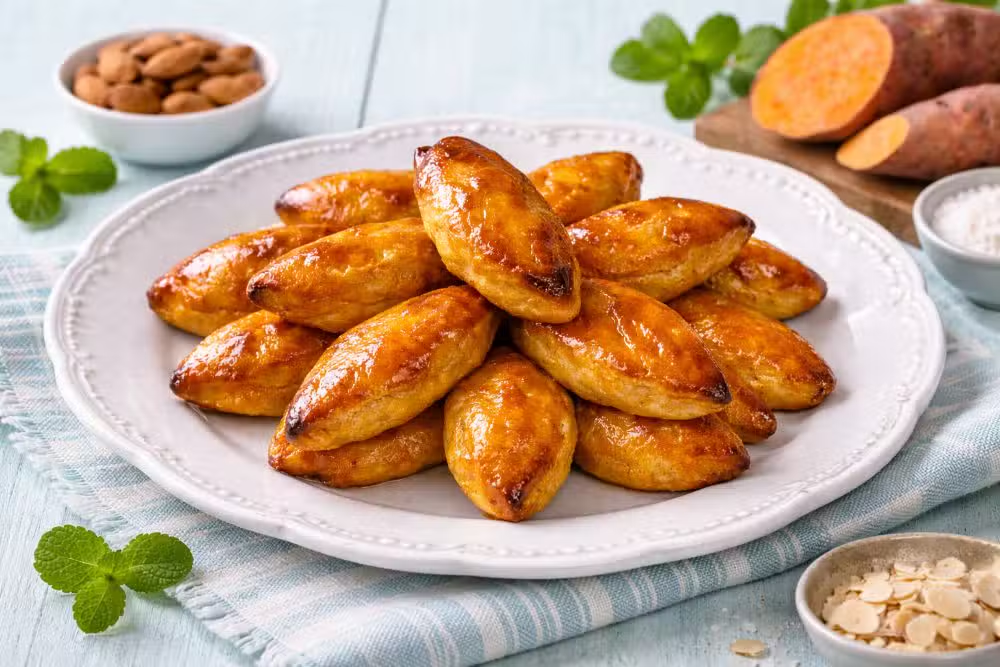
Broas Castelares occupy a special place in historic Portuguese pastry making. These soft biscuits, prepared primarily during Christmas, are linked to the great tradition of convent sweets developed between the 17th and 18th centuries, a period when sugar, honey, and dried fruit became central elements in monastic cuisine.
The name probably refers to Castilian influence (castelares), evidence of the continuous exchanges between Portugal and Spain across the Iberian Peninsula. Unlike many dry European biscuits, these broas remain intentionally moist and compact, thanks to the presence of cooked pumpkin, an ingredient widespread in the Portuguese countryside after its introduction from the Americas.
In the regions of Lisbon, Ribatejo, and Alentejo, each family maintains slightly different proportions, but the base remains stable: pumpkin, honey, almonds, and light spices. These desserts are designed to last several days and improve with age.
Ingredients for about 10 people (20 large biscuits)
- 400 g cleaned pumpkin pulp
- 250 g sugar
- 120 g honey
- 250 g 00 flour
- 150 g ground almonds
- 2 egg yolks
- 40 g butter
- 1 teaspoon cinnamon
- 1 teaspoon ground fennel seeds
- Grated zest of 1 lemon
- 1 pinch of salt
For finishing:
- 1 egg yolk
- 20 g water
Preparation time
Prep: 30 minutes
Cook: 25 minutes
Total time: 55 minutes
Procedure
Cut the pumpkin into pieces and bake at 180°C (350°F) or steam until soft. It is best to avoid boiling it, as this would introduce too much water into the mixture. Once cooked, mash it until smooth and let it cool completely.
Transfer the purée to a saucepan and add the sugar and honey. Cook over low heat, stirring constantly for a few minutes, until the mixture thickens slightly and loses some moisture. This step concentrates the flavors and stabilizes the mixture.
Add the butter, lemon zest, cinnamon, and fennel seeds, typical flavorings of the Portuguese Christmas tradition.
Remove from the heat and add the ground almonds, then the egg yolks, mixing carefully until smooth. Finally, add the sifted flour a little at a time until you obtain a soft but malleable dough.
Let it rest for about 20 minutes: during this time the flour absorbs the moisture from the pumpkin, making shaping easier.
With slightly damp hands, shape the dough into elongated ovals or small compact loaves and place them on a baking tray lined with baking paper.
Mix the egg yolk with a little water and gently brush the surface. This gives the biscuits their characteristic amber color.
Bake in a conventional oven at 180°C (350°F) for about 20–25 minutes. The Broas Castelares should brown without drying out. They must remain soft and fragrant inside.
Let them cool completely: after a few hours they develop a more balanced texture and deeper aromas.
Success depends on controlling the pumpkin’s moisture. A dough that is too wet causes the biscuits to spread; one that is too dry makes them heavy. In traditional bakeries, the purée is often cooked again to adjust this balance.
These biscuits improve after a day or two, when honey and spices fully integrate.
Nutritional values per 100 g
Calories: 310 kcal
Carbohydrates: 48 g
Protein: 6 g
Fat: 10 g
Sugars: 28 g
During the Christmas period they are widespread in historic pastry shops in Lisbon and in the traditional markets of Alentejo, where they are often sold alongside other convent sweets prepared for winter celebrations.
Wine pairing
Broas Castelares find balance with Moscatel Roxo di Setúbal by António Saramago, capable of supporting honey and spices without heaviness. A Vin Santo del Chianti by Capezzana also works beautifully, its oxidative character interacting with almond notes. For a regional pairing, Madeira Malvasia by Barbeito enhances the dessert’s aromatic depth while maintaining freshness.
Cocktail pairing: Black Russian.