Directions

Do you know where I ate the best alfajores of my life? In Buenos Aires, sitting at a table at “La Casa del Alfajor” on Avenida Corrientes, a stone’s throw from Teatro Colón. They were so fragrant and creamy that even today, as I tell you about them, I can still feel that divine flavor on my tongue! But you’re wondering, uncle, what are alfajores?
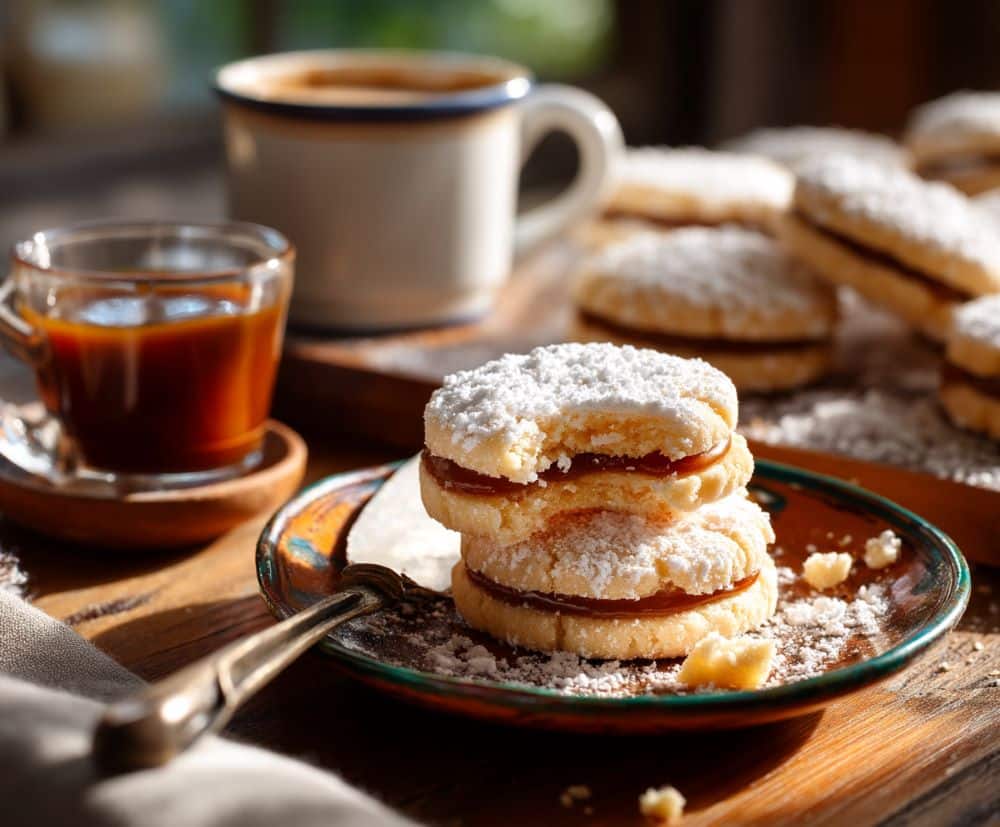
Traditional alfajores are made of two crumbly discs of dough made from cornstarch, flour, butter, sugar and eggs, with a heart of dulce de leche, the famous Latin American caramel obtained by slowly cooking sweetened milk.
The texture is magical: they literally melt in your mouth. The outside can be plain, rolled in grated coconut, or covered in dark or white chocolate. After meat, they are the best and most luxurious thing you can eat in Argentina.
Origin and history
Alfajores originated in medieval Moorish Spain: the term derives from the Arabic al-fakhir which means “luxurious”, “sumptuous”. Initially they were sweets made of honey, nuts and spices, widespread in Andalusia. During the Spanish colonization, the recipe emigrated to South America, where it underwent a radical transformation.
In Argentina, Uruguay, Peru, and Chile, alfajores have evolved into a national gastronomic emblem. Each country boasts its own version: soft, crumbly, filled with dulce de leche and rolled in coconut or covered in chocolate. Today, they are one of the most beloved snacks in the entire South American continent.
Where to eat the best alfajores
If you happen to travel to Argentina, don’t miss the legendary alfajores of “Havanna”, an institution, the chocolate-covered ones are to die for. In Lima, however, the best are at “Dulceria Santa Rosa”. In Uruguay, a stop at “La Pataia” in Punta del Este is a must.
Ingredients
(to make about 20 alfajores)
- 200 g of 00 flour
- 300 g corn starch
- 200 g of soft butter
- 100 g of icing sugar
- 3 egg yolks
- 1 whole egg
- 1 teaspoon vanilla extract
- 1 teaspoon baking powder
- Grated zest of 1 untreated lemon
- 400 g dulce de leche (for filling)
- Shredded coconut or melted chocolate for the topping
Procedure
- Prepare the dough: in a large bowl, beat the butter with the icing sugar until you get a soft cream. Add the egg yolks and the egg one at a time, continuing to beat. Add the vanilla and lemon zest.
- Combine the dry ingredients: sift the flour, starch and yeast and add them to the dough, working briefly with a spatula or by hand. The mixture should be soft but not sticky. If necessary, add a spoonful of flour.
- Rest: wrap the dough in cling film and leave it to rest in the fridge for at least 1 hour.
- Shaping: Roll out the dough to a thickness of about 5 mm. Using a pastry cutter, cut out 4-5 cm diameter discs.
- Baking: place the discs on a baking tray lined with baking paper and bake in a static oven preheated to 170°C for about 10-12 minutes. The biscuits must remain light.
- Filling: Once cooled, spread a generous amount of dulce de leche on one disc and pair it with another.
- Decoration: roll the edges in grated coconut or dip the alfajores in melted chocolate if desired.
Conservation
Alfajores can be stored in a closed tin for 4-5 days. They become even better after 24 hours, when the dulce de leche has further softened the dough.
Nutritional values (per 100 g)
- Calories: 420 kcal
- Fat: 22 g
- Carbohydrates: 50 g
- Protein: 5g
Fun Facts
- In Argentina, over 900 million alfajores are sold each year.
- There is an entire festival dedicated to it: “ Festival Nacional del Alfajor ”.
- The most famous industrial alfajores? The “Havanna” and the “Balcarce”.
Make them at home and you will discover that a bite of alfajor is worth more than a thousand intercontinental flights!
Wine to pair with Alfajores
With their buttery tones, velvety dulce de leche and sugary finish, Alfajores deserve a companion that can be sweet but also refreshing. A Moscato d’Asti DOCG is perfect: gentle bubbles, fruity freshness, balance.
Recommended wine
Moscato d’Asti DOCG “Lumine” – Ca’ d’Gal : soft, aromatic of peach and sage, perfect for balancing the creamy sweetness of the Alfa.
Recommended cocktail