
Max und Moritz Berlin: Eisbein, Schnitzel and German Beer Since 1902

Max & Moritz has been serving traditional German food at Oranienstraße 162 in Berlin-Kreuzberg since 1902. More than a century later, this historic wirtshaus still has the dark wooden furniture, decorative tiles, stained glass and old-fashioned dining rooms that make Berlin’s surviving beer halls so fascinating.
Named after the mischievous characters created by Wilhelm Busch, the restaurant specialises in Berliner Eisbein, Königsberger Klopse, beef roulades, Wiener Schnitzel and other hearty German dishes. Potatoes, cabbage, pork, mustard and generous gravies dominate the menu. This is not a kitchen interested in contemporary trends or delicate plating.
What makes Max & Moritz especially attractive is the setting. The building preserves much of its early twentieth-century character, while the menu reflects the working-class cooking traditions that developed as Berlin grew into an industrial metropolis.
A Berlin Restaurant That Has Survived Since 1902
Founded in 1902, Max & Moritz retains Gründerzeit furniture, Jugendstil details, blue-green glazed tiles, stained-glass panels and decorative reliefs inspired by Wilhelm Busch’s famous characters. The result is a proper Alt-Berliner Wirtshaus rather than a modern restaurant dressed up to look historical.
The dining rooms are spacious, with wooden tables, traditional furnishings and enough old-fashioned character to make dinner feel pleasantly removed from contemporary Berlin.
There is also something appropriate about finding this restaurant in Kreuzberg, a neighbourhood shaped by migration, working-class history and cultural reinvention. Berlin’s traditional cuisine developed through precisely that mixture of regional influences.
Berliner Eisbein Is the Dish to Order
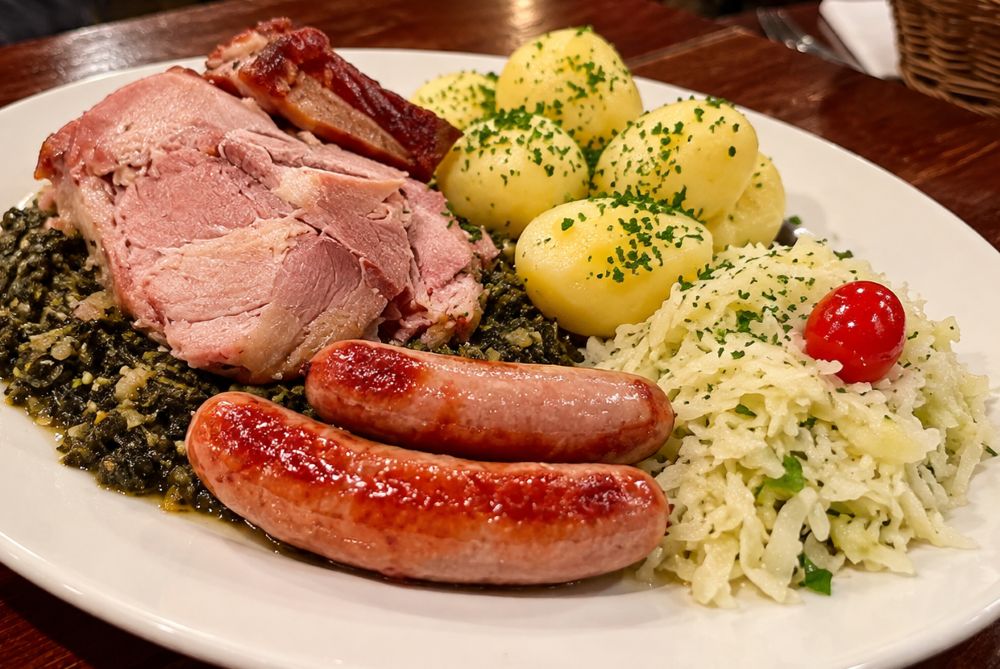
The Berliner Eisbein (€24.50) is one of the clearest expressions of the restaurant’s culinary identity.
Unlike the crispy roasted pork knuckle associated with Bavaria, traditional Berlin Eisbein is generally cured and gently simmered. The meat becomes tender, the skin soft and gelatinous, and the fat contributes richness without needing a crunchy crust.
At Max & Moritz, it comes with pea purée, sauerkraut, boiled potatoes and mustard.
The accompaniments are essential. Peas bring sweetness, sauerkraut supplies acidity and mustard cuts through the richness of the pork.
For two hungry diners, the Schlachteplatte (€47.80) is an even more substantial proposition, combining pork knuckle, smoked pork chop, kale, sauerkraut, potatoes and mustard.
Neither dish belongs to the lighter end of German cooking, but both capture the robust character of Berlin’s traditional taverns.
Königsberger Klopse: Meatballs with a Distinctive Sauce
The Königsberger Klopse (€22.50) are another classic worth understanding.
These gently cooked meatballs originated in Königsberg, now Kaliningrad, and became firmly established in Berlin’s culinary repertoire.
Traditionally made from minced meat and served in a pale sauce flavoured with capers, they offer a gentler alternative to roasted pork and dark beef gravies.
The characteristic combination of tender meat, creamy sauce and sharp capers gives the dish a surprisingly delicate balance.
Max & Moritz serves them with boiled potatoes and beetroot salad, providing both a neutral accompaniment for the sauce and a sweet, earthy contrast.
Beef Roulade Is German Comfort Food at Its Best
The Rinderroulade (€26.80) takes beef in a richer direction.
Thin slices of beef are traditionally filled with mustard, bacon, onions and pickles, rolled tightly and braised until tender.
The pleasure comes from the contrast between the deeply savoury meat, the acidity of the filling and the concentrated cooking juices.
Here, the roulade is accompanied by apple red cabbage and potato dumplings. The slightly sweet cabbage balances the richness, while the dumplings absorb the gravy.
The Rheinischer Sauerbraten (€25.50) provides another traditional interpretation of slow-cooked beef. Marinated before braising, the meat is served with a raisin sauce, apple compote, red cabbage and potato dumplings.
Its sweet-and-sour character is considerably more distinctive than an ordinary pot roast.
Wiener Schnitzel and Westphalian Goulash

The Wiener Schnitzel (€26.80) is prepared with veal rather than pork and served with lukewarm potato salad.
A proper Wiener Schnitzel depends on thinly pounded meat, a delicate breadcrumb coating and frying that produces a crisp, golden crust without drying the veal.
For something less familiar, the Westfälisches Kutschergulasch (€26.20) deserves attention.
This Westphalian-style beef goulash is braised with beer and mushrooms, then thickened with pumpernickel, the dense, dark rye bread associated with northern Germany.
The bread adds a malty, earthy depth and gives the sauce body without relying entirely on flour. Boiled potatoes complete the dish.
It is a particularly good choice for anyone interested in regional German cooking beyond schnitzel and sausages.
There Is More to Berlin Food Than Pork
Although meat dominates, Max & Moritz also offers a few alternatives.
The Berlin-style potato soup (€5.80) is vegan and flavoured with marjoram, an herb closely associated with traditional German potato dishes.
Vegan Maultaschen (€16.80) arrive with braised onions and salad, while Käsespätzle (€18.20) combine soft egg noodles, melted cheese and caramelised onions.
Another distinctly Berlin preparation is Hoppel Poppel (€17.80), a hearty variation on Bauernfrühstück made with potatoes, eggs and diced roast pork.
It is an old-fashioned, practical dish built around leftovers and substantial ingredients rather than presentation.
Vegetarians have reasonable choices, although this remains fundamentally a traditional meat-focused restaurant.
Kreuzberger Molle: The Beer to Drink
Beer is central to the Max & Moritz experience.
The most characteristic order is Kreuzberger Molle, the restaurant’s own naturally cloudy, unfiltered beer. With its malty profile, amber colour and restrained hop bitterness, it is well suited to pork knuckle, beef roulades and sausages.
The restaurant also pours Barre Pilsener, a crisp German pilsner with a more pronounced bitter finish, alongside Berliner Pilsner, wheat beers and Mönchshof Schwarzbier.
A 0.5-litre draught beer costs approximately €5.50.
For something particularly Berlin-specific, try a Berliner Weisse, the city’s traditional wheat-based sour beer, or a Berliner Strippe, combining Berliner Weisse with caraway schnapps.
The beer selection is more compelling than the wine list for this style of cooking.
Apple Strudel Makes the Right Ending

Dessert stays comfortably traditional.
The homemade apple strudel (€9.80) comes with vanilla sauce, combining baked pastry, softened apples and warm sweetness.
Another option is Rote Grütze (€6.50), a northern German dessert made with red berries and served with vanilla sauce.
Atmosphere, Service and Prices
Max & Moritz is a busy, traditional German restaurant with an atmosphere shaped by its historic rooms, wooden furnishings and long-established tavern character.
The service can be brisk, especially when the restaurant is crowded. The large dining rooms accommodate groups comfortably, although the combination of conversation and beer-hall energy does not always make for a quiet evening.
The food is substantial, with most main courses costing €20–€27.
A dinner with a main course and half a litre of beer generally comes to €25–€35 per person, rising to around €40–€50 with a starter or dessert.
Prices are no longer particularly cheap for old-fashioned German cooking, and the kitchen’s execution is not always as memorable as the historic surroundings. Nevertheless, the combination of regional dishes, generous portions and a remarkable interior makes Max & Moritz a worthwhile address for exploring Berlin’s traditional food culture.
Bring cash: the restaurant does not accept credit or debit cards.
Useful Information
- Restaurant: Max & Moritz – Das Kulturwirtshaus
- Address: Oranienstraße 162, 10969 Berlin
- Area: Kreuzberg
- Cuisine: Traditional Berlin and regional German cooking
- Established: 1902
- Specialities: Berliner Eisbein, Königsberger Klopse, Rinderroulade, Sauerbraten, Wiener Schnitzel
- Berliner Eisbein: €24.50
- Königsberger Klopse: €22.50
- Wiener Schnitzel: €26.80
- Beef roulade: €26.80
- Platter for two: €47.80
- Draught beer: Approximately €5.50 for 0.5 litres
- Typical dinner: €25–€40 per person
- Vegetarian options: Käsespätzle, potato dishes and seasonal preparations
- Vegan options: Potato soup and Maultaschen
- Opening hours: From 18:00 daily, starting October 20, 2026
- Reservations: Recommended
- Payment: Cash only
- Telephone: +49 30 695 15 911
- Best for: Traditional Berlin food, German beer, historic restaurant interiors and hearty dinners in Kreuzberg
Our Rating of Max & Moritz Berlin
Food: 8.3/10
Traditional German dishes with generous portions, hearty sauces and a strong regional identity.
Berlin Specialities: 8.8/10
Eisbein, Königsberger Klopse and Hoppel Poppel provide a substantial introduction to old Berlin cooking.
Meat Dishes: 8.5/10
Slow-braised beef, pork knuckle and veal schnitzel form the backbone of the menu.
Beer Selection: 8.8/10
Kreuzberger Molle, German pilsners and regional beer styles complement the food particularly well.
Atmosphere: 9.4/10
The preserved 1902 interiors, Jugendstil details and traditional dining rooms are the restaurant’s greatest strengths.
Service: 7.5/10
A lively, sometimes hurried tavern experience, with hospitality less consistent than the historic setting.
Value for Money: 7.9/10
Substantial portions and a remarkable location, although main courses now approach €27.
Overall Rating: 8.4/10

